
How to Find an NHS Dentist in 2026: A Practical Guide
Finding an NHS dentist has become one of the most challenging health tasks for UK adults. With 97% of dental practices no longer accepting new patients, many over-50s feel locked out of NHS care. Yet your options are not exhausted.
This guide walks you through every practical method to find an NHS dentist, including the NHS Find a Dentist tool, 111 referrals, dental access centres, and what to do when local options run out. Whether you have just moved area or lost your dentist, this step-by-step approach will help you navigate the current crisis and access dental care.
How Can You Find an NHS Dentist Accepting New Patients?
Your first port of call is the NHS Find a Dentist tool. Visit nhs.uk/service-search/find-a-dentist and enter your postcode. The tool shows NHS dentists in your area, their opening hours, and whether they accept new adult patients. Be prepared: most results will show “not accepting new patients”. But some will accept. Check the “accepting new patients” filter to narrow your search immediately.
If the online tool shows no available dentists, call local practices directly. Many update their patient list status by phone before updating the online system. Ask explicitly: “Are you accepting new NHS adult patients?” Some receptionists may ask for your details and add you to a waiting list – this is worthwhile even if they are currently full.
Here are practical tips to improve your chances:
- Search multiple times per week – practices update their lists frequently as existing patients move or leave.
- Expand your search radius to neighbouring postcodes, especially if you live in a rural area.
- Try practices in adjacent towns; many people commute for work and can attend appointments outside their immediate area.
- Register with a practice even if they have a waiting list; you are more likely to get an appointment than if you do not try at all.
- Use the NHS 111 service if you are in pain – they can arrange urgent appointments and refer you to available providers.
Calling ahead takes effort, but it remains one of the most effective ways to find NHS dental care in 2026.
Watch: The 2026 NHS Dental Crisis – The Escalation Strategy
Struggling to find an NHS dentist? This short video explains the escalation steps you can take in 2026, from contacting NHS England to using the complaints process to secure the dental care you are entitled to.
Our guide to NHS vs private dentist costs compares NHS and private dentist costs side by side, with real UK prices for every common treatment.
What Is the NHS 111 Dental Helpline and How Does It Work?
NHS 111 is a free phone service (24/7) designed to help when you need urgent health advice. For dental emergencies, it is a lifeline. Call 111 if you have severe tooth pain, swelling, or suspected infection. The advisors assess your problem, provide guidance, and can arrange an urgent dental appointment – often within 24 hours.
Here is what to expect: you will describe your symptoms, and the advisor will refer you to an available provider. This might be an NHS dentist, a dental access centre, or an out-of-hours urgent dental service. Some NHS dentists reserve emergency slots specifically for 111 referrals, even if they are not accepting routine new patients. You will not pay extra for a 111-arranged appointment; standard NHS dental charges apply.
111 is particularly valuable if you have tried the Find a Dentist tool and called practices without success. It is not a solution for routine check-ups – dentists arrange those through normal registration – but it provides access when you are in genuine distress. Use it confidently; that is exactly what it is there for.
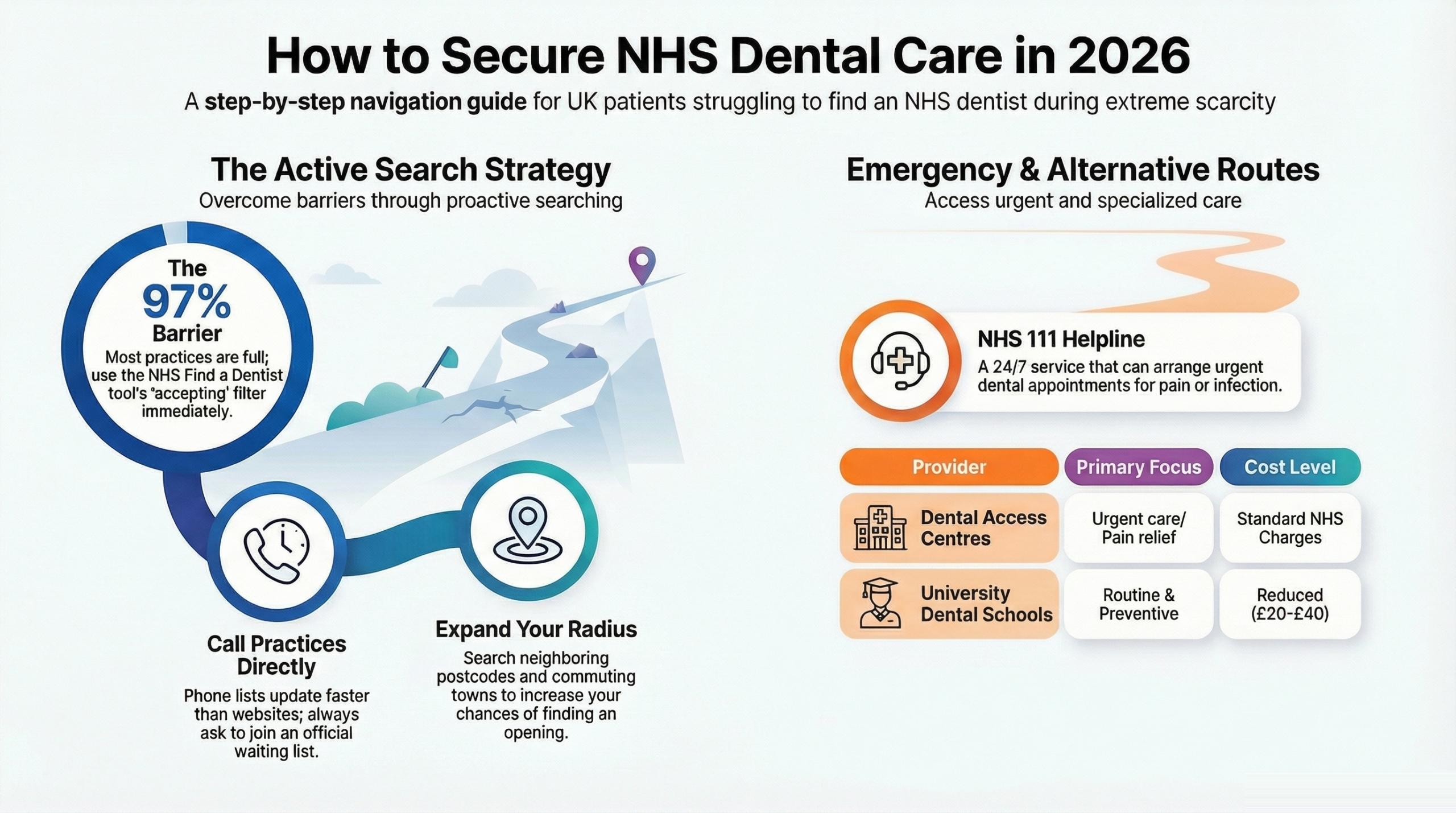
Key dental care facts at a glance – The Best of Health 2026
Find out more in our complete guide to NHS dental charges 2026, which explains exactly what NHS Band 1, 2 and 3 dental charges cover and who qualifies for free treatment.
What Are NHS Dental Access Centres?
Dental access centres (also called urgent dental care centres) are NHS clinics designed to treat patients who cannot find a regular dentist. They focus on urgent and emergency care: pain relief, extractions, infections, and trauma. Access is usually free or at standard NHS charges, depending on the service.
How do you find one? Search “dental access centre near me” or “urgent dental care centre [your area]” online. Most are run by local NHS dental commissioning services. Your local Integrated Care Board (ICB) should list them on their website. Alternatively, NHS 111 can refer you directly if you have an urgent problem.
Access centres do not provide routine preventive care. You will not get a scale and polish or a full examination for a small fee. Instead, they treat acute problems and may stabilise your teeth until you find a regular dentist. Some areas have very limited access centre provision, so availability varies widely. If you live in a city or urban area, you are more likely to have one nearby.

For more detail, read our guide on emergency dentist costs UK – it explains what counts as a dental emergency, where to go, and what you will pay on the NHS versus privately.
What Should You Do If No NHS Dentist Is Available in Your Area?
If you have exhausted local NHS options, you have several routes:
Dental Schools: University dental schools (King’s College London, University of Birmingham, University of Manchester, and others) offer reduced-cost treatment delivered by trainee dentists under supervision. A scale and polish or filling costs far less than private – often £20 to £40 per appointment – but appointments take longer. Contact your nearest dental school directly for waiting times and acceptance criteria.
Community Dental Services: Your local NHS community dental service treats vulnerable patients: older people with mobility issues, people with learning disabilities, and those with dental anxiety. If you have complex health needs, ask your GP for a referral. These services are not open to everyone but exist to ensure access for hard-to-reach groups.
Dental Hospitals: NHS dental hospitals provide specialist and emergency care. Some also accept general patients when capacity allows. Ask your GP or NHS 111 for a referral.
Healthwatch: If you have been unable to find an NHS dentist after a genuine effort, contact your local Healthwatch (a patient advocacy organisation in every area). They can challenge your ICB and escalate your case. Your ICB has a duty to commission sufficient dental care in your area; Healthwatch can hold them to account.
Private Dental Insurance or Payment Plans: If NHS access genuinely is not available, some people choose private care, either through insurance or upfront payment. This is not ideal when you rely on a fixed income, but it may be necessary short-term until NHS access opens up.
How to Stay on Your NHS Dentist’s Patient List Once You Have Registered
Once you have found an NHS dentist, hold on to your place. Many people lose their registration by not attending appointments or not visiting for more than 24 months. Here is how to stay registered:
- Attend all routine appointments – dental schools recommend a check-up every 12 to 24 months, depending on your oral health.
- If you need to cancel, give notice rather than simply not turning up.
- Notify your dentist if you move house; they can transfer your records or refer you.
- If you are on a waiting list, confirm your interest annually so you are not dropped.
- Use your NHS dentist even if you have had private work done elsewhere; keep your NHS registration active.
Losing a dentist and trying to find another in 2026 is an exhausting process you want to avoid. Once you are in, stay in.
Our guide to gum disease treatment covers NHS and private gum disease treatment options, costs, and what to expect from specialist periodontal care.
Frequently Asked Questions
What should I do if my local NHS dentist is not accepting new patients but I have an urgent dental problem?
Contact NHS 111 immediately – they can help you access urgent dental care in your area. Many practices are required to provide at least some urgent appointment slots for patients who need emergency treatment, even if they are not accepting routine new patients.
Can I get NHS dental treatment if I have never been registered with an NHS dentist before?
Yes – if you can find an NHS dentist accepting new patients in your area. Use the NHS Find a Dentist service online, or contact your local integrated care board (ICB) for help locating practices that are currently accepting patients.
Do I have the right to choose which NHS dentist I register with, or am I assigned one?
You have the right to choose an NHS dentist from those accepting patients in your area. However, since very few practices are accepting new patients in 2026, your choice may be limited to whichever practices have availability.
If I move house, can I easily transfer my NHS dental registration to a new area?
You can register with a new NHS dentist in your new area, but you will need to find one that is accepting patients. Your previous dental records may not automatically transfer, so ask your new dentist to request them from your old practice.
Key Takeaways
- The NHS Find a Dentist tool (nhs.uk/service-search/find-a-dentist) remains your first step, though 97% of practices are not accepting new patients.
- Call NHS 111 if you are in pain or need an emergency referral; they can access appointments you will not find online.
- Dental access centres provide urgent and emergency care when routine dentists are unavailable.
- Dental schools offer reduced-cost care and are worth exploring if local NHS access is extremely limited.
- Once you have found an NHS dentist, attend appointments regularly to keep your registration active.
Explore more: Our guide to NHS dental charges 2026 breaks down routine costs, treatment fees, and how your income might affect what you pay. And if you are considering private care as a backup, our NHS vs private dentist costs comparison covers waiting times, quality, and costs head-to-head. Join our Facebook community to share your experience finding NHS dental care.
This article is for information only. Always consult your dentist, GP or a qualified healthcare professional before making decisions about dental treatment.