
Dental Crowns and Bridges Cost UK 2026: NHS vs Private
If your dentist has told you that you need a crown or a bridge, your first question is probably what it will cost. On the NHS in England, the answer is £332.10 in 2026. That single Band 3 charge covers the whole course of treatment, even if you need two crowns and a three-unit bridge. Privately, expect to pay from about £700 for one crown and £2,100 to £4,600 for a three-unit bridge. Those are Bupa Dental Care prices we checked in September 2026.
So the gap is big. For many adults over 50, it is the difference between one week of State Pension and several months of it. This guide sets out the real dental crowns and bridges cost UK-wide, nation by nation. It also covers what the NHS will and won’t give you, and when paying privately makes sense.
Last updated: 30 September 2026. Prices checked on the day of update.
Dental Crowns and Bridges Cost UK: 2026 Price Table
Here is what you pay for crowns and bridges in each UK nation, compared with private prices at three Bupa Dental Care practices in different regions.
| Treatment | NHS England | NHS Wales | Scotland and Northern Ireland | Private (Bupa practices checked) |
|---|---|---|---|---|
| One crown | £332.10 (Band 3) | £140.44 plus lab fees | 80% of the fee, max £384 | From £702 to from £929 |
| Two crowns, same course | £332.10 (still one Band 3 charge) | £140.44 plus lab fees | 80% of the fee, max £384 | From £1,404 to from £1,858 |
| Three-unit bridge | £332.10 (one Band 3 charge) | £140.44 plus lab fees | 80% of the fee, max £384 | From £2,127 to from £4,566 |
| New patient check-up | £27.90 (Band 1) | Varies by care package | Free in Scotland | £80 to £175 |
Sources: NHS England charges from the NHS guide to dental charges. Wales from the Welsh Government’s NHS dental charges and exemptions page. Northern Ireland from the Business Services Organisation, and Scotland from NHS Inform. Private prices are the “from” prices listed by Bupa Dental Care in Brigg, Trowbridge and London Bank on 30 September 2026. Bridge prices are three times the per-unit price.
One NHS charge covers the whole course
This is the point most price guides get wrong. The NHS says that if you need a mix of treatments from the same band, you pay the band charge once. Band 3 also includes any Band 1 and Band 2 work in the same course. That means a filling or root canal treatment before the crown goes on.
- England: £332.10 per course of treatment, however many crowns or bridge units you need.
- Wales: the old bands were replaced by care packages in April 2026. The crown and bridge package costs £140.44 and covers up to two crowns or a three-unit bridge. Laboratory charges are added on top, and the maximum for a course is £384.
- Scotland: you pay 80% of the NHS fee, up to £384 per course. Check-ups are free.
- Northern Ireland: you pay 80% of the fee, up to £384 per course.
If you need more work within two months and it falls in the same band or a lower one, you don’t pay again. Our guide to NHS dental charges in 2026 explains all three bands and who gets free treatment.
Key Figures at a Glance
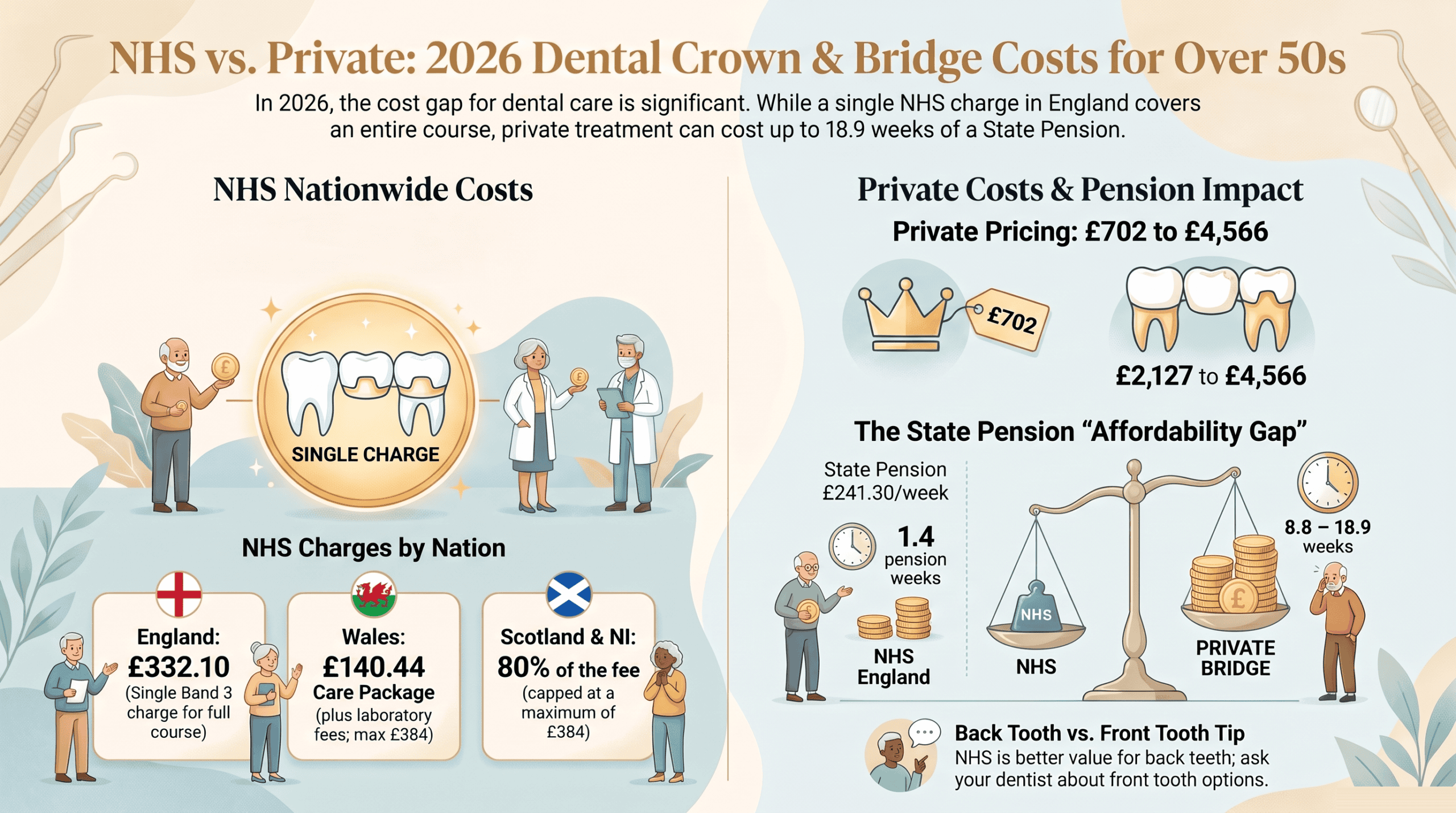
- £332.10 – one NHS Band 3 charge in England, whether you need one crown or a three-unit bridge (NHS, 2026)
- £2,127 to £4,566 – starting price for a private three-unit bridge at the three Bupa practices we checked (Bupa Dental Care, September 2026)
- 1.4 weeks of State Pension – the £332.10 NHS charge is equal to 1.4 weeks of the full new State Pension (£241.30 a week in 2026-27)
- 8.8 to 18.9 weeks of State Pension – a private three-unit bridge at £2,127 to £4,566 is equal to 8.8 to 18.9 weeks of the full new State Pension
- £384 – the most you pay for one course of NHS treatment in Wales, Scotland or Northern Ireland
How we worked out the pension figures: we divided each price by the full new State Pension of £241.30 a week for 2026-27, as published by Age UK. So £332.10 divided by £241.30 is 1.4 weeks, and £4,566 is 18.9 weeks.
Watch: Dental Crowns and Bridges Cost UK 2026 in 3 Minutes
In just over three minutes, this video shows you why one NHS charge of £332.10 covers a crown or bridge in England, what you pay in Wales, Scotland and Northern Ireland, and what private prices mean in weeks of State Pension.
How Much Is a Crown on the NHS?
An NHS crown costs £332.10 in England. A crown is a tooth-shaped cover, often called a cap, that fits over a damaged or weakened tooth. Your dentist will suggest one when a tooth has a very large filling, has had root canal treatment, or has broken.
The Band 3 charge includes the examination, X-rays, preparing the tooth, the impression, the temporary crown, the laboratory work and the fitting. You won’t get a separate bill for any of those.
Metal or tooth-coloured?
The NHS provides what your dentist considers clinically necessary. On back teeth, that is often a metal crown. On front teeth, where appearance matters more, you may be offered a tooth-coloured crown. If you want a white crown on a back tooth purely for looks, that is a private choice.
Are crowns free for over-60s?
No, not in England. Turning 60 gives you free prescriptions, but not free dental treatment. You only pay nothing if you qualify for another reason, such as receiving Pension Credit Guarantee Credit or holding a valid HC2 certificate. Check the NHS exemptions list before your appointment.
Finding an NHS dentist is often harder than paying for one. Our guide on how to find an NHS dentist in 2026 covers the practical steps.
How Much Does a Dental Bridge Cost?
A bridge costs £332.10 on the NHS in England and from about £2,100 privately for three units. A bridge replaces one or more missing teeth by fixing a false tooth to the teeth next to the gap. Each tooth in the bridge is called a unit, and private dentists usually price per unit.
That per-unit pricing is why private bridges get expensive fast. A standard bridge for one missing tooth is three units: two supporting crowns and the false tooth in between.
Traditional bridge
The teeth either side of the gap are shaped and crowned, with the false tooth joined between them. It is the most common type. At the Bupa practices we checked, units start at £709 in Brigg, £1,030 in Trowbridge and £1,522 in London Bank.
Adhesive (Maryland) bridge
The false tooth has a thin wing bonded to the back of a neighbouring tooth. Much less drilling is needed. It suits a single missing front tooth where the neighbours are healthy. On the NHS it is still one Band 3 charge.
Cantilever bridge
The false tooth is supported from one side only. Dentists use it where there is a sound tooth on just one side of the gap. Again, the NHS charge is the same £332.10.

Private Crowns: What the Extra Money Buys
An NHS crown and a private crown do the same job. Both protect the tooth and let you chew normally. The extra cost of going private mostly buys you more choice.
- Materials: private dentists offer all-ceramic, porcelain-bonded and zirconia crowns on any tooth, with close colour matching.
- Laboratory: some private practices use specialist labs for more detailed shade work.
- Time: private appointments are often longer, and you may be seen sooner.
- Aftercare: some practices include adjustments or a guarantee in the price. Ask what happens if the crown fails.
For a back tooth, the main thing to weigh up is a price gap of about £370 or more against how much the look matters to you, as back teeth are rarely seen. For a front tooth, it is worth asking your NHS dentist what they can offer first. If you want a specific material or a closer colour match, private treatment gives you that choice. Whichever you decide, get any private quote in writing.
Our guide to NHS vs private dentist costs compares prices for every common treatment side by side.
Dental Crowns and Bridges Cost vs Other Options
A crown or bridge isn’t the only answer for a damaged or missing tooth. Here is how the alternatives compare on NHS cost in England:
- Filling: Band 2, £76.60. Fine for small or medium damage, but not for a badly broken tooth.
- Root canal treatment: Band 2, £76.60 on its own. A back tooth often needs a crown afterwards, which moves the whole course into Band 3.
- Dentures: Band 3, £332.10. Removable, and cheaper privately than a bridge, but some people find them harder to get used to.
- Dental implant: rarely available on the NHS, so most people pay privately. An implant doesn’t rely on the neighbouring teeth, but it costs more and involves minor surgery.
For the full picture, see our guides to dental implants cost UK, dentures cost UK and root canal cost UK.
Questions to Ask Before You Commit
A few questions at the start can save you hundreds of pounds and some disappointment.
- Can this be done on the NHS? If yes, what material would you use on this tooth?
- What is the total cost? Privately, ask whether the quote includes the consultation, X-rays, temporary crown and lab fees.
- How many units is the bridge? Private bridges are priced per unit, so this drives the bill.
- Do I need root canal treatment first? On the NHS it is covered by the same Band 3 charge. Privately it is usually extra.
- What happens if it fails? Ask about guarantees and who pays for a replacement.
- Is the dentist registered? Every UK dentist must be on the General Dental Council register.
Making it last
Most crowns and bridges last many years with good care. Clean carefully around the edge of a crown and under a bridge, using floss threaders or small interdental brushes. If you grind your teeth at night, ask about a night guard. And keep your check-ups, because decay under a crown is easy to miss at home.
If you’d rather spread the cost, our guide to private dental insurance for over-50s looks at whether cover is worth it.
Frequently Asked Questions
How much is a crown on the NHS in 2026?
In England, a crown costs £332.10, the Band 3 charge. That covers the whole course of treatment, including any fillings or root canal work needed first. In Wales, the crown and bridge care package costs £140.44 plus lab fees. In Scotland and Northern Ireland, you pay 80% of the fee, up to £384.
Do I pay Band 3 twice for a bridge or two crowns?
No. In England you pay one Band 3 charge of £332.10 per course of treatment, however many crowns or bridge units it includes.
Is a tooth cap the same as a crown?
Yes. “Cap” is the everyday word for a crown, and it costs the same. That is £332.10 on the NHS in England, or from about £700 privately at the practices we checked.
Can I get a white crown on the NHS?
Often, on a front tooth. The NHS provides what is clinically necessary, which usually means metal on back teeth and may mean tooth-coloured at the front. A white crown on a back tooth for looks alone is a private choice.
Is a dental bridge better than an implant?
It depends on the gap and the teeth around it. A bridge is quicker and available on the NHS, but the neighbouring teeth are usually drilled. An implant leaves them untouched but is rarely available on the NHS, costs more, and involves minor surgery.
Are dental crowns free for over-60s?
Not in England. Age alone doesn’t qualify you for free NHS dental treatment. You may qualify through Pension Credit Guarantee Credit or the NHS Low Income Scheme.
Key Takeaways
- Dental crowns and bridges cost UK patients £332.10 on the NHS in England, as one Band 3 charge per course.
- A bridge or several crowns in the same course do not mean paying Band 3 twice.
- Private prices at the Bupa practices we checked start at £702 for a crown and £2,127 for a three-unit bridge.
- Wales, Scotland and Northern Ireland cap a course of NHS treatment at £384.
- For back teeth, weigh the price gap against how much the look matters to you. For front teeth, it is worth asking what the NHS can offer before deciding.
- Over-60s in England still pay NHS dental charges unless they qualify for help.
Making Your Decision
A good first step is to check the NHS price. If your dentist can do the work on the NHS, you will pay £332.10 in England, and less in Wales, Scotland or Northern Ireland. Then ask what, specifically, a private crown or bridge would give you for the extra £370 to £4,200 or so.
Whether that is worth it is your call, and it often matters more for a front tooth than a back one. Whichever you choose, get every quote in writing before treatment starts.
Explore more: read our guides to NHS dental charges in 2026, dentures cost UK and dental implants cost UK. And join over 100,000 readers in The Best of Health community on Facebook to share your own experience of NHS and private dentists.
Disclaimer: This article is for information only. Always consult your GP, dentist or a qualified healthcare professional before making health decisions. NHS charges are correct for 2026. Private prices are starting prices listed by individual practices on 30 September 2026 and will vary by practice, location and treatment.