
Emergency Dentist Costs UK: NHS vs Private Prices in 2026
A sudden toothache at midnight. A chipped tooth before an important meeting. A lost filling on a Sunday afternoon. Dental emergencies don’t wait for surgery hours, and when you need urgent help, the first question is often: how much will this cost?
If you’re over 50, you’ve likely built up years of dental experience. But emergency treatment pricing can still catch you off guard. The cost difference between NHS and private emergency dental care is stark-and the choice isn’t always straightforward.
This guide breaks down exactly what you’ll pay for emergency dental treatment in the UK in 2026, how to access urgent help fast, and when going private actually makes sense.
What Counts as a Dental Emergency?
Not every tooth problem is a true emergency. Understanding what counts helps you decide where to go and how much you’re likely to spend.
A dental emergency is a condition that causes severe pain, bleeding, or risk of serious infection. Common examples include:
- Severe toothache (often a sign of infection or deep decay)
- Knocked-out or broken tooth
- Loose or lost filling or crown
- Bleeding gums that won’t stop
- Swollen jaw or face (possible sign of abscess)
- Difficulty swallowing or breathing due to tooth/gum pain
- Post-operative pain after dental treatment
Non-emergencies (which can usually wait for a routine appointment) include minor tooth sensitivity, cosmetic damage without pain, or a slightly loose retainer. Being clear about the severity helps you access the right service at the right cost.
Watch: The Emergency Triage – UK Dental Crisis 2026
Watch this short cinematic overview of your options when a dental emergency strikes. It covers NHS 111, urgent dental helplines, A&E, pharmacy advice, and private emergency appointments – so you know exactly where to turn and what it will cost.
Our guide to NHS vs private dentist costs compares NHS and private dentist costs side by side, with real UK prices for every common treatment.
Emergency Dentist Costs: NHS vs Private Comparison
The cost gap between NHS and private emergency treatment is substantial. Here’s the current 2026 pricing for England, Wales, Scotland, and Northern Ireland:
| Treatment Type | NHS Cost (England) | Private Cost | NHS Wait Time | Private Wait Time |
|---|---|---|---|---|
| Emergency Consultation | £26.80 (Band 1) | £50-£150 | Same day or next day | Same day (often within hours) |
| Emergency Extraction | £73.50 (Band 2) | £150-£350 | 2-7 days typical | Same day possible |
| Temporary Filling/Repair | £73.50 (Band 2) | £80-£200 | Same day or next day | Same day (often 1-2 hours) |
| Out-of-Hours Surcharge | Included (no extra charge) | +£50-£100 | Limited availability | Evenings/weekends available |
| A&E Attendance (Triage Only) | Free (via NHS) | N/A | Variable (busy A&E) | N/A |
NHS Charges by Nation (2026)
Dental charges vary across the UK. If you live in Wales, Scotland, or Northern Ireland, costs differ:
- England: Band 1 (urgent/emergency) £26.80; Band 2 (simple treatment, extractions) £73.50
- Wales: Band 1 (urgent) £14.70; Band 2 (treatment) £47.00
- Scotland: You pay 80% of the treatment cost, capped at £384 per course
- Northern Ireland: You pay 80% of treatment cost, capped at £384 per course
For over-50s, these NHS charges are significantly lower than private alternatives. However, access speed often favours private emergency dentists.
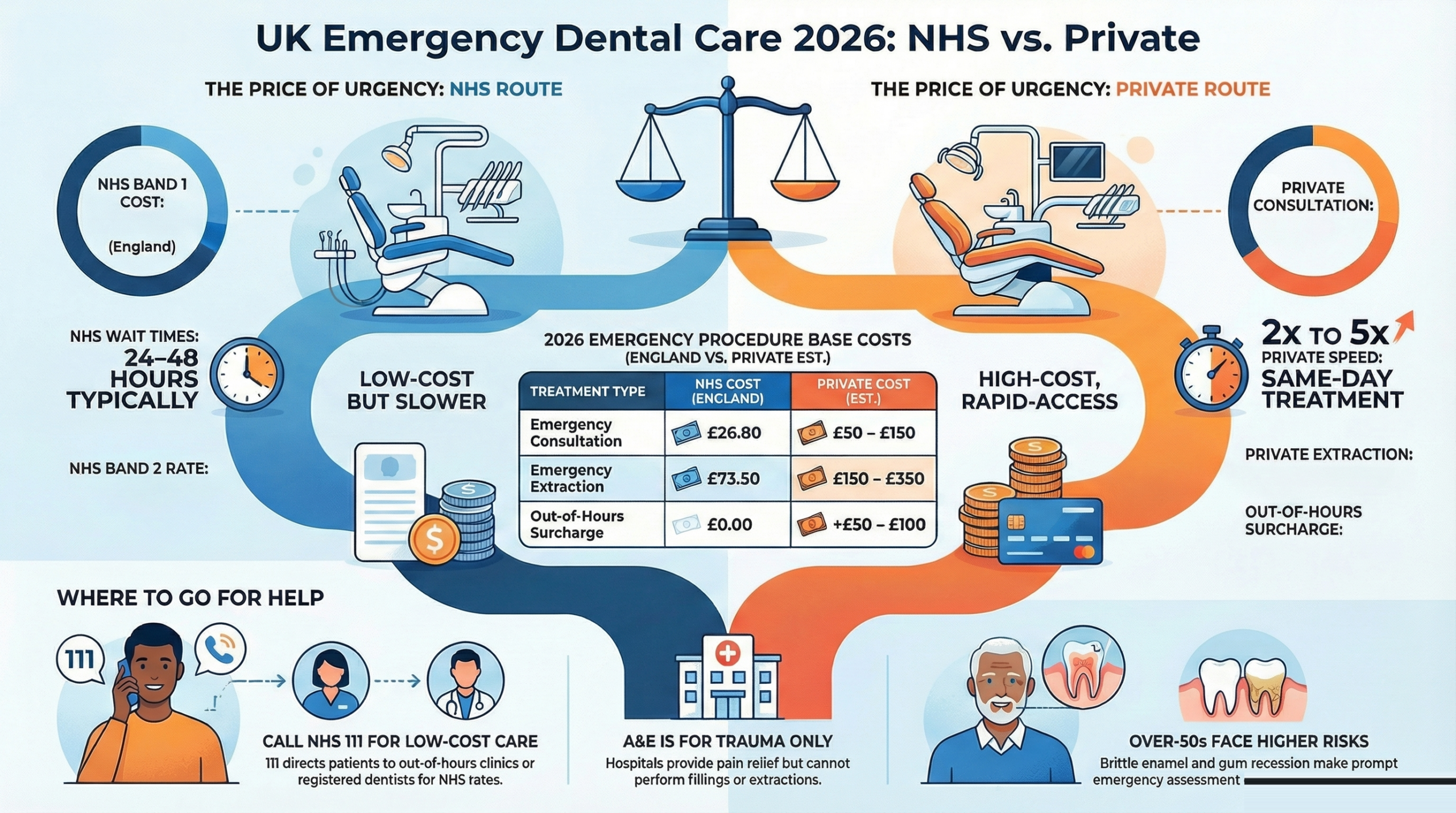
Key dental care facts at a glance – The Best of Health 2026
You may also find our guide to sensitive teeth causes and treatment: a complete guide for adults o… helpful.
You may also find our guide to a guide to what steps to take if you are injured on holiday helpful.
How to Access NHS Emergency Dental Care
Getting urgent NHS dental treatment involves knowing the right steps. Here’s the pathway:
Step 1: Contact NHS 111
If you have a toothache or dental injury outside surgery hours, call NHS 111. They assess your problem and direct you to:
- An NHS out-of-hours dental service (if available in your area)
- Your own dentist (if they have emergency slots)
- A local emergency dental clinic
- A&E (if there’s risk of serious infection)
Step 2: Emergency Dental Clinic or Your Dentist
Most NHS areas run emergency dental clinics that open outside normal hours. These are usually accessed through NHS 111 and see patients the same day or next morning. Your own dentist may also reserve emergency slots if you’re a registered patient.
If you don’t have an NHS dentist, tell NHS 111-they’ll direct you to the nearest emergency clinic.
Step 3: A&E for Severe Cases
Hospital accident and emergency departments handle dental trauma (knocked-out teeth, serious injuries) and infections with signs of spreading (fever, difficulty swallowing, facial swelling). However, A&E provides pain relief and antibiotics only-not definitive treatment like a filling or extraction. You’ll still need to follow up with a dentist.
Private Emergency Dentist Costs Explained
Private emergency dental fees are higher but offer speed and convenience. Here’s what to expect:
Emergency Consultation
A private emergency dentist visit for assessment and pain relief costs £50-£150. This is 2-5 times the NHS Band 1 charge but buys you same-day or rapid access (often within hours).
Emergency Extraction
If a tooth must come out immediately, private extraction costs £150-£350 depending on difficulty. A simple extraction is towards the lower end; a stuck or impacted tooth costs more. NHS extraction under Band 2 is just £73.50-a difference of £77-£276 per tooth.
Temporary Filling or Repair
A temporary filling to seal a cavity or repair a broken edge runs £80-£200 privately, versus £73.50 on the NHS. The private fee often includes a longer consultation and materials for a stronger temporary repair.
Out-of-Hours Surcharge
Private emergency dentists charge an additional £50-£100 for evening, weekend, or bank holiday appointments. NHS out-of-hours services do not charge extra.
Follow-Up Treatment
Emergency treatment (NHS or private) is a temporary fix. A filled tooth may need a crown. An extraction requires healing time before a bridge or implant. These follow-up costs are separate-and significantly higher privately.
When Should You Choose Private Emergency Dentistry?
The NHS is cheaper, but private emergency care has real advantages for certain situations:
Choose Private If:
- Speed is critical. A business meeting, holiday, or important event tomorrow. Private dentists often fit emergencies the same day; NHS waits are typically 24-48 hours.
- You’re not registered with an NHS dentist. NHS 111 can direct you to a clinic, but you’ll likely wait longer. Private is immediately available.
- Out-of-hours care. Need a dentist at 11 p.m. on a Saturday? Private emergency practices are widespread; NHS out-of-hours is patchy outside major towns.
- Complex cases. If you need advanced imaging, root canal assessment, or specialist extraction, private surgeries have more on-site equipment.
- Follow-up treatment planned. Going private for emergency treatment can mean staying with one dentist for the full course of care-no NHS waiting lists for crowns or implants.
Choose NHS If:
- Cost matters most. You’ll save £75-£250+ per emergency visit.
- You have an NHS dentist. They often keep emergency slots for registered patients.
- Pain relief is the main goal. NHS emergency dentists prioritise pain management and stabilising the tooth-not cosmetic outcomes.
- You can wait 24-48 hours. NHS emergency clinics are efficient and safe once you’re in the system.

Find out more in our complete guide to find an NHS dentist, which shows you how to find an NHS dentist near you, what to do if no one is accepting patients, and your rights.
What Can A&E Do for Dental Emergencies?
Hospital A&E can help with severe dental problems but offers limited treatment:
- Pain relief: Paracetamol, ibuprofen, or stronger analgesia if needed
- Antibiotics: If infection is present (fever, swelling, difficulty swallowing)
- Initial stabilisation: Cleaning and dressing a traumatic injury
- Referral: To an emergency dental clinic for definitive care
A&E cannot: Fill teeth, extract teeth, perform root canals, or provide lasting repairs. It is free but should be reserved for genuine emergencies (serious infection, facial trauma, difficulty breathing).
Most dental pain-even severe toothache-should be handled by a dentist, not A&E. Going to A&E for a toothache typically means a long wait and referral back to a dentist anyway.
Out-of-Hours Dental Services in the UK
If you need help outside normal surgery hours, here’s what’s available:
NHS Out-of-Hours
Most NHS areas run emergency dental clinics. Access is via NHS 111, usually free or at Band 1 cost (£26.80 in England). Availability varies by region-major cities have services most evenings and weekends; rural areas may be more limited.
Private Emergency Dentists
Many private practices operate evening and weekend emergency slots. Fees are higher (£50-£150 for assessment, plus £50-£100 out-of-hours surcharge), but availability is more reliable. Search online for “emergency dentist [your town]” to find local providers.
Dental Helplines
Some dental insurance policies include access to helplines that can advise whether you need emergency treatment or can wait. If you’re unsure whether your situation is urgent, calling a helpline (free with many policies) can save unnecessary A&E trips.
Dental Emergencies in Over-50s: What Changes
Older teeth have specific emergency risks. If you’re over 50, watch for these:
- Brittle teeth: Older enamel cracks more easily. A fall or hard food can chip a tooth faster than in younger people.
- Gum disease: Recession and periodontitis make teeth looser and more prone to sudden loss. Swelling or bleeding gums need urgent assessment.
- Root exposure: Receding gums expose tooth roots, which are softer and more sensitive. Pain from a minor knock may indicate damage requiring quick treatment.
- Implant or bridge problems: Failing implants or loose bridges need emergency repair to prevent bone loss and further damage.
- Medication side effects: Some blood pressure and osteoporosis medicines affect healing. Your dentist needs to know your medication list for emergency care.
Questions to Ask Your Emergency Dentist
Before accepting emergency treatment, clarify costs and next steps:
- What exactly is the problem, and why is treatment urgent?
- What is the total cost, including any follow-up needed in the next 1-2 weeks?
- Is this a temporary fix or permanent treatment?
- If temporary, when and where should I have follow-up care? (Important if going private for emergency but want to return to NHS for the full course)
- What painkillers or aftercare do I need?
- Are there payment plans or dental insurance options?
- Is there a warranty or guarantee on the treatment?
Find out more in our complete guide to NHS dental charges 2026, which explains exactly what NHS Band 1, 2 and 3 dental charges cover and who qualifies for free treatment.
Preventing Dental Emergencies in Over-50s
The best emergency is one you avoid. These steps reduce your risk:
Routine Care
Regular check-ups (every 6-12 months) catch decay and gum disease early. Most emergencies start as small problems-detection early prevents the crisis.
Strengthen Your Teeth
Use fluoride toothpaste, floss daily, and consider fluoride mouthwash if you have receding gums. Stronger enamel is less likely to crack.
Protect Against Trauma
Wear a mouthguard if you play sports or have a fall risk (important if you take osteoporosis medicines that weaken bones). Use a night guard if you grind your teeth-grinding weakens enamel and can crack teeth suddenly.
Watch Your Diet
Acidic drinks (fruit juice, wine, cola) and hard foods (boiled sweets, nuts) damage older teeth. Rinse your mouth with water after acidic foods and wait 30 minutes before brushing-immediate brushing spreads acid.
Gum Health
Gum disease is the main cause of tooth loss in adults over 50. Brush and floss every day, and ask your dentist about antimicrobial mouthwash if you have bleeding gums.
The Real Cost of Waiting
Delaying emergency dental care often makes the problem-and the final bill-worse. A small cavity that costs £73.50 to fill on the NHS can become a root canal needing £300-£500+ if infection spreads. A loose tooth left too long may require an implant at £1,500-£3,000.
For over-50s, quick action protects not just your teeth but also your ability to eat and your long-term oral health. When you have severe tooth pain, swelling, or trauma, contact your dentist or NHS 111 the same day. Cost difference is real, but speed matters.
For more detail, read our guide on dental crowns and bridges cost – it compares NHS and private prices for dental crowns and bridges, the materials available, and what to expect.
Frequently Asked Questions
If I call NHS 111 about a dental emergency on a Sunday, will I get an appointment the same day?
It depends – NHS 111 can assess your condition and direct you to urgent dental services, but same-day appointments are not guaranteed. You may be offered an appointment the next working day, or directed to an out-of-hours service if available in your area.
Will I receive pain relief or antibiotics during an NHS emergency dental visit?
NHS emergency dentists can provide painkillers, topical anaesthetics, and antibiotics if infection is present. However, emergency treatment often focuses on pain relief and temporary solutions; definitive treatment may be scheduled for a follow-up appointment.
If I go to a private emergency dentist, do I have to register with them as a regular patient?
No – private emergency dentists typically see patients on a one-off basis without requiring long-term registration. You will pay the emergency consultation fee (usually £100-£200) plus the cost of treatment, and can use your regular NHS dentist for follow-up care.
Can I claim back the cost of private emergency dental treatment through my health insurance?
It depends on your specific policy – some private health insurance plans include emergency dental cover, whilst others exclude it entirely. Always check your policy documents and inform your insurance provider if you have paid privately for emergency treatment.
Key Takeaways
- NHS emergency dental costs are £26.80-£73.50 in England (lower in Wales and Scotland); private emergency care costs £50-£350+
- NHS emergency dentists are accessed via NHS 111 and are free or low-cost but may involve a 24-48 hour wait
- Private emergency dentists offer same-day access and out-of-hours availability but charge £50-£100 extra for evenings and weekends
- A&E can provide pain relief and antibiotics but cannot fill, extract, or perform dental repair-only a dentist can
- For over-50s, gum health and tooth strength decline with age; prompt emergency care prevents longer-term damage and higher costs
- Prevention (routine check-ups, fluoride, gum care) is far cheaper than emergency treatment
If you’re unsure whether you need emergency dental care, call NHS 111 or your dentist. Waiting to see if the pain goes away often leads to more serious (and expensive) problems. Quick action now saves pain, time, and money later.
Want to understand your broader options? See our guide to for a full comparison of routine care pricing, or learn more about in your area.
This article is for information only and is not a substitute for professional dental advice. Always consult your dentist or GP before deciding on emergency dental treatment. If you experience difficulty breathing, severe facial swelling, or signs of serious infection, call 999 or attend your nearest A&E immediately.