
Root Canal Cost UK: What You Will Pay on the NHS and Privately
A painful tooth can feel like a crisis. If your dentist mentions a root canal, you may be wondering about the real costs involved – both on the NHS and privately. Root canal cost in the UK varies significantly depending on which path you choose, ranging from the NHS Band 2 charge of just £76.60 to private treatment costing £400 to £900 or more. This article breaks down root canal costs in plain English, explains what the procedure involves, and helps you decide which option suits your situation.
How Much Does a Root Canal Cost in the UK?
The cost of your root canal depends on the NHS or private route and the tooth involved. Let us look at the real figures.
NHS root canal cost
On the NHS, root canal treatment falls under Band 2 treatment, which costs £76.60 as of 2026. This single charge covers all appointments needed to complete your root canal within that course of treatment. Typically, a root canal takes one to three appointments, depending on complexity, and you pay £76.60 regardless.
However, if your tooth needs a crown afterwards – which is very common – the crown is a separate treatment and falls under Band 3, costing £332.10 if it is a new course of treatment.
Private root canal cost
Private root canal costs vary based on the tooth’s location and the dentist’s experience:
- Front tooth (incisor): £400 – £600
- Premolar: £500 – £700
- Molar: £600 – £900
- Specialist endodontist: £800 – £1,500
| Tooth Type | NHS Cost | Private Cost (General) | Private Cost (Specialist) | Private Wait |
|---|---|---|---|---|
| Front tooth (incisor) | £76.60 | £400 – £600 | £800 – £1,000 | 1-2 weeks |
| Premolar | £76.60 | £500 – £700 | £900 – £1,200 | 1-3 weeks |
| Molar | £76.60 | £600 – £900 | £1,000 – £1,500 | 1-3 weeks |
The stark difference is clear: the NHS offers a one-time, low charge, but waiting times can stretch to 12 weeks. Private treatment costs more upfront but you are typically seen within 2 to 3 weeks.
Our guide to NHS vs private dentist costs compares NHS and private dentist costs side by side, with real UK prices for every common treatment.
Watch: Root Canal Cost UK – NHS vs Private Prices Explained
This cinematic overview compares NHS Band 2 charges with private root canal fees of 300 to 900 pounds, explains what the treatment involves step by step, and helps you decide which route is right for your situation.
What Happens During Root Canal Treatment?
Root canal treatment sounds complicated, but the process is straightforward. Your dentist is removing the infected nerve inside your tooth and sealing it to save the tooth.
Your dentist will give you a local anaesthetic to numb the tooth. You will not feel pain, though you may feel pressure and vibration. They will then place a rubber dam (a thin rubber sheet) around the tooth to keep it dry and isolated.
Using special instruments, your dentist carefully removes the infected or inflamed nerve (pulp) from inside the tooth’s root. This is called cleaning and shaping. For a straightforward front tooth, this might take 30 minutes. A molar with multiple roots can take 45 minutes to over an hour.
Once the nerve is removed, the root canal is filled with a biocompatible material called gutta-percha, a natural rubber-like substance. Your dentist seals it with a final filling to prevent bacteria re-entering. Most root canals are completed in one appointment, though complex teeth may need a second visit.
After treatment, the tooth may feel sensitive for a few days. Over-the-counter painkillers like paracetamol or ibuprofen usually help.
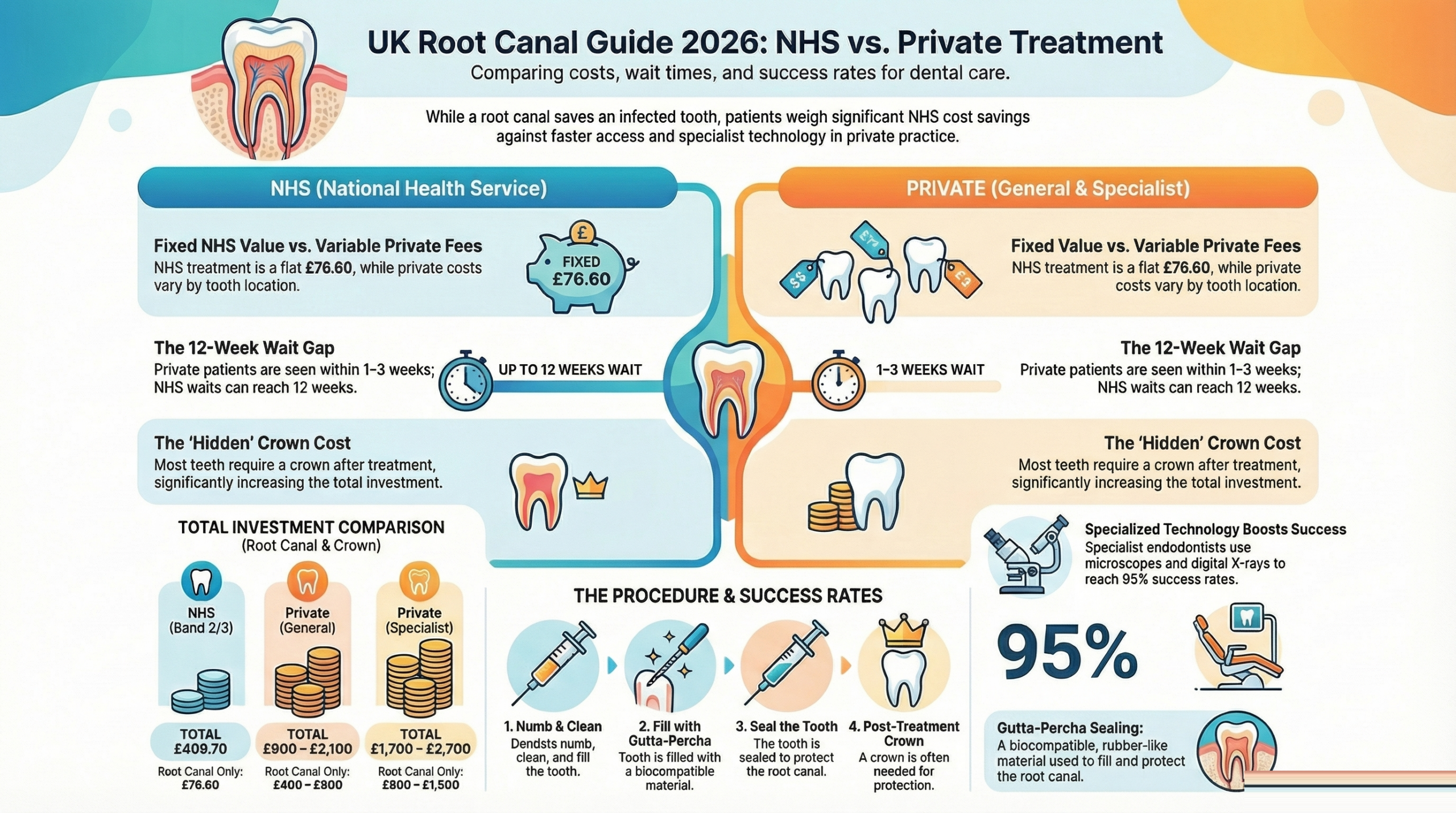
Key dental care facts at a glance – The Best of Health 2026
For more detail, read our guide on dental crowns and bridges cost – it compares NHS and private prices for dental crowns and bridges, the materials available, and what to expect.
Should You Choose NHS or Private for Root Canal Treatment?
The decision between NHS and private root canal treatment is not only about cost. Quality, convenience, and success rates matter too.
NHS root canal: what to expect
The NHS dentist performing your root canal is trained and competent. However, they may not specialise exclusively in root canal treatment. Waiting times are the main drawback: 4 to 12 weeks is typical in many parts of the UK. The NHS success rate is around 85 to 90% over five years.
The £76.60 charge represents exceptional value. You are paying a fixed, affordable price regardless of complexity. This makes NHS root canal an excellent choice if you can wait and are not in severe pain.
Private root canal: what you gain
Private dentists offer faster access, often within 1 to 3 weeks. If you see a specialist endodontist, you gain access to advanced microscopes, rotary instruments, and expert technique. Specialist endodontists often achieve success rates of 90 to 95%.
The private appointment is usually longer. Your dentist is not rushing between patients. They can discuss the procedure, answer questions thoroughly, and address anxieties. Private dentists often use superior materials and take digital X-rays.
However, you are paying significantly more: £400 to £900 for a general dentist, or £800 to £1,500 for a specialist.
Which should you choose?
- Choose NHS if: you are not in severe pain, you can wait 4 to 12 weeks, and you want the lowest cost.
- Choose private if: you are in pain and need urgent relief, you want the fastest appointment, or you have a complex tooth and want a specialist’s expertise.
Many patients choose a hybrid approach: NHS root canal treatment, then private crown placement for better aesthetics and durability.
Our guide to dental implants cost UK covers the full cost of dental implants in the UK, NHS eligibility criteria, and private pricing by region.
Will You Need a Crown After a Root Canal?
After root canal treatment, your tooth is weak. The nerve is gone, and the tooth becomes brittle over time. Most teeth need a crown to protect them and restore full function.
Your tooth was likely painful because the nerve was infected. Once removed, the tooth is dead – it no longer receives blood supply. Without a crown, it can crack when you bite. A crown acts like a helmet, distributing bite force evenly and protecting the tooth from breaking.
Studies show that teeth without crowns are significantly more likely to fail within 5 to 10 years compared to crowned teeth.
Crown cost after root canal
On the NHS, a crown costs £332.10 (Band 3) as of 2026. If your crown is completed in the same course of treatment as the root canal, you may pay just the Band 2 charge (£76.60) for both. If it is a new course of treatment (usually 2 to 4 weeks later), you will pay £332.10 separately.
Privately, crowns cost £500 to £1,200 depending on the material and the dentist’s location.
Total cost: root canal plus crown
| Route | Root Canal | Crown | Total |
|---|---|---|---|
| NHS | £76.60 | £332.10 | £408.70 |
| Private (General) | £600 (molar) | £700 | £1,300 |
| Private (Specialist + Crown) | £1,000 (molar) | £900 | £1,900 |
Even when you add the crown, NHS treatment remains far more affordable. However, some patients prefer private treatment because they are seen faster and often finish both the root canal and crown within 4 to 6 weeks, versus 8 to 16 weeks on the NHS.
What Questions Should You Ask Before Root Canal Treatment?
Before you agree to root canal treatment, ask your dentist these important questions.
About the procedure: How many appointments will I need? How long is each appointment? Can I have the root canal in one visit? What happens if the infection is severe – will I need antibiotics first?
About pain and aftercare: Will it hurt? What painkillers should I use afterwards? How long before I can eat normally? When can I return to work?
About success and long-term outcomes: What is the success rate for my tooth? What happens if the root canal fails? How long will the treatment last? Will I definitely need a crown?
About cost: What is your fee for my tooth (front, premolar, or molar)? Does this include follow-up appointments? If I need a crown, what are your crown options and costs? Are there any payment plans?
About alternatives: Is there any alternative to root canal treatment? What happens if I do not have treatment? How much would a replacement tooth (implant or bridge) cost?
Our guide to gum disease treatment covers NHS and private gum disease treatment options, costs, and what to expect from specialist periodontal care.
Frequently Asked Questions
If my NHS dentist says I need a root canal and a crown, will I pay one fee or two?
You will pay one combined Band 3 charge (£326.70 in 2026) if your dentist’s treatment plan includes both the root canal and crown as part of the same course of treatment. This single fee covers everything, regardless of the number of appointments needed.
How long does an NHS root canal appointment typically take, and will I need multiple visits?
An NHS root canal can take anywhere from 30 minutes to over an hour, depending on the tooth’s complexity. You may need one, two, or more appointments – but you only pay the one Band 2 charge (£75.30) for the entire course.
What happens if my root canal treatment fails and I need it redone?
If root canal treatment fails and requires retreatment within a reasonable timeframe, it is often considered part of the original course of treatment and may be covered at no extra cost. Confirm this with your dentist before starting treatment.
Can I choose private root canal treatment instead of NHS, and what is the advantage?
Yes – private endodontists (root canal specialists) typically charge £850-£1,800 and often use advanced technology like surgical microscopes for greater precision and comfort. Private treatment may also offer shorter wait times and more appointment flexibility.
Key Takeaways
- NHS root canal costs £76.60 (Band 2) regardless of tooth type or complexity – exceptionally good value but with 4 to 12 week waits.
- Private root canal costs £400 to £900 for a general dentist, or £800 to £1,500 for a specialist endodontist, with 1 to 3 week waits.
- Root canal treatment removes the infected nerve inside your tooth; the procedure usually takes one appointment and you will not feel pain.
- A crown is usually essential after root canal treatment to protect the weakened tooth, adding £332.10 (NHS) or £500 to £1,200 (private).
- Total cost with crown: £408.70 (NHS) or £900 to £2,100 (private).
- Success rates are high (85 to 95%), and most teeth last 10+ years with proper care and a crown.
Explore more: Compare your options in our full NHS vs private dentist costs guide. If you need a crown after your root canal, read our dental crown and bridge costs breakdown. And if pain strikes suddenly, our guide to emergency dentist costs explains your options for urgent care. Join the Best of Health community on Facebook to share your experiences.
This article is for information only. Always consult your dentist, GP or a qualified healthcare professional before making decisions about dental treatment.