
NHS vs Private Dentist Costs 2026: Your Complete UK Guide
If you have tried to register with an NHS dentist recently, you already know how difficult it has become. As of 2026, 97% of people looking for a new NHS dentist in England cannot find one accepting patients. That leaves millions of adults weighing up a decision they never expected to face: stick with the NHS or pay privately.
This guide compares NHS vs private dentist costs for every common treatment, from a routine check-up to dental implants. You will see exactly what each option costs in pounds, understand the key differences in quality and waiting times, and know when going private genuinely makes financial sense.
What Are the NHS Dental Charges in 2026?
NHS dental care in England uses a simple banding system. You pay one fixed charge per course of treatment, no matter how many appointments it takes to complete. From April 2026, the three bands are:
| Band | Cost | What It Covers |
|---|---|---|
| Band 1 | £27.90 | Examination, diagnosis, X-rays, scale and polish if clinically needed, fluoride varnish, advice on preventing future problems |
| Band 2 | £76.60 | Everything in Band 1, plus fillings, root canal treatment, extractions, and gum disease treatment |
| Band 3 | £332.10 | Everything in Bands 1 and 2, plus crowns, dentures and bridges |
| Urgent | £27.90 | Emergency treatment to relieve pain, stop bleeding or drain an abscess |
These charges increased by 1.7% in April 2026. In Wales, Scotland and Northern Ireland the system works differently. Wales uses a similar banding structure but at lower prices. Scotland and Northern Ireland calculate charges by individual treatment item.
If you receive certain benefits, including Universal Credit, Pension Credit or Income Support, you may qualify for free NHS dental treatment. You can also apply through the NHS Low Income Scheme if you are on a modest income.
Watch: The 2026 Dentistry Dilemma
Before diving into the detailed cost comparison, watch this short cinematic overview covering the key differences between NHS and private dental care in 2026, including what you will pay and how to decide which route is right for you.
Find out more in our complete guide to NHS dental charges 2026, which explains exactly what NHS Band 1, 2 and 3 dental charges cover and who qualifies for free treatment.
NHS vs Private Dentist Costs: Treatment-by-Treatment Comparison
The table below shows what you will pay for the most common dental treatments on the NHS and privately in 2026. Private prices are UK averages and can vary by region. London practices typically charge 20-30% more than those in the north of England.
| Treatment | NHS Cost | Private Cost | Key Difference |
|---|---|---|---|
| Check-up and X-rays | £27.90 (Band 1) | £50 – £120 | Private includes longer appointment and full discussion of options |
| Scale and polish | £27.90 (Band 1) | £50 – £130 | NHS only provides if clinically needed; private available on request |
| White filling | £76.60 (Band 2) | £90 – £250 | NHS may offer amalgam on back teeth; private uses composite as standard |
| Root canal | £76.60 (Band 2) | £400 – £900 | Private often uses specialist endodontist with microscope |
| Extraction (simple) | £76.60 (Band 2) | £150 – £400 | Surgical extractions cost more privately; NHS price stays fixed |
| Crown (porcelain) | £332.10 (Band 3) | £500 – £1,200 | Private offers wider choice of materials including zirconia |
| Bridge (per unit) | £332.10 (Band 3) | £700 – £1,500 | Private bridges often use stronger, more lifelike ceramics |
| Dentures (full set) | £332.10 (Band 3) | £2,000 – £5,000 | Private uses higher-quality acrylics and chrome options for better fit |
| Dental implant (single) | Rarely available | £1,800 – £5,500 | Almost never offered on the NHS; a primarily private treatment |
| Emergency consultation | £27.90 (urgent) | £100 – £200 | Private can usually see you same day; NHS may involve a longer wait |
At first glance, the NHS is dramatically cheaper. A full course of treatment including a crown costs just £332.10 on the NHS compared with £500 to £1,200 privately. But the real question in 2026 is not whether the NHS is cheaper. It is whether you can actually access it.
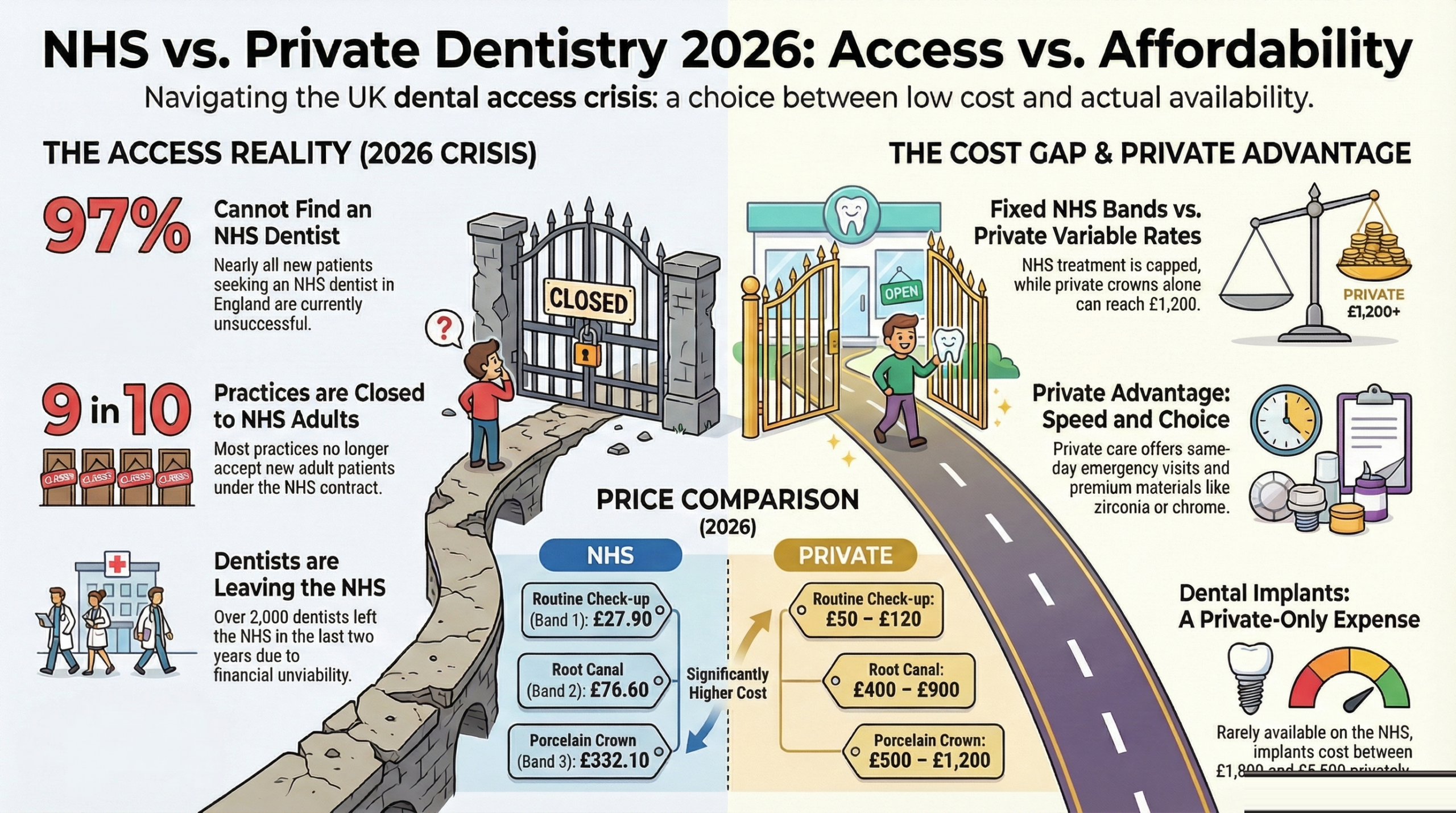
Key dental care facts at a glance – The Best of Health 2026
Why Are So Many People Switching to Private Dental Care?
The cost comparison above only tells half the story. The NHS dentistry crisis means that for many adults, the affordable option simply is not available.
The British Dental Association reports that 97% of new patients who tried to find an NHS dentist in 2025-2026 were unsuccessful. Nine out of ten dental practices across England are not accepting new adult NHS patients. For existing NHS patients, appointment waits have stretched from weeks to months in many areas.
The reasons behind the crisis are financial. Over 2,000 full-time equivalent dentists have left NHS practice in the past two years. More than half of practice owners now say that NHS work is financially unviable under the current contract. Dentists returned nearly £1 billion in public funding between 2023 and 2025 because the system makes it impossible to deliver care at the rates offered.
The impact falls hardest on people with lower incomes. Research from Healthwatch in March 2026 found that the proportion of financially struggling people paying for private dentistry has nearly doubled, rising from 14% in 2023 to 27% in 2025. Meanwhile, 78.5% of people who cannot find an NHS dentist simply go without any dental care at all.
Find out more in our complete guide to find an NHS dentist, which shows you how to find an NHS dentist near you, what to do if no one is accepting patients, and your rights.
When Does Going Private Make Sense for NHS vs Private Dentist Costs?
Choosing between NHS and private dental care is not straightforward. Your best option depends on your situation. Here are the scenarios where each route tends to make more sense for adults over 50.
When the NHS is the better choice
- You already have an NHS dentist and can get appointments within a reasonable timeframe.
- You need routine treatment such as fillings, extractions or basic dentures.
- You qualify for free treatment through benefits or the NHS Low Income Scheme.
- Your dental needs are straightforward and you are not seeking cosmetic improvements.
When going private may be worth the extra cost
- You cannot find an NHS dentist accepting new patients in your area.
- You need a dental implant, which is almost never available on the NHS.
- You want a choice of materials for crowns, bridges or dentures, such as zirconia or chrome.
- You need treatment quickly and cannot wait months for an NHS appointment.
- You value longer appointments with more time to discuss your options.
- You have complex needs, such as advanced gum disease, that benefit from specialist care.
Our guide to dental implants cost UK covers the full cost of dental implants in the UK, NHS eligibility criteria, and private pricing by region.
For many over-50s, the tipping point is a combination of access and complexity. If you need a crown, the NHS price of £332.10 is hard to beat. But if you cannot get an NHS appointment for four months and you are in discomfort, paying £500 to £1,200 privately to be seen within a week may be the more practical decision.
What Should You Ask Before Choosing a Private Dentist?
If you are considering private dental care for the first time, it helps to ask the right questions before committing. Private practices vary widely in what they charge and what is included in their fees.
- Does the quoted price include X-rays and the initial consultation, or are these charged separately?
- What materials will be used for my crown, bridge or dentures, and how do they compare in durability?
- Is there a written treatment plan with an itemised cost breakdown before work begins?
- Do you offer a payment plan or interest-free finance for larger treatments?
- Are follow-up appointments included in the price, or charged as additional visits?
- Is the dentist registered with the General Dental Council (GDC), and does the practice display its registration?
- What guarantee do you offer on crowns, implants or other restorative work?
A reputable private practice will always provide a written treatment plan before starting any work. If they are reluctant to give you a clear cost breakdown, consider looking elsewhere.
Can Dental Insurance Help Reduce Private Dentist Costs?
With NHS access so limited, dental insurance has become a realistic option for many adults over 50. Plans typically cost between £10 and £50 per month depending on the level of cover.
Basic plans from providers such as Denplan, Simplyhealth and Bupa start from around £10 to £15 per month and cover routine check-ups, hygiene appointments and a contribution towards fillings. More comprehensive plans at £30 to £50 per month may cover crowns, root canals and even a portion of dental implant costs.
Whether insurance is worth it depends on your dental history. If you typically need two check-ups a year and the occasional filling, a basic plan may save you money compared with paying privately each time. If you are facing larger work such as implants or multiple crowns, the annual limits on most plans mean you will still pay a significant amount out of pocket.
It is also worth noting that most dental insurance policies have waiting periods of several months before you can claim for major treatments. Pre-existing conditions are often excluded. Read the small print carefully before signing up.
Find out more in our complete guide to private dental insurance for over 50s, which compares private dental insurance plans for over 50s, what they cover, and when self-funding may be the better option.
Frequently Asked Questions
How much does an NHS dental check-up cost in 2026?
An NHS dental check-up falls under Band 1, which costs £26.80 in England. In Wales, the charge is £14.70. Scotland and Northern Ireland offer free NHS dental examinations for all patients.
Is a private dentist better than the NHS?
Neither is universally better. NHS dentistry covers essential treatments at regulated prices, but waiting times can be long and appointment slots are often short. Private dentists typically offer longer appointments, a wider choice of materials, and shorter waits, but costs are significantly higher. The right choice depends on your budget, dental needs, and how quickly you need treatment.
Can I see an NHS dentist and a private dentist at the same time?
Yes. You can be registered with an NHS dentist for routine care and see a private dentist for specific treatments such as cosmetic work or implants. There is no rule preventing you from using both, and many patients mix NHS and private care to manage costs.
Why can I not find an NHS dentist accepting new patients?
Many NHS dental practices have closed their lists due to high demand and funding pressures. The NHS contract pays dentists per course of treatment rather than per patient, which makes taking on complex cases less financially viable. If you cannot find an NHS dentist, try the NHS Find a Dentist tool, call NHS 111, or contact your local Healthwatch for help.
Are NHS dental charges going up in 2026?
NHS dental charges in England are reviewed annually and typically rise by a small percentage each April. For the latest confirmed figures, check the NHS dental charges page on nhs.uk. Patients on qualifying benefits, under 18, pregnant, or receiving certain income-related support may be exempt from all charges.
Key Takeaways
- NHS dental care remains far cheaper than private treatment, but 97% of new patients cannot access it in 2026.
- From April 2026, NHS dental charges are £27.90 (Band 1), £76.60 (Band 2) and £332.10 (Band 3).
- Private check-ups cost £50 to £120 and crowns £500 to £1,200, but you typically get seen within days rather than months.
- Dental implants are almost exclusively a private treatment, costing £1,800 to £5,500 per tooth.
- NHS vs private dentist costs matter most when you factor in access, waiting times and the quality of materials offered.
- Dental insurance plans from £10 to £50 per month can help spread the cost of private care, but check waiting periods and exclusions.
Explore more: Read our full guides to dental implant costs, NHS dental charges explained, and how to find an NHS dentist in 2026. Join our Facebook community to share your experiences and ask questions about dental care options.
This article is for information only. Always consult your dentist, GP or a qualified healthcare professional before making decisions about dental treatment. Prices quoted are indicative and may vary by provider, region and individual treatment needs.