
Cataract Surgery Cost UK: Complete NHS vs Private Price Guide for 2026
Cataracts affect millions of people over 50 in the UK. Your vision becomes increasingly blurry, colours lose their clarity, and everyday activities like reading or driving become harder. Our guide to age-related vision changes explains what to watch for as you get older. Surgery is the only proven cure-but cost matters. Should you wait for NHS treatment, or explore private options? This guide compares exact prices from named UK providers, NHS waiting times, lens options, and financing plans to help you decide.
NHS vs Private Cataract Surgery: Quick Cost Comparison
The most important decision is not just whether to have surgery, but how and when. Here’s what you need to know upfront:
| Aspect | NHS | Private (Average) |
|---|---|---|
| Cost per eye | Free | £2,000-£3,500 |
| Typical waiting time | 6-9 months | 2-4 weeks |
| Standard lens type | Monofocal only | Monofocal, multifocal, toric |
| Premium lens options | Not available | Yes (£3,200-£7,500) |
| Aftercare appointments | Free, as needed | Included in price (1 year) |
Cataract surgery is one of the 10 most common surgeries for over-50s in the UK. The choice depends on your circumstances. If you can wait 6-9 months and are happy with a basic monofocal lens, the NHS is free. If you need surgery sooner or want premium lens options for reduced dependence on glasses, private surgery starts from £1,995 per eye.
Watch: Buying Time or Buying Vision – The 2026 UK Cataract Surgery Guide
This cinematic overview compares NHS and private cataract surgery in the UK for 2026, covering costs, waiting times, lens options, and what to expect from each pathway.
Why Age 50+ Makes a Difference: Understanding Cataracts
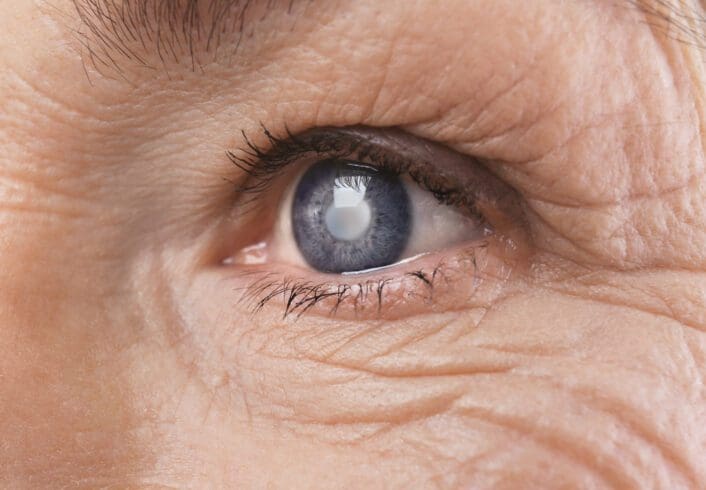
Cataracts are a natural part of ageing. After 50, your eye’s lens becomes less transparent. Proteins clump together, creating a cloudy film over the lens. Light cannot reach the retina clearly, so vision becomes blurry, colours fade, and glare becomes intolerable.
Early on, stronger glasses may help. But as the cataract progresses, surgery becomes the only effective treatment. The good news: cataract surgery is one of the most successful procedures in modern medicine, with a 95% success rate.
You may also find our guide to give your eyes a lift without surgery helpful.
You may also find our guide to dental care tips for older people helpful.
You may also find our guide to life insurance – who needs it? helpful.
You may also find our guide to what to expect from laser eye surgery helpful.
NHS Cataract Surgery: What You Get and How Long You’ll Wait
The NHS provides free cataract surgery for patients whose vision significantly impacts daily life. However, eligibility and waiting times vary by region.
NHS Eligibility: Are You Suitable for Free Surgery?
Your GP or eye clinic must confirm that cataracts are affecting your quality of life. Common signs include:
- Difficulty reading or watching television despite glasses For a general overview of the procedure, our guide to cataract surgery: the facts explains what is involved and what to expect.
- Trouble with driving (failing the number plate test at 20 metres)
- Glare from bright light or headlights causing discomfort
- Colours appearing faded or with a yellow or brown tinge
- Double vision or halos around lights
- Frequent changes to your glasses prescription that don’t help
Once your GP refers you, an eye hospital consultant will assess whether surgery is needed. The NHS does not assess cosmetic concerns alone-the focus is on functional impact.
NHS Waiting Times: Regional Variation
As of 2026, NHS waiting times for cataract surgery vary significantly by region. Recent data suggests:
- Urban areas (London, Manchester, Birmingham): 6-9 months average
- Suburban areas: 4-7 months
- Rural areas: 8-12 months in some areas
Pre-pandemic, the average wait was 5 months. The pressure on NHS ophthalmology services remains substantial due to staff shortages and high demand. You may be able to reduce your wait by using the NHS e-Referral Service to choose a hospital with a shorter queue.
NHS Lens Choice: Monofocal Only
The NHS offers one lens type: monofocal. This lens has a single focal point, correcting either distance vision (for driving) or near vision (for reading), but not both. Most patients choose distance vision, meaning glasses are still needed for close work after surgery.
This is adequate for many people. However, if you want to reduce or eliminate the need for glasses, you’ll need to explore private multifocal or premium lens options. If you are also considering laser correction, our guide to laser eye surgery costs in the UK compares LASIK, LASEK, and lens replacement prices. Not ready for surgery? Our guide to alternatives to reading glasses covers multifocal contact lenses, refractive lens exchange and other options for tackling age-related vision changes.
Private Cataract Surgery Costs: 2026 Prices from Top UK Providers
Private cataract surgery offers shorter waiting times, a choice of lens types, and greater flexibility. Costs vary by provider, location, and lens choice. Below is a detailed breakdown from major UK chains and independent providers.
Find and Compare Private Providers
Use the directory below to compare UK providers at a glance, see what each includes, and find your nearest hospital. All prices are self-pay guide prices as of early 2026.
Private Cataract Surgery Providers: Prices & Where to Go
Compare the UK’s leading private cataract surgery providers at a glance. See current self-pay prices per eye, what’s included, finance options, and find your nearest hospital.
NHS vs Private: The Key Difference
Cataract surgery is the most common operation in the NHS, with around 450,000 procedures a year. On the NHS it is free, but the average wait is 16-20 weeks from referral – and some trusts have waits of 6-12 months. Going private typically costs £1,995-£3,600 per eye for a standard monofocal lens, with surgery usually within 1-4 weeks. Private patients can also choose premium multifocal or toric lenses (from £3,500-£5,500) that are not available on the NHS.
Check your local NHS wait at myplannedcare.nhs.uk before deciding.
Quick Comparison: All Providers at a Glance
| Provider | Price Per Eye | Consultation | Finance | Aftercare | UK Locations |
|---|---|---|---|---|---|
| Practice Plus Group | £1,995 | £95 | Ask provider | Standard | 13 |
| Optical Express | From £2,500 | Included | 0% from £28/mo | 12 months | Multiple |
| Ramsay Health Care | £2,700-£2,800 | Varies | 10x interest-free | Standard | 34 |
| Spire Healthcare | £2,800-£3,400 | Separate | Available | Standard | 39+ |
| Optegra | £2,895 | Free | 0% APR 12-24 mo | 1 year | Multiple |
| Moorfields Private | £2,990 | £225 | 0% up to 10 mo | Included | 2 (London) |
| Circle Health Group | £2,119-£3,081 | Separate | 10 mo 0% or 5 yr | Included | 50+ |
| Nuffield Health | £3,613 avg | Included | Ask provider | Unlimited | Multiple |
Understanding Lens Types & Costs
| Lens Type | Private Cost | On NHS? | Best For |
|---|---|---|---|
| Monofocal (standard) | £1,995-£3,600 | Yes – free | Distance vision; happy to wear reading glasses |
| Toric (astigmatism) | £3,000-£4,000 | No | Correcting astigmatism at the same time |
| Multifocal / Trifocal | £3,500-£5,500 | No | Reducing dependence on glasses at all distances |
The NHS provides monofocal lenses only. If you want toric or multifocal lenses, you will need to go private. Some providers offer a ‘top-up’ option where the NHS covers the surgery and you pay the difference for a premium lens – ask your ophthalmologist.
5 Questions to Ask Before Booking Private Cataract Surgery
1. What exactly is included in the quoted price? Surgery, lens, anaesthetist, aftercare appointments, and medication should all be covered. If not, ask for the full cost.
2. Is the consultation fee credited against the surgery cost? Some providers deduct it; others charge it on top.
3. What lens options are available, and what are the upgrade costs? If you have astigmatism or want to reduce glasses dependency, ask about toric and multifocal options.
4. What happens if I need follow-up treatment? Posterior capsule opacification affects up to 20% of patients within 5 years. Check whether YAG laser treatment is included or costs extra.
5. What are the surgeon’s personal outcomes? Check your surgeon’s complication rates on PHIN (phin.org.uk) and the hospital’s CQC rating at cqc.org.uk.
Directory note: All prices are self-pay guide prices as of early 2026 and may vary by consultant, location, lens type, and individual circumstances. Always contact providers directly for an official written quote. Sources: Individual provider websites, PHIN, NHS.uk.
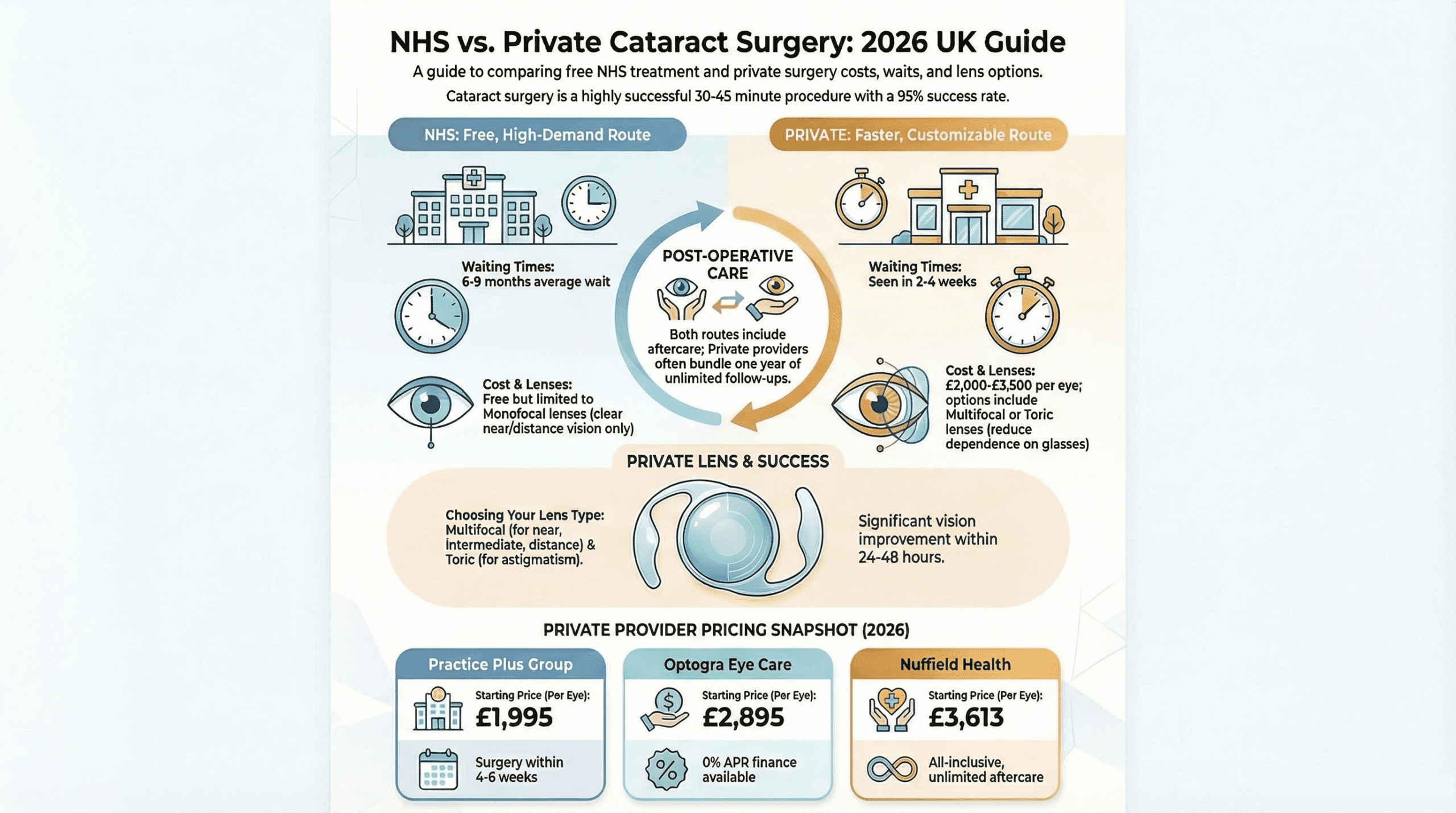
A visual overview of cataract surgery costs, NHS waiting times, and private treatment options in the UK
Understanding Lens Types and Their Cost Impact
Your lens choice is the biggest cost variable. The type of lens you select affects both the price and your vision after surgery. Here’s a breakdown of the four main types available in the UK:
| Lens Type | Cost per Eye | Best For | Key Advantage |
|---|---|---|---|
| Monofocal (Standard) | £1,995-£2,995 | Distance OR near vision (not both) | Most affordable; covered by NHS |
| Enhanced Monofocal (Premium) | £2,500-£3,200 | Better intermediate vision, less glare | Sharper vision at all distances than standard |
| Multifocal | £3,195-£4,100 | Near, intermediate, and distance vision | Potentially glasses-free living |
| Toric (Astigmatism Correction) | £2,995-£3,995 | Astigmatism + cataract; can be combined with multifocal | Corrects blurred vision at all distances |
Most patients over 50 have presbyopia-difficulty focusing on close objects. A standard monofocal lens corrects distance vision, so reading glasses are still needed. Multifocal lenses have multiple focal zones, allowing clear vision at all distances and offering potential freedom from glasses. The trade-off is higher cost and potential for slight glare or halos in dim light, though this improves within weeks.
If you have astigmatism (an irregular corneal shape causing blurred vision at all distances), a toric lens can correct this during cataract surgery, eliminating the need for separate surgery later.
Financing Your Private Cataract Surgery
Most private providers offer flexible payment plans, making surgery more accessible. Here’s what’s available:
Interest-Free Plans
Many providers offer 10-12 month interest-free plans with no deposit required:
- Nuffield Health: 10 months interest-free
- BMI Healthcare: 12 months interest-free
- Ramsay Healthcare: 10 months interest-free
These are ideal if you can comfortably spread the cost over a year without paying interest.
Longer-Term Payment Plans
For extended terms (18-48 months), interest rates typically apply. For example:
- Optical Express: 36 months from £48.89 per month (monofocal, £500 deposit)
- Ultralase: 48 months; for monofocal, around £187 per month (£500 deposit)
- Optegra: 12-24 months with 10-20% upfront deposit
Calculate the total cost carefully: a £2,500 loan over 48 months at 9.9% interest costs around £3,000 total.
Private Medical Insurance
Many private health insurance policies cover cataract surgery. Check your policy documents or contact your insurer to confirm whether cataract surgery is included and whether there are any waiting periods or restrictions.
Common insurers covering cataract surgery include BUPA, AXA, and Vitality.
The Cataract Surgery Procedure: What Happens
Understanding the procedure helps you prepare mentally and physically. Cataract surgery is straightforward and takes 30-45 minutes per eye.
Pre-Operative Assessment
Before surgery, you’ll have diagnostic eye tests:
- Visual acuity test: Measures how clearly you see at different distances
- Slit-lamp examination: Inspects the lens and eye structures in detail
- Biometry: Measures your eye dimensions to calculate the correct lens power
Your surgeon will also discuss your daily activities, work, and vision goals to recommend the best lens type.
The Surgery Itself
The procedure happens under local anaesthetic (numbing eye drops). You remain conscious but feel no pain, only mild pressure.
- Local anaesthetic is administered around the eye
- Your pupil is dilated with medicated eye drops
- The surgeon makes a tiny incision (2-3mm) in the cornea
- An ultrasound probe (phacoemulsification) breaks the cloudy lens into small pieces
- The lens fragments are gently suctioned out
- The artificial intraocular lens (IOL) is inserted and positioned
- The incision usually self-seals without sutures
You’ll go home the same day with a protective eye shield.
Laser-Assisted Surgery
Some private providers use femtosecond laser technology instead of a manual blade for corneal incisions. This approach offers greater precision and may reduce astigmatism. Laser surgery takes about 10 minutes and is bladeless. However, it costs more (typically £500-£1,000 additional) and may not benefit all patients.
Recovery: Timeline and Self-Care
Recovery is quick for most people, though your eyes need time to adjust fully to the new lens.
First Week After Surgery
You’ll experience some blur and mild discomfort. Common sensations include:
- Blurred or hazy vision (normal and temporary)
- Watering or tearing
- A gritty sensation or mild irritation
- Sensitivity to bright light (wear sunglasses outdoors)
Most patients see significant improvement within 24-48 hours. You’ll wear an eye shield, especially at night, to prevent accidental rubbing.
Two Weeks to Six Weeks
Vision continues improving. You can resume most daily activities:
- Reading and computer use (take regular breaks)
- Light housework
- Walking and gentle exercise
Restrictions during this period:
- Avoid heavy lifting (anything over 5kg)
- No strenuous exercise or contact sports
- No swimming for 4-6 weeks (chlorine risks infection)
- Avoid rubbing your eyes or putting soap in them
- No eye makeup for at least 4 weeks
Six Weeks and Beyond
Most people have recovered fully by six weeks. However, it can take up to 12 weeks for your vision to stabilise completely, especially with multifocal lenses (your brain adapts to multiple focal zones gradually).
Once stable, you can have your eyes tested for a new glasses prescription if needed. Many multifocal lens patients find they need no glasses at all for everyday tasks.
Follow-Up Appointments
You’ll attend appointments at 1 day, 1 week, 1 month, and 3 months post-surgery. Your surgeon will check for infection, measure eye pressure, assess vision, and adjust your treatment plan. Both NHS and private providers include these appointments in their care.
Risks and Complications: What You Should Know
Cataract surgery is among the safest surgical procedures, with a 95% success rate. However, complications can occur, though they’re rare. It’s important to recognise warning signs and know when to contact your surgeon.
Common Minor Side Effects (Usually Temporary)
- Watering or dryness: Resolves within days to weeks
- Grittiness or irritation: Improves with antibiotic or lubricating drops
- Mild redness: Normal post-operative inflammation; typically clears within weeks
- Blurred vision: Expected initially; vision improves daily for 4-6 weeks
- Glare or halos: With multifocal lenses, these usually fade as the brain adapts
Serious Complications (Rare)
Contact your surgeon immediately if you experience:
- Sudden loss of vision
- Severe eye pain not relieved by painkillers
- Signs of infection (increasing redness, pus, fever)
- Persistent swelling of the eyelid or white of the eye
- Floating spots or shadows appearing in your vision
- Light flashes or new floaters (possible retinal problems)
Serious complications include infection, bleeding, swelling, retinal detachment, and lens dislocation. Most are treatable if caught early, which is why follow-up appointments are critical.
Secondary Cataracts (Posterior Capsule Opacification)
Months or years after surgery, some patients develop a secondary cataract when the lens capsule (the membrane holding the artificial lens) becomes cloudy. This is not a return of the original cataract and is easily treated with a simple 5-minute laser procedure in the clinic. No surgery is needed.
Questions to Ask Your Surgeon
Before deciding on cataract surgery, whether NHS or private, ask your surgeon these questions:
About Your Specific Case
- How advanced is my cataract, and is surgery the right choice for me now?
- Do I have any other eye conditions (glaucoma, dry eyes, astigmatism) that might affect the outcome?
- What is my expected visual outcome with the recommended lens type?
- Will I still need glasses after surgery?
About Lens Options
- What lens type do you recommend for my lifestyle and activities?
- If I choose a multifocal lens, what should I expect regarding glare or halos?
- Can I combine astigmatism correction with my chosen lens type?
- What is the failure rate of the specific lens brand you use?
About the Procedure
- Will you use laser-assisted surgery, or a manual technique?
- How long has your team been performing cataract surgery?
- What happens if complications occur during surgery?
- Will I be treated by the same surgeon for both eyes?
About Costs and Aftercare
- What is the total cost, and what is included (consultation, surgery, aftercare)?
- Are there any hidden costs (e.g., if complications develop)?
- What payment and financing options are available?
- How many follow-up appointments are included?
- What happens if I’m unhappy with the result?
NHS vs Private: Making Your Decision
Choose NHS surgery if:
- You can wait 6-9 months for treatment
- A standard monofocal lens meets your needs (you’re happy with glasses for reading)
- You prefer zero out-of-pocket cost
- You trust your local NHS eye hospital
Choose private surgery if:
- You need surgery within weeks (not months)
- You want multifocal or premium lenses for reduced glasses dependence
- You have astigmatism and want it corrected during cataract surgery
- You prefer a choice of surgeon or hospital
- You can access financing and afford £2,000-£3,500 per eye
- You want the latest technology (laser-assisted surgery, extended-range lenses)
Cataract Surgery Cost Summary: Key Takeaways
Key Takeaways
- NHS cataract surgery is free but requires waiting 6-9 months and you’re limited to a standard monofocal lens.
- Private surgery starts from £1,995 per eye with monofocal lenses and as little as 2-4 weeks waiting time.
- Multifocal and premium lenses cost £3,200-£4,100 and can reduce or eliminate the need for glasses after surgery.
- Most private providers offer flexible financing: 10-12 months interest-free or longer-term plans from major chains.
- Surgery is highly effective: 95% of patients achieve improved vision, and the procedure takes just 30-45 minutes.
- Recovery is quick: Most people see significant improvement within 24 hours and are back to normal activities within 6 weeks.
- Budget-friendly options include Optical Express (£1,995), BMI Healthcare (from £2,073), and Ultralase (£2,495) for monofocal lenses.
- For over-50s, the decision is about balancing cost, waiting time, and quality-of-life improvement. A modest investment in private multifocal surgery often pays dividends in reduced glasses dependence and improved daily living.
Useful Resources and Sources
For more information about cataract surgery, lens options, and NHS waiting times, consult these trusted sources:
- NHS.uk: Cataracts – Official NHS information on cataract diagnosis, symptoms, and NHS treatment options
- NICE (National Institute for Health and Care Excellence) – Clinical guidance on cataract surgery best practice and outcomes
- Royal College of Ophthalmologists – Professional standards and guidance for eye surgery in the UK
- Which?: Private Healthcare Providers – Independent patient reviews and ratings of private eye clinics
- Private Healthcare Information Network (PHIN) – Industry data on private healthcare costs and waiting times
Frequently Asked Questions
How much does private cataract surgery cost in the UK?
Private cataract surgery typically costs 2,500 to 4,500 pounds per eye in 2026, depending on the lens type and provider. Standard monofocal lens surgery is at the lower end, while premium multifocal or toric lenses (which correct astigmatism) cost more. Some providers offer package deals for both eyes. London prices are typically 20 to 30 per cent higher than regional clinics.
How long is the NHS waiting list for cataract surgery?
NHS waiting times for cataract surgery vary by region but are typically 12 to 26 weeks from referral as of 2026. Some areas have longer waits. The NHS target is 18 weeks from referral to treatment. You can use the My Planned Care website to check current waiting times at hospitals near you and choose a provider with a shorter wait.
Is cataract surgery painful?
No. Cataract surgery is performed under local anaesthetic (eye drops), so you should feel no pain during the procedure. You may feel some pressure or see bright lights. The operation takes approximately 15 to 30 minutes per eye. Afterwards, your eye may feel gritty, watery, or slightly sore for a day or two. Your surgeon will prescribe eye drops to prevent infection and reduce inflammation during recovery.
How long does it take to recover from cataract surgery?
Most people notice improved vision within a few days, though full recovery takes four to six weeks. You can usually return to most daily activities within a day or two. Avoid rubbing your eye, swimming, and heavy lifting for at least two to four weeks. You will use antibiotic and anti-inflammatory eye drops for several weeks. A follow-up appointment is usually scheduled one to four weeks after surgery.
Can cataracts come back after surgery?
Once a cataract is removed, it cannot come back. However, some people develop posterior capsule opacification (sometimes called a secondary cataract) months or years later, where the membrane behind the new lens becomes cloudy. This is easily treated with a quick, painless laser procedure called YAG capsulotomy, which takes about five minutes and restores clear vision immediately.
Important Disclaimer
This article is for information only and does not constitute medical advice. Cataract surgery decisions should always be made in consultation with your GP or a qualified eye specialist. Prices, waiting times, and treatment options are current as of March 2026 but are subject to change. Always verify costs and services directly with your chosen provider before proceeding. If you experience symptoms of cataracts (blurred vision, glare sensitivity, faded colours), contact your GP for a professional assessment. Your eye health is too important to leave to chance.