
Alternatives to Reading Glasses Over 50: Glasses, Contacts, or Surgery?
If you’re over 50 and suddenly struggling with your vision, you’ve likely wondered about your options. Should you stick with reading glasses, try contact lenses, or consider surgery? As presbyopia (the natural ageing of the eye) sets in, finding the right vision correction becomes a priority.
This guide will help you understand the real differences between glasses, contact lenses, and surgical options-including NHS availability, private costs, and what actually works best for the over-50 body.
The Royal College of Ophthalmologists states: “Focusing errors such as short-sightedness, astigmatism, and long-sightedness are usually corrected by wearing spectacles or contact lenses. Over the years a number of surgical techniques have been used to treat refractive errors and reduce the need for glasses.”
Understanding Presbyopia: Vision Changes After 50
Vision changes are a normal part of ageing. Many people notice they need stronger prescriptions in their 50s and 60s. **Presbyopia**-difficulty focusing on close objects like menus or text messages-becomes almost universal. This is why exploring alternatives to reading glasses over 50 is so common.
The good news? If you’re over 60, you’re entitled to a free NHS eye test every two years. This is an excellent opportunity to check your eye health, discuss your vision needs with an optician, and explore which presbyopia correction options suit your lifestyle best.
Watch: Your Guide to Vision Correction After 50
In under seven minutes, our cinematic overview walks you through the main choices for correcting your vision after 50 – glasses, contact lenses, and refractive lens exchange – with real UK costs and the key trade-offs for each option.
Glasses: The Most Popular and Versatile Option
Spectacles remain the most commonly chosen vision correction method in the UK-especially for people over 50. From basic reading glasses to designer varifocals, you have complete control over cost and style.

Advantages of Glasses
- Easy to clean and maintain-no complicated routines.
- No direct contact with the eye, so no infection risk.
- Excellent for dry eye syndrome, which affects many people over 50.
- Long-lasting-a good pair of varifocals lasts 2-3 years.
- Can include specialist coatings (anti-glare, UV protection, photochromic).
- NHS optical vouchers can offset costs for eligible people.
Disadvantages of Glasses
- They sit half an inch from your eyes, so peripheral vision may be distorted.
- Fog up in rain, snow, or when cooking.
- Can slip down your nose during exercise or activity.
- Constantly taking reading glasses on and off can be frustrating.
Glasses Costs: NHS vs Private
The NHS provides optical vouchers to eligible people, including those over 60 on certain means-tested benefits.
- NHS route: £20-£60 depending on voucher entitlement (after contribution).
- Private opticians: £100-£400+ for a good pair of varifocals with quality coatings.
Contact Lenses: Freedom with a Learning Curve
Contact lenses offer excellent peripheral vision and work well for sports. However, they require discipline and aren’t suitable for everyone, especially those with dry eyes. For presbyopia correction, multifocal contact lenses are available.
Advantages of Contact Lenses
- Sit directly on the eye, giving you natural peripheral vision.
- Ideal for active people or those who play sports like golf or tennis.
- Never fog up in rain or when cooking.
- Multifocal options can correct both distance and reading vision.
Disadvantages of Contact Lenses
- Require dexterity and practice to insert and remove safely.
- Restrict oxygen flow to the eyes-can significantly worsen age-related dry eye syndrome.
- Daily handling increases the risk of eye infection if not cleaned properly.
- Require ongoing supplies (solution, cases, replacement lenses).
Contact Lens Costs
The NHS does not typically cover contact lens costs for standard vision correction.
- Daily disposables: £300-£600 per year.
- Monthly lenses: £150-£350 per year (plus £50-£100 for cleaning supplies).
Surgical Options: Is Laser Eye Surgery Worth It After 50?
Many people wonder if laser eye surgery is worth it after 50. While LASIK reshapes the cornea to correct distance vision, it is crucial to understand that standard laser eye surgery cannot cure presbyopia.
If you have LASIK at 55, you will likely still need reading glasses. Because of this, many over-50s opt for Lens Replacement Surgery instead.
1. Standard Laser Eye Surgery (LASIK/SMILE)
- Pros: Quick recovery, excellent for fixing distance vision, permanent.
- Cons: Can worsen dry eyes, does not fix the need for reading glasses (unless you opt for “monovision” where one eye is corrected for distance and one for reading).
- Cost: £3,000-£5,000 for both eyes.
2. Lens Replacement Surgery (RLE) – The Over-50s Alternative
Refractive Lens Exchange (RLE) involves replacing your natural hardening lens with an artificial multifocal lens.
- Pros: Corrects both distance and reading vision, completely prevents cataracts from ever forming, permanent.
- Cons: More invasive than LASIK, longer recovery time, higher upfront cost.
- Cost: £6,000-£9,000 for both eyes.
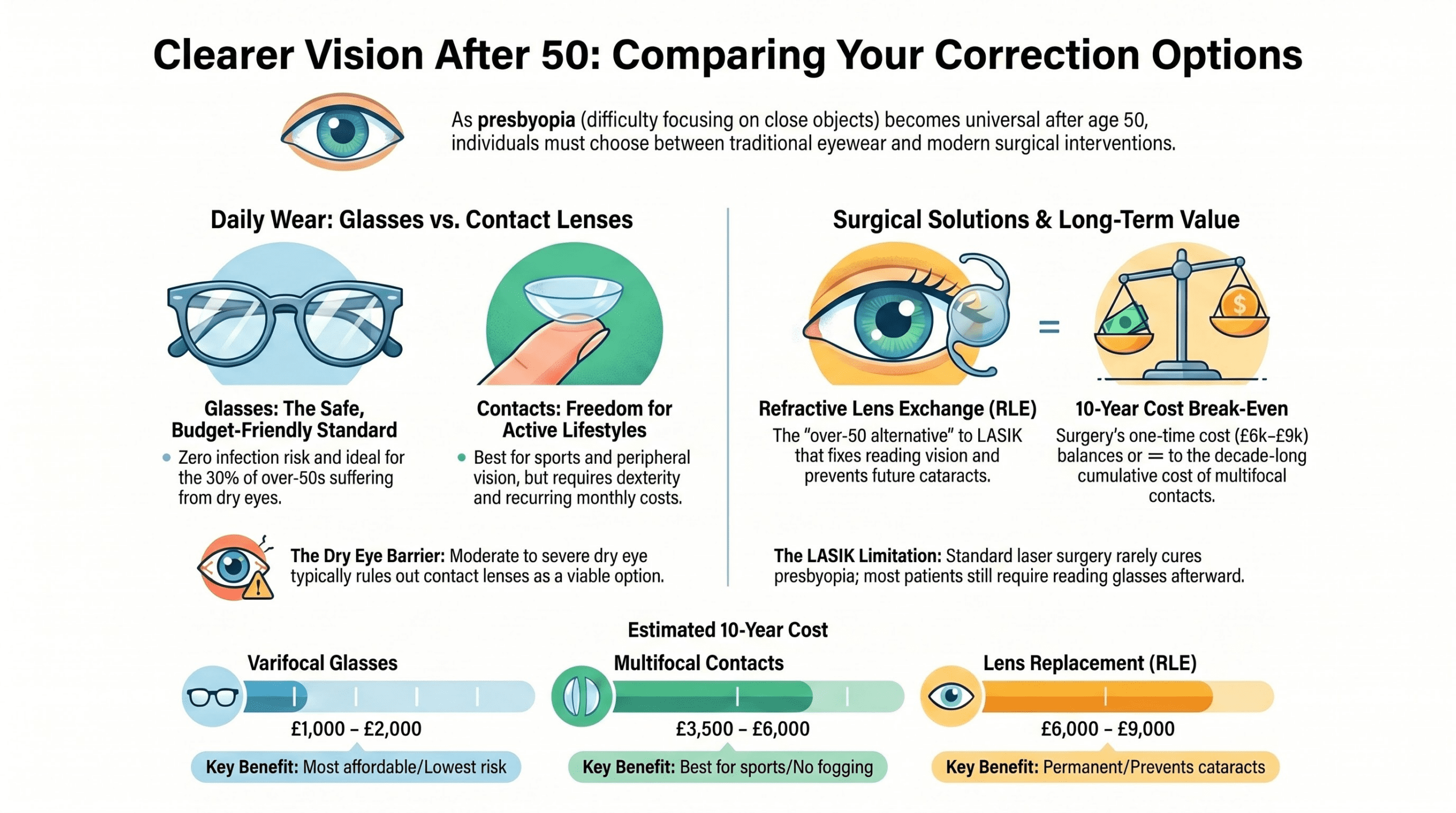
Comparison Table: Glasses vs Contacts vs Surgery
| Option | Pros | Cons | 10-Year Cost Est. |
|---|---|---|---|
| Varifocal Glasses | Easy to use; safe for dry eyes; low maintenance. | Can fog up; easy to misplace; peripheral distortion. | £1,000 – £2,000 |
| Multifocal Contacts | Natural vision; great for sports. | Requires dexterity; worsens dry eye; daily routine. | £3,500 – £6,000 |
| Lens Replacement (RLE) | Fixes reading & distance vision; prevents cataracts. | High upfront cost; surgical risks. | £6,000 – £9,000 (One-time) |
How to Choose: A Decision Framework for Over-50s
Ask yourself:
- Do I have dry eyes? If yes, choose glasses. Avoid contact lenses.
- Am I very active or play sports? Consider contact lenses or surgery.
- Am I frustrated by reading glasses? Look into varifocals or Lens Replacement Surgery.
- Do I have dexterity issues? Glasses or surgery; avoid contacts.
- Am I on a tight budget? Glasses + NHS voucher is most affordable.
Key Takeaways
- Presbyopia is a normal age-related change – almost everyone over 50 needs some form of vision correction for close work.
- Reading glasses are the cheapest and simplest option (from £5 off-the-shelf to £150+ for prescription), but can be inconvenient if you need them constantly.
- Contact lenses – including multifocal and monovision options – offer freedom from glasses but involve daily handling and ongoing costs of £15-£50 per month.
- Laser eye surgery is rarely suitable for over-50s with presbyopia; refractive lens exchange (RLE) at £3,500-£5,500 per eye is usually a better long-term option.
- The right choice depends on your prescription, lifestyle, budget, and tolerance for risk – speak to both your optician and an independent ophthalmologist before deciding.
Frequently Asked Questions
Which is cheaper long term: glasses, contact lenses, or laser eye surgery?
Over 10 to 20 years, surgical options often break even. Glasses typically cost £150 to £400 per pair, replaced every two years. Daily disposable contact lenses cost around £400 to £600 a year, adding up to £10,000+ over two decades. A one-off surgery payment of £4,000 to £7,000 can be cheaper overall. See our detailed breakdown in the laser eye surgery cost UK 2026 guide.
Can I wear contact lenses if I have dry eyes?
Mild dry eye may be manageable with specific daily disposables and lubricating drops, but moderate to severe dry eye usually rules contact lenses out. Dry eye affects up to 30% of adults over 50, according to the College of Optometrists, so have your tear film assessed before persisting with lenses.
Is laser eye surgery suitable if I am over 60?
While LASIK is possible after 60, most ophthalmologists recommend refractive lens exchange (RLE) or cataract surgery instead. These procedures correct the refractive error, address presbyopia, and prevent future cataracts in one step. Read more on how laser eye surgery results compare for over-50s.
Explore More Vision Options
If you found this helpful, our companion guides cover the next decisions you will face:
- Our full cost breakdown compares NHS availability and private pricing in Laser Eye Surgery Cost UK 2026.
- For the step-by-step patient experience, read What to Expect From Laser Eye Surgery.
For a wider conversation with adults 50+ making the same decisions, join our Best of Health community on Facebook.
Disclaimer: This article is for information only and is not a substitute for professional medical advice. Always consult your GP, optician, or qualified eye specialist before making decisions about your vision care. Vision correction needs are individual and depend on your prescription, eye health, lifestyle, and preferences.