
NHS Dental Charges 2026: Band 1, 2 and 3 Explained
NHS dental charges can be confusing, especially when the prices change every April. If you are planning a trip to the dentist in 2026, you need to know exactly what you will pay before you sit in the chair.
This guide breaks down every NHS dental charge for 2026, explains what each band covers, and tells you who qualifies for free treatment. Whether you live in England, Wales, Scotland or Northern Ireland, you will find the figures that apply to you.
How Do NHS Dental Charges Work in England?
England uses a banding system for NHS dental treatment. Rather than paying for each individual procedure, you pay a single fixed fee based on the most complex treatment you need during that course of care.
This means that if you visit the dentist for a check-up and they discover you also need two fillings and an extraction, you pay one Band 2 charge that covers everything. You do not pay separately for each filling or for the extraction.
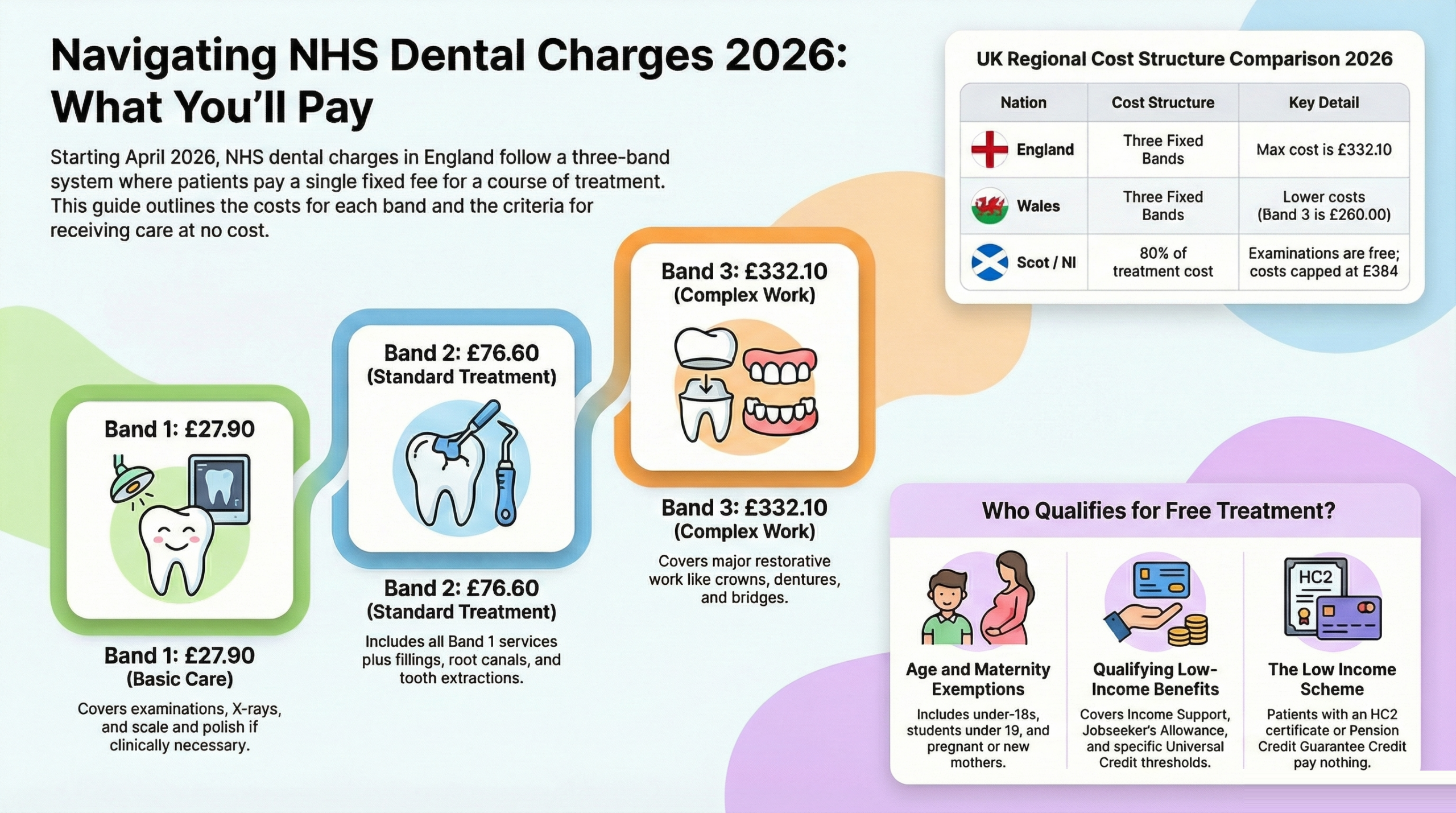
From April 2026, the three NHS dental charge bands in England are:
| Band | Cost | What It Covers |
|---|---|---|
| Band 1 | £27.90 | Examination, diagnosis, X-rays, scale and polish if clinically needed, fluoride varnish, urgent referrals, advice on oral health |
| Band 2 | £76.60 | Everything in Band 1, plus fillings, root canal treatment, tooth extractions, and treatment for gum disease |
| Band 3 | £332.10 | Everything in Bands 1 and 2, plus crowns, dentures (full and partial), and bridges |
| Urgent | £27.90 | Emergency care to relieve pain, stop bleeding, treat an abscess or repair a broken tooth or denture |
These charges rose by 1.7% in April 2026. The NHS reviews dental charges annually, and they typically increase in line with or slightly above inflation.
Watch: The 2026 NHS Dental Bill Survival Guide
This short video walks you through the NHS dental band system, what each band covers, and how to avoid unexpected charges at the dentist in 2026.
Our guide to NHS vs private dentist costs compares NHS and private dentist costs side by side, with real UK prices for every common treatment.
What Does Each NHS Dental Charge Band Cover?
Band 1: Check-ups and diagnosis
A Band 1 appointment is your routine dental visit. Your dentist will examine your teeth, gums and mouth, take X-rays if needed, and carry out a scale and polish if they judge it clinically necessary.
One important point that catches many patients out: a scale and polish is not automatic under Band 1. Your dentist will only provide one if they believe it is needed for your oral health. If you want a purely cosmetic clean, you may need to pay privately for a hygienist appointment.
Band 2: Fillings, extractions and root canals
Band 2 covers the treatments most people associate with a trip to the dentist. This includes white and amalgam fillings, simple and surgical extractions, root canal treatment, and treatment for gum disease.
The Band 2 charge of £76.60 applies regardless of how many fillings or extractions you need within that course of treatment. If you need three fillings and a root canal, you still pay just £76.60 in total.
Band 3: Crowns, dentures and bridges
Band 3 is the most expensive NHS dental charge at £332.10, but it covers complex restorative work. This includes all types of crowns, full and partial dentures, and dental bridges.
Band 3 also includes everything from Bands 1 and 2. So if you need a crown plus two fillings plus a check-up, you pay one Band 3 charge that covers the lot.
Key dental care facts at a glance – The Best of Health 2026
Find out more in our complete guide to find an NHS dentist, which shows you how to find an NHS dentist near you, what to do if no one is accepting patients, and your rights.
How Do NHS Dental Charges Differ Across the UK?
The banding system only applies in England. Wales, Scotland and Northern Ireland each have their own dental charging structures, and the differences can be significant.
| Nation | How Charges Work | Key Details |
|---|---|---|
| England | Three fixed bands (1, 2, 3) plus urgent rate | Band 1: £27.90 | Band 2: £76.60 | Band 3: £332.10 |
| Wales | Banding system similar to England but at lower prices | Band 1: £20.00 | Band 2: £60.00 | Band 3: £260.00 |
| Scotland | You pay 80% of treatment cost, capped at £384 per course | Examinations are free. Free dental care for everyone under 26 |
| N. Ireland | You pay 80% of treatment cost, capped at £384 per course | Examinations are free. Similar exemptions to England for benefits |
If you live in Scotland or Northern Ireland, a complex course of treatment could cost you more than it would in England under Band 3, because you pay 80% of the itemised cost up to the £384 cap. However, routine examinations are free in both nations, which saves you the £27.90 Band 1 charge that English patients pay.
Wales currently offers the lowest fixed charges in the UK. A Band 3 course of treatment costs £260 in Wales compared with £332.10 in England.

For more detail, read our guide on emergency dentist costs UK – it explains what counts as a dental emergency, where to go, and what you will pay on the NHS versus privately.
Who Qualifies for Free NHS Dental Treatment in 2026?
You are entitled to free NHS dental treatment in England if you fall into any of the following groups:
- You are under 18, or under 19 and in full-time education.
- You are pregnant or have had a baby in the past 12 months (apply for a maternity exemption certificate).
- You receive Income Support.
- You receive income-based Jobseeker’s Allowance.
- You receive income-related Employment and Support Allowance.
- You receive Pension Credit Guarantee Credit (Savings Credit alone does not qualify).
- You receive Universal Credit and your take-home pay is £435 or less per month, or £935 or less if your award includes a child element or limited capability for work.
- You hold a valid HC2 certificate through the NHS Low Income Scheme.
- You are named on a valid NHS tax credit exemption certificate.
If you receive Pension Credit Savings Credit on its own, you do not automatically qualify. However, you can apply for help through the NHS Low Income Scheme, which may entitle you to an HC2 certificate for full help or an HC3 certificate for partial help with costs.
A warning about claiming free treatment incorrectly
It is your responsibility to confirm that you are eligible before ticking the free treatment box at the dentist. If you claim free treatment and are not entitled, you can be fined up to £100 on top of the original treatment charge. If you are unsure, check with the NHSBSA or call the NHS helpline before your appointment.
How Can You Keep Your NHS Dental Charges as Low as Possible?
Even within the NHS system, there are practical steps you can take to manage what you spend on dental care.
- Attend regular check-ups. Your dentist will recommend a recall interval of between 3 and 24 months based on your risk. Catching problems early at a Band 1 visit is far cheaper than waiting until you need Band 2 or Band 3 treatment.
- Ask about the NHS Low Income Scheme if you are on a modest income but do not receive qualifying benefits. Many people over 50 are eligible but never apply.
- Query your treatment plan. Before agreeing to Band 3 work, ask your dentist whether a less expensive Band 2 alternative exists. For example, an extraction at Band 2 may be an option instead of a crown at Band 3.
- Do not skip appointments. Missed NHS appointments can lead to being removed from a practice list, and finding a new NHS dentist in 2026 is extremely difficult.
- Check if your dentist offers a payment plan for Band 3 charges. Some NHS practices allow you to spread the £332.10 cost over two or three payments.
Our guide to dentures cost UK compares NHS Band 3 and private denture prices, the different types available, and what affects the cost.
Frequently Asked Questions
How long does it take to register with an NHS dentist and start treatment on the same band charge?
Once you are registered with an NHS dentist, you receive one band charge per course of treatment regardless of how many appointments you need to complete it. The charge covers the entire treatment episode, so if you need multiple visits to finish a filling or cleaning, you still only pay the single Band 1 fee.
Do I need to pay upfront for NHS dental treatment, or can I pay after my appointment?
Most NHS dental practices ask for payment on the day of treatment, either by cash, card, or cheque. Some practices may accept payment plans for larger Band 3 treatments, but this varies by practice – check with your dentist beforehand.
If I am unemployed or claiming benefits, do I qualify for free NHS dental care?
Yes – you qualify for free NHS dental treatment if you receive Universal Credit, Income Support, Pension Credit (Guarantee Credit), or income-based ESA or JSA. You will need to prove eligibility with your benefit documents when registering with a dentist.
Are routine dental check-ups on the NHS included in Band 1, and how often can I have them?
Yes, a routine examination is included in Band 1, and it covers diagnosis, advice about preventing dental problems, and any necessary fluoride varnish. The frequency depends on your individual need, typically recommended every six to 12 months for adults.
Key Takeaways
- NHS dental charges in England for 2026 are £27.90 (Band 1), £76.60 (Band 2) and £332.10 (Band 3), covering all treatment within that band.
- Each band charge is a fixed fee regardless of how many procedures you need within that course of treatment.
- Wales charges less than England; Scotland and Northern Ireland use an 80% cost-sharing system capped at £384.
- Free NHS dental treatment is available if you receive Pension Credit Guarantee Credit, certain benefits, or qualify through the Low Income Scheme.
- Regular check-ups at Band 1 are the most cost-effective way to avoid expensive Band 2 and Band 3 treatment later.
Explore more: See our full NHS vs private dentist costs comparison to find out how these charges compare with private dental fees. You can also read our guide to finding an NHS dentist in 2026 if your current practice is no longer accepting patients.
This article is for information only. Always consult your dentist, GP or a qualified healthcare professional before making decisions about dental treatment. Charges quoted are based on published NHS schedules and may be subject to change.