

How to Choose a Hip Replacement Surgeon: Your 2026 UK Guide
Choosing who performs your hip replacement is one of the biggest decisions you will make. The right surgeon can mean a smoother operation, faster recovery, and a hip that lasts decades. Yet many patients have no idea how to choose a hip replacement surgeon. Some do not even realise they have a choice.
This guide shows you exactly how to research, compare, and choose a hip replacement surgeon in the UK. We cover what to check, where to look, and which questions to ask – whether you are going private or using the NHS.
Does It Matter Which Surgeon You Choose for Hip Replacement?
Yes. Research consistently shows that surgeon experience affects outcomes. Higher-volume surgeons who perform more hip replacements each year tend to achieve lower complication rates, fewer revision surgeries, and better patient satisfaction.
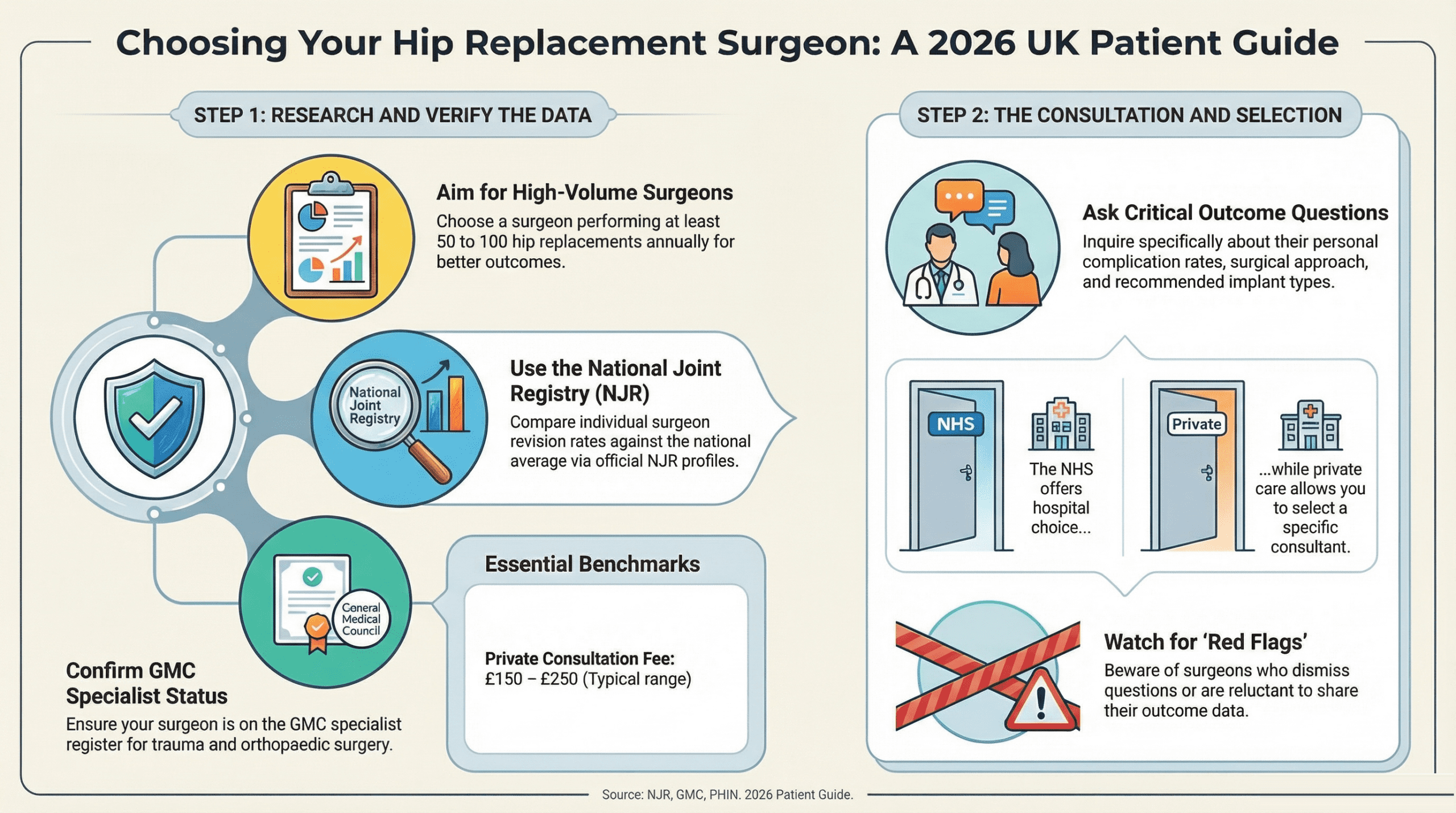
A widely cited study found that surgeons performing 35 or fewer hip replacements per year had higher rates of dislocation and revision surgery. Most orthopaedic specialists recommend choosing a surgeon who carries out at least 50 to 100 hip replacements annually. High-volume surgeons often perform 150 or more.
Beyond numbers, the surgeon’s technique, their choice of implant, and how they position the components during surgery all influence how well your new hip functions. Getting this right is critical.
Our guide to hip replacement implant types compared covers the full details of ceramic, metal, and ceramic-on-metal options, costs, and which materials last longest.
For more detail, read our guide on why choose private hip replacement – it covers the full cost comparison between NHS and private hip replacement, including waiting times, pricing, and what you get for your money.
For more information about hip replacement surgery, visit the NHS hip replacement guide.
Watch: How to Choose Your Hip Replacement Surgeon
This cinematic overview walks you through how to research surgeon credentials, check outcome data on the National Joint Registry, compare NHS and private options, and prepare the right questions for your consultation.
How to Check a Hip Replacement Surgeon’s Credentials
There are several free, public tools you can use to research any surgeon in the UK. Here is where to look and what to check.
The GMC register
Every practising doctor in the UK must be registered with the General Medical Council. You can search the GMC register. Confirm that your surgeon holds a current licence to practise and has no restrictions. Check they are on the specialist register for trauma and orthopaedic surgery.
This is a basic but essential check. It confirms that the person operating on you is fully qualified and in good standing.
The National Joint Registry surgeon profiles
The National Joint Registry (NJR) collects data on every hip replacement carried out in England, Wales, Northern Ireland, and the Isle of Man. Since 2002, it has recorded more than two million joint replacement procedures.
You can view individual surgeon profiles at National Joint Registry surgeon profiles. Each profile shows how many hip replacements the surgeon has performed and the types of implant they use. It also shows how their revision rates compare with the national average. This is the single most useful tool for comparing surgeons.
Look for a surgeon whose outcomes are in line with or better than the national average. If a surgeon’s profile shows them as an outlier with higher-than-expected revision rates, that is a warning sign.
The PHIN website
The Private Healthcare Information Network (PHIN) publishes performance data for private hospitals and consultants. At PHIN.org.uk, you can search by procedure and location to compare patient feedback scores, average lengths of stay, and complication rates.
PHIN data is particularly useful if you are choosing a private hip replacement surgeon, as it covers the independent hospital sector in detail.
Professional memberships
Look for membership of the British Orthopaedic Association (BOA) and the British Hip Society (BHS). These are not guarantees of quality, but they indicate that the surgeon is actively engaged in their specialty and keeps up with current practice.
How to Choose a Hip Replacement Surgeon – credentials, questions, and what to look for in 2026
How to Choose a Hip Replacement Surgeon on the NHS
Many NHS patients do not realise they have any choice at all. In fact, you do have some options, although they are more limited than on the private pathway.
Your right to choose
Under NHS patient choice, you can choose which hospital to be referred to for your hip replacement. Your GP should discuss this with you. Different NHS trusts have different waiting times, so choosing a hospital with a shorter queue can get you into surgery faster.
However, the NHS cannot guarantee that a specific named surgeon will carry out your operation. You may be allocated to whichever consultant has the next available slot. In some trusts, your surgery may be performed by a registrar under consultant supervision.
What you can do
Ask your GP to refer you to a specific hospital trust where a surgeon you have researched works. While you cannot demand a named surgeon, being within their team increases the likelihood of them performing or closely supervising your procedure.
You can also ask your consultant at your pre-operative appointment who will be performing the surgery. If you have concerns, raise them at this stage.
NHS e-Referral Service
When your GP refers you, they use the NHS e-Referral Service. This shows you the available hospitals and their approximate waiting times. Take the time to research surgeons at each option before making your choice. Do not simply accept the first option offered.
For the full cost and waiting time comparison, read our guide to hip replacement surgery: NHS versus private costs, which covers NHS waiting lists, private pricing, and when private makes sense financially.

For the complete picture, read our comprehensive guide to hip replacement surgery: NHS or private, which covers the complete picture of NHS vs private hip replacement costs, waiting times, and options across the UK.
How to Choose a Hip Replacement Surgeon Privately
Going private gives you significantly more control. You choose your consultant by name, and that person manages your care from first appointment to final follow-up. Here is how to make that choice well.
Start with the NJR and PHIN
Use the National Joint Registry surgeon profiles and PHIN data as your starting point. Shortlist two or three surgeons with high volumes, good outcomes, and experience with the type of implant you are considering.
Book an initial consultation
Most private surgeons offer an initial consultation for £150 to £250. Use this appointment to assess the surgeon as much as they assess you. Pay attention to how clearly they explain your options. Do they listen to your concerns? Do they recommend a plan that feels right for your situation?
You are not committed after a first consultation. It is perfectly acceptable to see two surgeons before deciding.
Check their hospital affiliations
Private surgeons typically work at one or more independent hospitals. Check the CQC rating of each hospital they operate at. A surgeon with excellent personal outcomes working in a hospital rated Requires Improvement is a concern.
Also check whether the hospital has the right facilities for your needs. If you have a complex medical history, confirm that the hospital has access to intensive care and specialist backup.
Ask for patient references
Some private surgeons can put you in touch with previous patients who are willing to share their experience. Online reviews on platforms such as Doctify, Top Doctors, or Google can also provide useful insight – though take individual reviews with caution.
Learn more in our guide to why choose private hip replacement, which covers the full cost comparison, waiting times, and what you get for your money.
Our guide to physiotherapy after hip replacement covers the full recovery timeline, exercises at each stage, and NHS vs private physio options.
What Questions Should You Ask a Hip Replacement Surgeon?
Whether NHS or private, asking the right questions at your consultation helps you choose a hip replacement surgeon with confidence. Here is a checklist.
How many hip replacements do you perform each year? Look for at least 50 to 100. Higher is generally better.
What are your personal revision rates? A good surgeon will know their own data and be willing to share it.
Which implant do you recommend for me, and why? The answer should be tailored to your age, activity level, and bone quality – not a one-size-fits-all response.
Will you personally perform the surgery? On the NHS, this is an important question. Privately, the answer should always be yes.
What approach do you use – posterior, lateral, or anterior? Each surgical approach has pros and cons. Your surgeon should explain their preference and why it suits your case.
What is your complication rate for dislocation and infection? The national average for dislocation is around 1 to 3 per cent. Infection rates should be below 1 per cent.
How many patients do you see for revision surgery? A low revision rate suggests good primary outcomes.
What does the recovery look like, and how much physiotherapy will I need? The answer should be specific, not vague.
Red Flags to Watch For When Choosing a Hip Replacement Surgeon
Not every surgeon is the right fit. Be cautious if you notice any of the following.
They are reluctant to share their outcomes data. A confident surgeon will be open about their results.
They recommend surgery without exploring alternatives first. A good surgeon considers whether you have tried physiotherapy, weight management, or steroid injections before proceeding to surgery.
They dismiss your questions or seem rushed. You deserve a consultation where your concerns are heard and answered.
Their NJR profile shows higher-than-expected revision rates. This does not necessarily mean they are a poor surgeon – they may take on more complex cases – but it warrants further discussion.
They are not on the specialist register for trauma and orthopaedic surgery. This is a basic requirement. Do not proceed without checking.
For more detail, read our guide on mobility aids after hip replacement – it lists everything you are likely to need, what the NHS provides free, and what you may need to buy yourself.
Frequently Asked Questions
How many hip replacements should a surgeon perform each year?
Research and National Joint Registry data suggest that surgeons performing at least 50 hip replacements per year tend to have better outcomes and lower revision rates. High-volume surgeons may perform 100 to 200 or more annually. You can check a surgeon’s procedure volume on the National Joint Registry website or ask directly during your consultation.
Can I choose my surgeon on the NHS?
On the NHS, you have the right to choose which hospital you are referred to, but you cannot usually choose a specific named surgeon. You will be allocated to a consultant based on the hospital’s scheduling. If choosing your surgeon by name is important to you, private treatment allows you to research individual consultants and book directly with the one you prefer.
What is the difference between an orthopaedic surgeon and a hip specialist?
All hip replacement surgeons are orthopaedic surgeons, but not all orthopaedic surgeons specialise in hips. A hip specialist focuses specifically on hip conditions and performs hip replacements as a major part of their practice. Subspecialisation generally means more experience with complex cases, newer techniques, and better familiarity with the latest implants. Check whether your surgeon lists hip arthroplasty as a declared subspecialty interest.
Where can I check a hip replacement surgeon’s results?
The National Joint Registry publishes individual surgeon data including procedure volumes and revision rates. The Private Healthcare Information Network (PHIN) provides outcome data for private consultants and hospitals. You can also verify a surgeon’s registration, specialist status, and any fitness-to-practise history on the GMC register.
Should I get a second opinion before hip replacement?
Getting a second opinion is always reasonable, and a good surgeon will not be offended if you seek one. A second opinion is particularly worthwhile if you have been told you need surgery but are unsure, if you have complex health conditions, or if you want to compare surgical approaches. On the NHS you can ask your GP for a referral to another consultant. Privately, you can book a consultation with any surgeon you choose.
Key Takeaways
- Surgeon experience matters. Choose a hip replacement surgeon who performs at least 50 to 100 procedures per year. High-volume surgeons achieve better outcomes.
- Use the National Joint Registry surgeon profiles (surgeonprofile.njrcentre.org.uk) to compare revision rates and implant choices. This is the most valuable free research tool.
- Check the GMC register to confirm your surgeon is fully qualified and on the specialist register for orthopaedics.
- On the NHS, you can choose your hospital but not your specific surgeon. Privately, you choose your consultant by name.
- Book an initial consultation with one or two private surgeons before committing. You are not obliged to proceed after a first appointment.
- Ask direct questions about volumes, revision rates, implant choice, and surgical approach. A good surgeon welcomes informed patients.
Ready to compare private hospitals and prices? Use our hip replacement hospital directory to compare 176 providers across the UK.
This article is for information only. Always consult your GP or a qualified healthcare professional before making health decisions.