

Physiotherapy After Hip Replacement: What to Expect in 2026
Physiotherapy after hip replacement is one of the most important parts of your recovery. The right exercises, at the right time, help you regain strength, mobility, and confidence. Yet many patients are surprised by how much the physiotherapy experience varies depending on whether you go NHS or private.
This guide explains what physiotherapy after hip replacement looks like in 2026. We cover how many sessions you may need, what it costs privately, and what exercises to do at each stage of recovery.
Why Is Physiotherapy After Hip Replacement So Important?
Your new hip joint gives you the hardware. Physiotherapy gives you the ability to use it properly. Without structured rehabilitation, you risk stiffness, muscle weakness, and a slower return to daily activities.
Research consistently shows that patients who follow a physiotherapy programme after hip replacement recover faster. They report less pain, better mobility, and greater confidence at the six-week and three-month milestones.
Early mobilisation is especially important. Getting up and moving within hours of surgery reduces the risk of blood clots, chest infections, and muscle wasting. Your physiotherapy starts in the hospital, on the same day as your operation.
For more detail, read our guide on choose a hip replacement surgeon – it explains what credentials to check, which questions to ask at your consultation, and how to research a surgeon’s track record.
Watch: Physiotherapy After Hip Replacement – Your Complete Recovery Roadmap
Get a cinematic overview of what to expect from physiotherapy after hip replacement in 2026 – from your first steps in hospital to the exercises and milestones that will get you back to full mobility.
For more information about physiotherapy on the NHS, visit the NHS physiotherapy.
What Physiotherapy Do You Get on the NHS?
NHS physiotherapy after hip replacement typically begins on the ward. A physiotherapist will visit you on the day of surgery or the following morning. They will help you stand, take your first steps with a walking frame, and begin a set of basic exercises.
In hospital
Most NHS hospitals aim to see you once or twice a day during your stay. You will practise getting in and out of bed, walking short distances, and climbing a few stairs if needed for discharge. The hospital stay is usually one to two nights.
Before you leave, your physiotherapist will give you an exercise sheet. This is your home programme for the first six weeks. The exercises focus on ankle pumps, knee bends, hip abduction, and gentle walking.
After discharge
This is where NHS provision varies significantly. Some hospital trusts offer outpatient physiotherapy classes or one-to-one sessions after discharge. Others provide only a leaflet and a helpline number.
A number of NHS trusts run circuit-based rehabilitation classes at six to eight weeks post-surgery. These group sessions focus on strength, balance, and range of movement. However, not all trusts offer them.
If your consultant feels you need additional support at your follow-up appointment, they can refer you for outpatient physiotherapy. But this is not automatic, and waiting times for NHS physiotherapy can be several weeks.
The reality is that many NHS patients manage their physiotherapy after hip replacement largely on their own, following the exercise sheet provided at discharge.
Understanding the broader costs helps you plan ahead. Our guide to hip replacement surgery: NHS vs private costs compared covers waiting times, pricing, and your options across the UK.
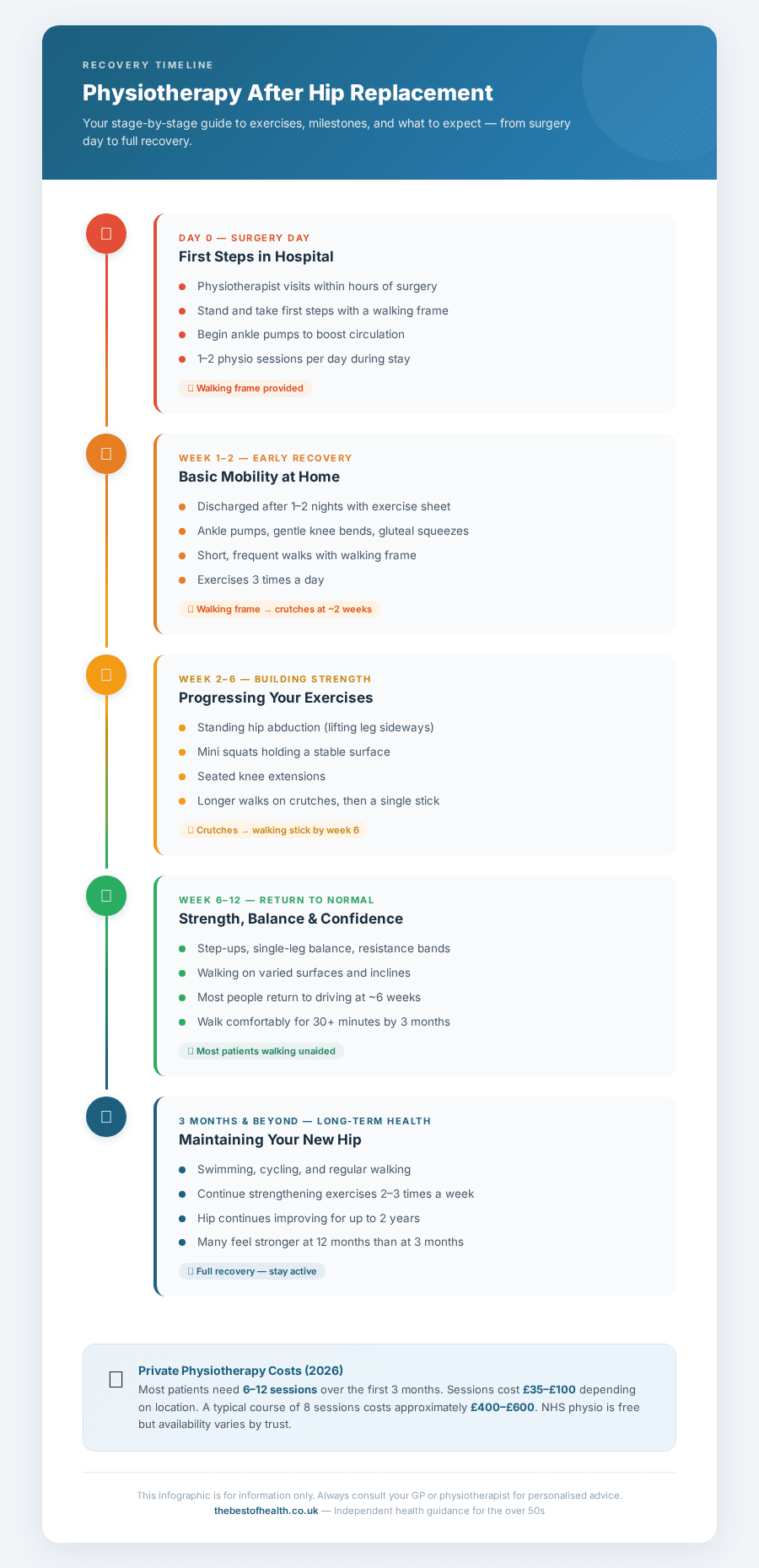
What Exercises Should You Do After Hip Replacement?
Your physiotherapist will give you a tailored programme, but most hip replacement recovery plans follow a similar structure. Here is a general guide to what to expect at each stage.
Week 1 to 2 (early recovery)
The focus is on basic mobility and preventing complications. Exercises include ankle pumps to improve circulation, gentle knee bends while lying down, static gluteal squeezes, and short walks with a walking frame.
You should aim to do your exercises three times a day. Keep walks short but frequent. Use your walking frame at all times.
Week 2 to 6 (building strength)
As your hip heals, exercises become more demanding. You will progress to standing hip abduction (lifting your leg sideways), mini squats holding a stable surface, and seated knee extensions. Walking distances increase, now with crutches.
Most people transition from a walking frame to crutches at around two weeks. By six weeks, many patients use a single stick or no aid at all.
Week 6 to 12 (return to normal)
The goal now is to restore full strength and confidence. Exercises include step-ups, single-leg balance work, resistance band exercises for the hip muscles, and walking on varied surfaces.
Most people return to driving at around six weeks. By three months, you should be able to walk comfortably for 30 minutes or more without pain.
Beyond 12 weeks
Physiotherapy after hip replacement does not stop at three months. Continuing regular exercise supports the long-term health of your joint. Swimming, cycling, and walking are all excellent for maintaining strength and flexibility without putting excessive stress on your new hip.
Your hip can continue to improve for up to two years after surgery. Many patients find that they feel stronger at 12 months than they did at three months.
The right equipment makes a real difference during recovery. Our guide to mobility aids after hip replacement explains what the NHS provides free, what you may need to buy, and how much each item costs in 2026.
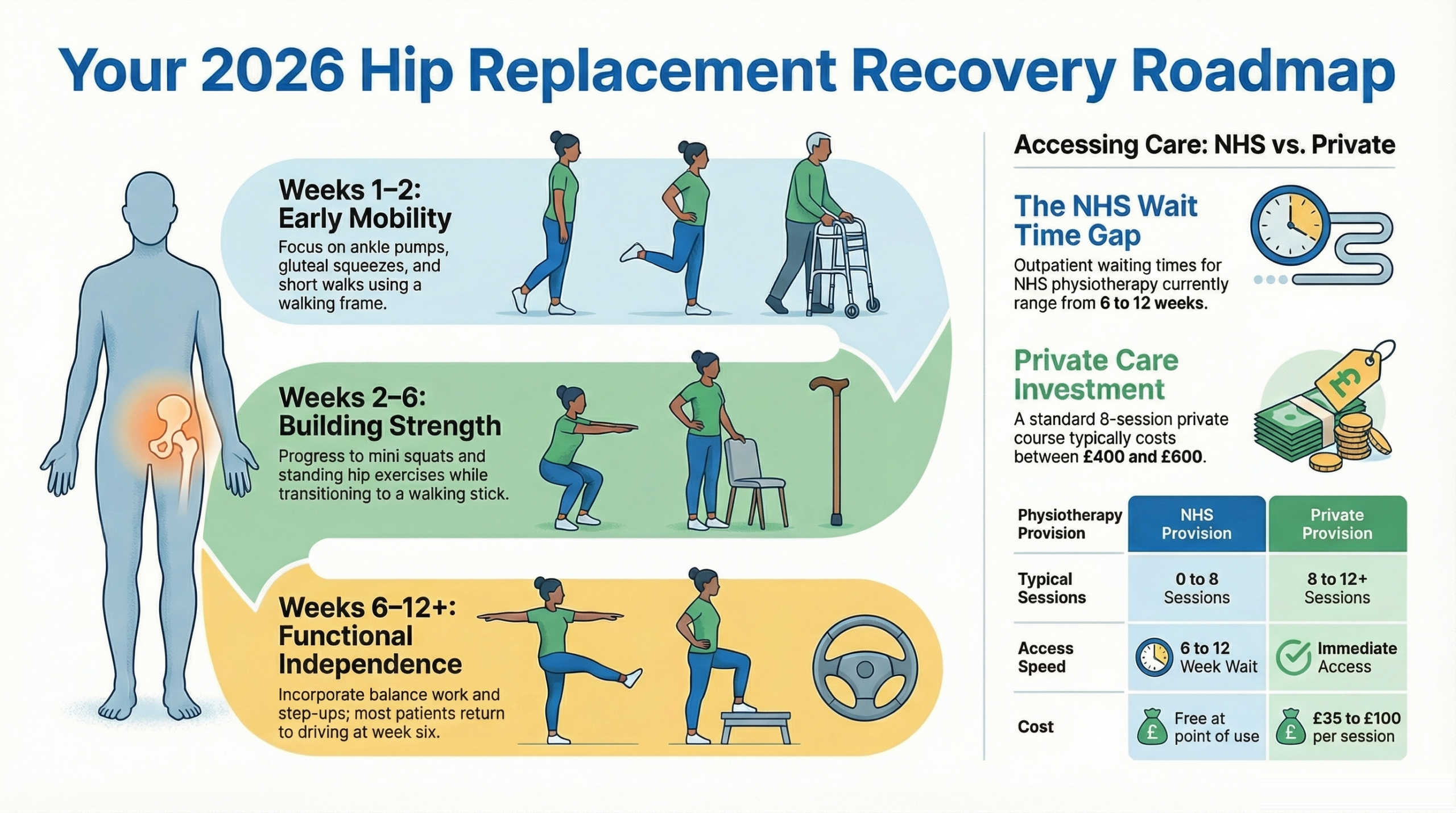
Your 2026 hip replacement recovery roadmap – NHS vs private physiotherapy at a glance
To find a chartered physiotherapist, visit the Chartered Society of Physiotherapy. For the complete picture, read our comprehensive guide to hip replacement surgery: NHS or private, which covers the complete picture of NHS vs private hip replacement costs, waiting times, and options across the UK.
What Physiotherapy Is Included in Private Hip Replacement?
Private hip replacement packages usually include some physiotherapy, but the amount varies by provider. It is essential to check exactly what is covered before you commit to a package.
What most private packages include
Most fixed-price private hip replacement packages include physiotherapy during your hospital stay. This is typically one or two sessions per day for two to four nights. You will also receive a structured home exercise programme.
Many packages include one follow-up physiotherapy appointment at two weeks post-surgery. Some providers include a second follow-up at six weeks.
What is usually not included
Additional outpatient physiotherapy sessions beyond the initial follow-ups are not always covered. If you need ongoing rehabilitation, you may need to arrange and pay for private physiotherapy separately. To find a chartered physiotherapist, visit the Chartered Society of Physiotherapy.
Pre-operative physiotherapy (sometimes called prehab) is also rarely included. However, evidence suggests that patients who strengthen their hip muscles before surgery recover more quickly afterwards.
Questions to ask your provider
Before booking private hip replacement, ask these specific questions about physiotherapy.
How many physiotherapy sessions are included in the package price? Get the number in writing.
Does the package include outpatient follow-up physiotherapy, or only in-hospital sessions? There is a big difference.
Is pre-operative physiotherapy (prehab) available, and what does it cost? Some providers offer this as an add-on.
If I need extra physiotherapy after my package sessions, can I book it at the same hospital? And what is the per-session cost?
Weighing up whether private physio is worth the cost? Our guide to why you might choose private hip replacement covers the full cost comparison, what you get for your money, and how to decide.

How Much Does Private Physiotherapy Cost After Hip Replacement?
You may need physiotherapy after hip replacement beyond what your package covers. To find a chartered physiotherapist, visit the Chartered Society of Physiotherapy. Or perhaps you had NHS surgery and want private rehab. Here is what to budget.
Cost per session
| Location | Typical Cost Per Session |
|---|---|
| London | £60 – £100 |
| Other major cities | £45 – £75 |
| Smaller towns and rural areas | £35 – £60 |
Sessions typically last 30 to 60 minutes. The first appointment is often longer and may cost more, as it includes a full assessment of your hip, strength, and range of movement.
How many sessions will you need?
Most patients benefit from six to twelve physiotherapy sessions over the first three months after hip replacement. The exact number depends on your starting fitness, the complexity of your surgery, and how well you progress with home exercises.
A typical pattern is weekly sessions for the first four to six weeks, moving to fortnightly sessions as you become more independent. Some patients need fewer; others benefit from more.
At £50 to £75 per session, a course of eight sessions would cost approximately £400 to £600. This is a worthwhile investment in your recovery and long-term mobility.
Can you claim physiotherapy on insurance?
If you have private medical insurance (PMI), your policy may cover post-operative physiotherapy. Check your policy for any session limits, excess payments, and whether your physiotherapist needs to be on your insurer’s approved list.
Some insurers cover a fixed number of sessions (often six to ten) as part of the surgical authorisation. Others require a separate referral.
Find out more in our guide to mobility aids after hip replacement, which lists everything you are likely to need, what the NHS provides free, and what you may need to buy yourself.
NHS vs Private Physiotherapy After Hip Replacement: A Comparison
| Feature | NHS | Private |
|---|---|---|
| In-hospital physiotherapy | Yes – 1-2 sessions per day | Yes – 1-2 sessions per day |
| Home exercise programme | Yes – exercise sheet at discharge | Yes – structured programme |
| Outpatient follow-up sessions | Varies by trust – not guaranteed | Usually 1-2 included in package |
| Additional outpatient sessions | Referral needed; may wait weeks | Book directly; seen within days |
| Pre-operative physiotherapy | Rarely offered | Available as add-on at some providers |
| Group rehabilitation classes | Some trusts at 6-8 weeks | Not common; usually one-to-one |
| Cost | Free | £35-£100 per session (beyond package) |
The key difference is consistency and access. To find a chartered physiotherapist, visit the Chartered Society of Physiotherapy. Private patients generally have a clearer pathway with guaranteed follow-up appointments. NHS patients may need to be more proactive about arranging their own rehabilitation.
Your surgeon plays a key role in your recovery pathway. Our guide to choosing your hip replacement surgeon explains how to check credentials, compare outcome data, and ask the right questions at your consultation.
How to Find a Physiotherapist for Hip Replacement Recovery
Finding the right physiotherapist matters for your recovery. Whether you want to supplement NHS care or arrange private physiotherapy after hip replacement, here is how to find a good one. To find a chartered physiotherapist, visit the Chartered Society of Physiotherapy.
Check the HCPC register. All physiotherapists in the UK must be registered with the Health and Care Professions Council. You can search the register at hcpc-uk.org.
Look for musculoskeletal or orthopaedic specialists. Not all physiotherapists specialise in post-surgical rehabilitation. Look for someone with experience in hip replacement recovery.
Ask your surgeon for a recommendation. Most orthopaedic surgeons have physiotherapists they work with regularly and trust.
Check the Chartered Society of Physiotherapy directory. The CSP maintains a directory of qualified physiotherapists at csp.org.uk.
Consider location and accessibility. In the early weeks after surgery, you may not be able to drive. Choose a physiotherapist who is easy to reach by car (with someone else driving) or who offers home visits.
Our guide to find a physiotherapist for hip replacement explains how to find a qualified physio near you, what credentials to check, and how much private sessions cost in 2026.
Frequently Asked Questions
How soon after hip replacement should I start physiotherapy?
Physiotherapy begins on the day of surgery or the morning after. A physiotherapist will help you stand, take your first steps, and begin gentle exercises while you are still in hospital. Early movement is essential for preventing blood clots, reducing stiffness, and starting your recovery. Most patients begin structured outpatient physiotherapy within one to two weeks of going home.
What are hip precautions and how long do they last?
Hip precautions are movement restrictions designed to prevent your new hip from dislocating while the surrounding tissues heal. Common precautions include not crossing your legs, not bending your hip beyond 90 degrees, and not twisting your leg inwards. Most surgeons advise following these precautions for six to twelve weeks, though some modern surgical approaches allow relaxed precautions from an earlier stage.
Can I do physiotherapy at home after hip replacement?
Yes, home-based physiotherapy is both common and effective. Your hospital physiotherapist will give you a written exercise programme to follow at home. Many NHS trusts also offer telephone or video follow-up. If you prefer face-to-face guidance, private physiotherapists can visit you at home – though home visits typically cost more than clinic sessions, usually around £60 to £100 per visit.
How long does it take to walk normally after hip replacement?
Most people can walk short distances with a frame or crutches on the day of surgery. By two to three weeks, you should be able to walk with a single stick. Many patients walk without any aid by four to six weeks. Walking with a fully normal gait – without a limp – usually takes three to six months and depends on your muscle strength, pre-surgery fitness, and commitment to physiotherapy exercises.
Is physiotherapy painful after hip replacement?
Some discomfort during physiotherapy is normal, particularly in the first two to three weeks when you are working to regain your range of movement. Your physiotherapist should push you to progress but never cause sharp or severe pain. Taking prescribed painkillers 30 to 60 minutes before a session, using ice packs afterwards, and doing gentle warm-up exercises can all help manage discomfort.
For comprehensive NHS guidance on hip replacement, see the NHS hip replacement page.
Key Takeaways
- Physiotherapy after hip replacement is essential for a full recovery. It starts in hospital and continues for at least three months.
- NHS provision varies widely. Some trusts offer structured outpatient rehabilitation; others provide only a discharge exercise sheet.
- Private packages typically include in-hospital physio and one or two follow-up sessions. Extra sessions cost £35 to £100 each depending on location.
- Most patients need six to twelve sessions over the first three months. A typical course costs £400 to £600 privately.
- Exercises progress from basic mobility in week one to strength and balance work by week six to twelve.
- Continuing regular exercise beyond three months supports the long-term health of your hip joint.
Want to compare private hospitals and what their packages include? Use our hip replacement hospital directory to compare 176 private providers across the UK.
This article is for information only. Always consult your GP or a qualified healthcare professional before making health decisions.