
Mobility Aids After Hip Replacement: What You’ll Need in 2026
Getting the right mobility aids after hip replacement makes a real difference to your comfort, safety, and confidence at home. Yet many patients only think about equipment a few days before surgery. Some only realise what they need after they get home and find they cannot manage.
This guide covers every mobility aid you are likely to need after hip replacement. We explain when to use each one, what the NHS provides for free, and what you may need to buy. A full checklist with current UK prices is included so you can prepare in advance.
Why Do You Need Mobility Aids After Hip Replacement?
After hip replacement surgery, your new joint needs time to heal. For the first six weeks, you must protect it from excessive bending, twisting, and weight-bearing beyond what your surgeon advises. Mobility aids help you move safely during this period.
The right equipment reduces your risk of falls. Falls in the first weeks after hip replacement can cause serious injury, including dislocation of the new joint. Mobility aids also help you maintain your independence at home without relying on others for every task.
Your occupational therapist (OT) will assess your home situation before discharge. They will recommend specific aids based on your mobility, your home layout, and whether you live alone or with someone who can help.
Find out more in our guide to why choose private hip replacement, which covers the full cost comparison between NHS and private hip replacement, including waiting times, pricing, and what you get for your money.
For full details on recovery guidance, see the NHS hip replacement recovery information.
Watch: Mobility Aids After Hip Replacement – Your Complete Guide
Watch our cinematic overview of the essential mobility aids and equipment you will need for hip replacement recovery, including what the NHS provides free and what you may need to buy privately.
What Walking Aids Will You Need?
Walking aids are the most important mobility aids after hip replacement. You will use them every day for at least six weeks, and most people continue using a stick for several weeks beyond that.
Walking frame (Zimmer frame)
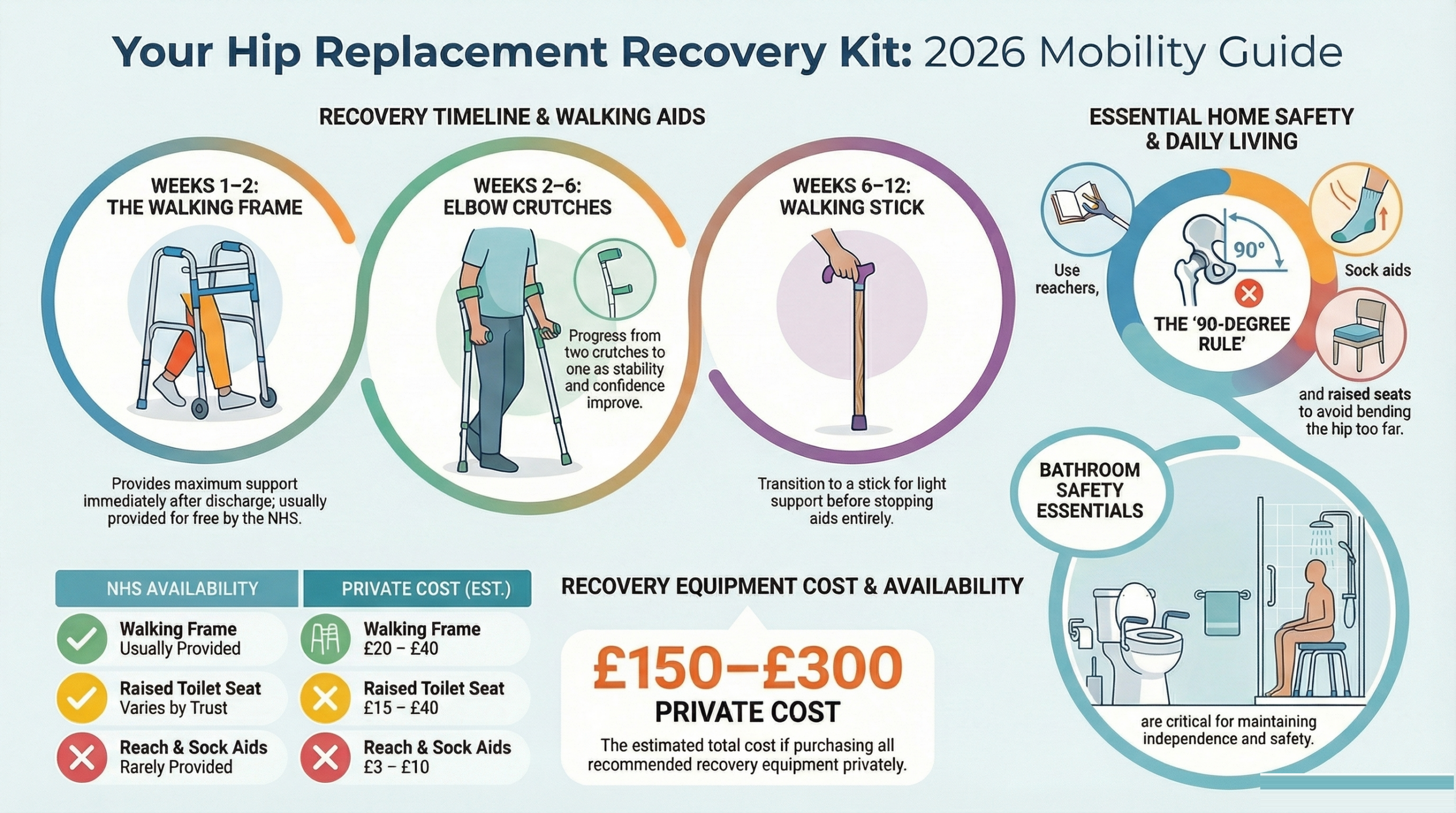
Most patients start with a walking frame immediately after surgery. The frame provides maximum support and stability while your muscles are at their weakest. You will use it to walk short distances in hospital and at home during the first one to two weeks.
Walking frames are lightweight and adjustable. The NHS normally provides one before you leave hospital at no cost. If you need to buy one privately, expect to pay £20 to £40.
Elbow crutches
Most patients progress from a frame to a pair of elbow crutches at around one to two weeks. Crutches allow you to walk further and faster while still taking weight off the operated leg.
You will use two crutches for approximately four to six weeks. After that, you may drop down to a single crutch on the opposite side to your new hip. The crutch moves forward at the same time as your operated leg.
The NHS usually provides crutches at discharge. Private purchase costs £15 to £30 per pair.
Walking stick
By six to eight weeks, many patients transition to a walking stick. A stick provides light support and confidence while you rebuild strength and balance. Some people use a stick for several months; others feel confident enough to stop sooner.
A standard adjustable walking stick costs £5 to £15. Folding sticks for portability cost around £10 to £20.
Your walking stick is just one part of recovery. Our guide to physiotherapy after hip replacement covers the full recovery timeline, exercises at each stage, and NHS vs private physio options.
Mobility Aids After Hip Replacement – your complete 2026 guide to walking aids, bathroom equipment, and recovery essentials
You may also find our guide to battling the bulge: the best exercises to help reduce your waist size helpful.
What Bathroom and Toilet Aids Do You Need?
The bathroom is where most difficulties arise after hip replacement. Standard toilets, baths, and showers are designed for people with full hip mobility. After surgery, your hip must not bend beyond 90 degrees for the first six to twelve weeks.
Raised toilet seat
A raised toilet seat is essential. It adds four to six inches to the height of your existing toilet, keeping your hip above knee level. This prevents excessive bending and reduces the risk of dislocation.
Raised toilet seats come with or without handles. The version with handles provides extra stability when sitting down and standing up. Cost: £15 to £40.
Some NHS trusts provide raised toilet seats on loan after hip replacement. Others expect you to buy your own. Ask your OT before discharge.
Shower stool or bath board
If you have a walk-in shower, a shower stool allows you to sit while washing. This is safer than standing on a wet surface with reduced balance. Three-legged corner stools fit neatly into shower cubicles.
If you have a bath rather than a separate shower, a bath board sits across the top of the bath. You sit on the board and wash using a shower attachment. This avoids the dangerous task of climbing in and out of the bath.
Shower stools cost £20 to £40. Bath boards cost £15 to £30.
Grab rails
Grab rails fitted beside the toilet, shower, or bath provide secure handholds. They make standing up, sitting down, and stepping in and out of the shower much safer.
Screw-in grab rails are the most secure option. They cost £10 to £25 each and require fitting to the wall. Suction-cup rails are easier to install but are less reliable – they can slip if the surface is wet.
The NHS may fit grab rails through a community occupational therapy referral. Waiting times vary by area. If you need them quickly, a local handyman can fit screw-in rails for around £30 to £60 per rail including fitting.
What Other Equipment Helps After Hip Replacement?
Beyond walking aids and bathroom equipment, several smaller items make daily life easier during recovery.
Long-handled reacher or grabber
A reacher allows you to pick up objects from the floor without bending your hip past 90 degrees. It is also useful for pulling on socks, reaching items on high or low shelves, and picking up the post. Cost: £5 to £10.
Long-handled shoe horn
Putting on shoes requires bending, which you must avoid. A long-handled shoe horn (around 50 cm) lets you slip into shoes without bending your hip. Cost: £3 to £8.
Sock aid
A sock aid is a simple plastic or fabric device that helps you pull on socks without bending. It can feel awkward at first, but most patients get the hang of it within a day or two. Cost: £3 to £7.
Perching stool
A perching stool has a forward-sloping seat that lets you sit at a kitchen worktop, bathroom basin, or ironing board without bending your hip beyond 90 degrees. It is height-adjustable and lightweight. Cost: £30 to £60.
Bed raiser or leg lifter
If your bed is low, raising it by a few inches makes getting in and out easier. Bed raisers fit under each leg of the bed and cost £10 to £20 for a set of four. A leg lifter – a strap that helps you swing your operated leg into bed – costs £5 to £10.

For the complete picture, read our comprehensive guide to hip replacement surgery: NHS or private, which covers the complete picture of NHS vs private hip replacement costs, waiting times, and options across the UK.
Full Checklist: Mobility Aids After Hip Replacement
Here is everything you are likely to need, with approximate UK costs for 2026.
| Item | NHS Provided? | Approximate Cost to Buy |
|---|---|---|
| Walking frame | Usually yes | £20 – £40 |
| Elbow crutches (pair) | Usually yes | £15 – £30 |
| Walking stick | Sometimes | £5 – £15 |
| Raised toilet seat | Varies by trust | £15 – £40 |
| Shower stool | Sometimes | £20 – £40 |
| Bath board | Sometimes | £15 – £30 |
| Grab rails (per rail) | Via OT referral | £10 – £25 (plus fitting) |
| Long-handled reacher | Sometimes | £5 – £10 |
| Long-handled shoe horn | Rarely | £3 – £8 |
| Sock aid | Rarely | £3 – £7 |
| Perching stool | Via OT referral | £30 – £60 |
| Bed raisers (set of 4) | Rarely | £10 – £20 |
| Leg lifter | Sometimes | £5 – £10 |
If you buy everything on this list privately, the total cost is approximately £150 to £300. Many patients already own some items or can borrow them from family.
What Does the NHS Provide for Free?
NHS provision of mobility aids after hip replacement varies by hospital trust and area. Here is a general guide to what you can expect.
Usually provided: Walking frame and elbow crutches. These are given to you before discharge from hospital.
Sometimes provided: Raised toilet seat, shower stool, bath board, long-handled reacher, leg lifter. These depend on your OT assessment and local availability. Some trusts loan equipment for six to twelve weeks; others have limited stock.
Rarely provided: Walking stick, sock aid, shoe horn, perching stool, bed raisers. You will usually need to buy these yourself.
Available via referral: Grab rails and home adaptations can be arranged through a community OT referral. Your hospital OT may initiate this before discharge, but fitting can take several weeks.
If you are having private hip replacement, your hospital OT will give you the same advice. However, private hospitals do not typically loan equipment. You will need to buy or arrange your own aids before surgery.
Our guide explains why you might choose private hip replacement, covering the full cost comparison, waiting times, and what you get for your money.
For more detail, read our guide on physiotherapy after hip replacement – it covers the full recovery timeline, exercises at each stage, and NHS vs private physio options.
Where to Buy Mobility Aids in the UK
You do not need to spend a fortune on mobility aids after hip replacement. Here are the main options.
Online retailers. Amazon, Argos, and specialist sites such as Mobility 2 You (mobility2you.com) and Direct Mobility (directmobility.co.uk) stock a full range. Delivery is usually within one to three days.
Local mobility shops. Most towns have at least one mobility equipment shop. The advantage is that you can try before you buy. Staff can help you choose the right height and style.
Pharmacies. Boots and Lloyds Pharmacy stock basic items such as walking sticks, reachers, and raised toilet seats.
Charity shops and loan schemes. Some local charities and community organisations loan or sell second-hand mobility equipment. The British Red Cross runs a mobility aids service in many areas, lending items such as wheelchairs and walking frames at no cost.
For a full breakdown of what you can expect to pay, read our guide to hip replacement surgery: NHS vs private costs, which compares NHS waiting times, private pricing, and your options across the UK.
How Long Will You Need Mobility Aids After Hip Replacement?
Recovery timelines vary, but here is a typical progression for when you can step down your mobility aids after hip replacement.
Week 1 to 2: Walking frame at home. Crutches for longer distances if confident.
Week 2 to 6: Two crutches for most activities. You may drop to one crutch towards the end of this period.
Week 6 to 12: One crutch or a walking stick. Most people stop using crutches by eight weeks.
Beyond 12 weeks: Many patients stop using aids entirely. Some prefer to keep a walking stick handy for longer walks or uneven ground.
Your physiotherapist will guide you on when to progress. Do not rush – moving to the next stage too quickly can increase your risk of falls.
Choosing the right consultant matters for your outcome. Our guide to choosing your hip replacement surgeon explains how to check credentials, compare outcome data, and prepare the right questions for your consultation.
Find out more in our guide to find a physiotherapist for hip replacement, which explains how to find a qualified physio near you, what credentials to check, and how much private sessions cost in 2026.
Frequently Asked Questions
What mobility aids do I need immediately after hip replacement?
In the first two weeks, you will need crutches or a walking frame, a raised toilet seat, a shower stool or bath board, a long-handled shoe horn, a sock aid, and a grabber or reaching aid. These help you move safely while following your hip precautions. The hospital typically provides crutches before discharge, and your occupational therapist will advise on other essential items.
Does the NHS provide mobility aids after hip replacement?
The NHS provides basic equipment through your hospital’s occupational therapy department. This typically includes crutches and may include a raised toilet seat, perching stool, and basic dressing aids, depending on your local trust. Provision varies significantly across the country – some trusts offer a comprehensive home equipment package, while others provide only crutches. Always ask your OT team before surgery what will be supplied.
How much do hip replacement mobility aids cost to buy privately?
A basic set of essential mobility aids costs approximately £100 to £250 if you purchase everything yourself. Individual items range from around £8 to £15 for a grabber, sock aid, or long-handled shoe horn, up to £30 to £70 for a raised toilet seat or shower stool. You can also hire rather than buy – rental companies typically charge £20 to £40 per month for items like toilet seat risers and bath boards.
When can I stop using crutches after hip replacement?
Most people progress from two crutches to one crutch by around two weeks, and stop using a crutch altogether by four to six weeks. Your physiotherapist will guide this transition based on your strength, balance, and confidence. Do not rush – using crutches correctly protects your new hip joint and helps you develop a normal walking pattern rather than a compensatory limp.
Do I need to modify my home before hip replacement surgery?
Yes, preparing your home before surgery makes the first few weeks much easier and safer. Key changes include moving essentials to waist height to avoid bending, placing a chair with armrests near the shower, removing loose rugs and trip hazards, arranging a firm chair with a cushion to raise the seat height, and setting up a bedside table with your phone, water, and medications. Your hospital’s occupational therapist can do a pre-surgery home assessment.
Key Takeaways
- The right mobility aids after hip replacement protect your new joint, prevent falls, and help you stay independent at home.
- Essential items include a walking frame, crutches, raised toilet seat, shower stool or bath board, and a long-handled reacher.
- The NHS provides walking frames and crutches at discharge. Other equipment varies by trust – ask your OT before surgery.
- The full list of aids costs approximately £150 to £300 if you buy everything privately. Many items are available from pharmacies, online retailers, or charity loan schemes.
- Most patients use a walking frame for one to two weeks, crutches for four to six weeks, and a stick for a further two to six weeks.
- Prepare your home before surgery. Having everything in place before you come home makes the first few days much easier.
For more guidance on making your home safe and accessible, see Age UK’s advice on staying in your own home.
Planning your hip replacement? Use our hip replacement hospital directory to compare 176 private providers, prices, and CQC ratings across the UK.
This article is for information only. Always consult your GP or a qualified healthcare professional before making health decisions.