

Hip Replacement Implant Types Compared: Your 2026 UK Guide
If you are considering hip replacement surgery, one of the most important decisions is which type of implant to use. The choice affects how long your new hip lasts, how it feels, and whether it suits your age and activity level. This guide explains every hip replacement implant type available in the UK in 2026. We compare materials, fixation methods, and what the latest evidence says about each option.
Going private? You can choose your own implant. Staying with the NHS? This article helps you understand what is available. Either way, you get the facts in plain English.
What Are the Main Hip Replacement Implant Types?
A hip replacement has two main parts: a ball (which replaces the head of your thigh bone) and a socket (which lines your hip joint). The materials used for these two parts create what surgeons call the bearing surface.
There are four main bearing surface combinations used in the UK today.
Metal-on-polyethylene (metal on plastic)
This is the most widely used hip replacement implant type in the UK. It has been in use since the 1960s and has the longest track record. The ball is made from cobalt-chromium metal and the socket lining is made from high-density polyethylene (a medical-grade plastic).
Modern polyethylene is highly cross-linked, which makes it far more durable than the versions used decades ago. Most metal-on-polyethylene implants now last 20 years or more. This is the standard implant used by the NHS for most patients. Learn more about hip replacement options on the NHS hip replacement guidance.
Ceramic-on-polyethylene (ceramic on plastic)
This combination uses a ceramic ball with a polyethylene socket lining. Ceramic produces less friction than metal, which can reduce wear on the plastic liner over time.
Ceramic-on-polyethylene is often recommended for patients under 65 who are more physically active. Research from the University of Bristol and the National Joint Registry suggests this combination may be the most cost-effective option for younger patients.
Ceramic-on-ceramic
Both the ball and the socket lining are made from ceramic. This produces the lowest wear rate of all bearing combinations. Ceramic-on-ceramic implants are sometimes recommended for younger, more active patients who need their hip to last as long as possible.
However, ceramic-on-ceramic implants have a small risk of producing a squeaking sound during movement. In rare cases, the ceramic can fracture, although modern ceramics are much stronger than earlier versions. This combination is more commonly used in private hip replacement, where patients can discuss the option directly with their surgeon.
Metal-on-metal
Metal-on-metal hip replacements use a cobalt-chromium ball and socket. These were popular in the 2000s but are now rarely used. Research showed that metal-on-metal implants can release tiny metal particles into the bloodstream, causing tissue reactions in some patients.
The NHS advises annual follow-up checks for anyone with an existing metal-on-metal implant. NICE and the National Joint Registry no longer recommend this combination for standard hip replacement. If you have a metal-on-metal hip and experience pain or swelling, speak to your GP.
Hip Replacement Surgery: NHS vs Private Costs Compared
Our guide to why choose private hip replacement covers the full cost comparison between NHS and private hip replacement, including waiting times, pricing, and what you get for your money.
Watch: Hip Replacement Implant Types – Matching the Material to Your Lifestyle
This cinematic overview explains how ceramic, metal and polyethylene hip implants compare, which materials last longest, and how to choose the best option for your age and activity level.
Cemented vs Uncemented Hip Replacement: What Is the Difference?
Alongside the bearing surface, the other key decision is how the implant is fixed to your bone. There are three main fixation methods.
Cemented hip replacement
The implant is held in place using bone cement (polymethylmethacrylate). The cement fills the gap between the implant and the bone, creating an immediate, strong bond. You can put weight on the joint straight after surgery.
Cemented hip replacement is the most common method in the UK. Research published by the University of Oxford found that cemented implants provide modest but important quality-of-life improvements compared with uncemented ones. This is especially true for patients over 60.
NICE guideline NG157 recommends cemented fixation as the standard for primary hip replacement in most patients.
Uncemented hip replacement
The implant has a rough or porous surface that encourages your natural bone to grow into it over time. This creates a biological bond that can be very durable, but it takes several weeks for the bone to fully integrate.
Uncemented implants are sometimes preferred for younger, more active patients with strong bone quality. The theory is that a biological bond may last longer than cement in someone who will use the joint heavily for decades.
However, large-scale UK registry data has not shown uncemented implants to be more cost-effective or longer-lasting than cemented ones for patients over 60.
Hybrid fixation
A hybrid hip replacement uses cement for one component and press-fit (uncemented) for the other. The most common combination is a cemented stem with an uncemented socket. This approach aims to combine the strengths of both methods.
Hybrid fixation is used by some surgeons as a middle ground. It is less common than fully cemented or fully uncemented approaches in UK practice.
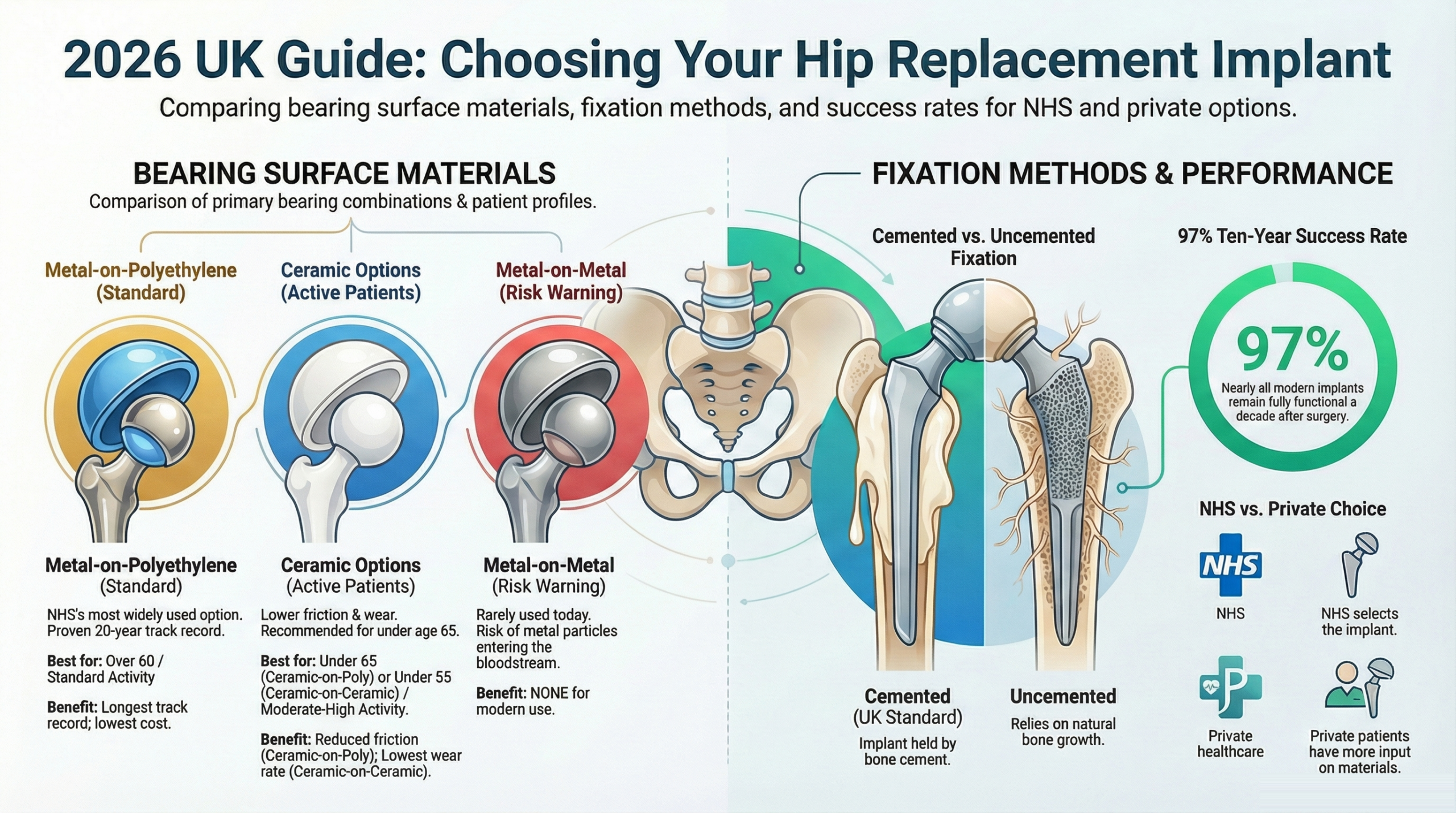
Your 2026 Guide to Hip Replacement Implant Types – comparing bearing surfaces, fixation methods, and what the evidence says

Which Hip Replacement Implant Type Lasts Longest?
This is the question most patients ask about hip replacement implant types. The honest answer is that all modern options perform well. The differences between them are smaller than many people expect.
The National Joint Registry tracks every hip replacement carried out in the UK. It reports that around 97 per cent are still functioning well after 10 years. At 15 years, the figure is approximately 90 per cent.
NICE guidance on joint replacement recommends that any prosthesis used in the NHS should have a 95 per cent chance of lasting at least 10 years.
What affects implant lifespan?
Several factors influence how long your hip replacement lasts. The implant type is one factor, but it is not the only one.
Your activity level matters. Higher-impact activities such as running or heavy lifting can increase wear. Your weight plays a role too – carrying extra weight puts more stress on the joint.
The skill of your surgeon is also important. Higher-volume surgeons who perform more than 100 hip replacements per year tend to achieve better outcomes. Correct positioning of the implant during surgery is crucial for long-term success.
Your bone quality affects fixation. Patients with osteoporosis may do better with cemented implants, which do not rely on bone ingrowth.
How to Choose Your Hip Replacement Surgeon
For the complete picture, read our comprehensive guide to hip replacement surgery: NHS or private, which covers the complete picture of NHS vs private hip replacement costs, waiting times, and options across the UK.
What Does the NHS Use vs What Can You Choose Privately?
On the NHS, your surgical team selects the implant based on clinical protocols and what is available at your hospital trust. For most patients over 60, this will be a cemented metal-on-polyethylene implant. This is in line with NICE guidance and the strongest body of evidence.
You may have limited input into the implant choice on the NHS. The decision is typically made by the surgeon based on your age, bone quality, and activity level.
When you choose private hip replacement, you have a conversation with your surgeon about implant options. You can discuss the pros and cons of each bearing surface and fixation method. If you want a ceramic bearing or an uncemented implant, your surgeon can explain whether it is appropriate for your situation.
Private patients also have access to newer implant designs more quickly. Some private hospitals offer dual-mobility implants, which have an extra layer of movement within the socket. These are designed to reduce the risk of dislocation and are becoming more popular for patients who are concerned about joint stability.
Why Choose Private Hip Replacement? Your Complete 2026 UK Guide
For more detail, read our guide on choose a hip replacement surgeon – it explains what credentials to check, which questions to ask at your consultation, and how to research a surgeon’s track record.
Hip Replacement Implant Types at a Glance
| Implant Type | Typical Patient | Fixation | Pros | Cons |
|---|---|---|---|---|
| Metal-on-polyethylene | Over 60, standard activity | Cemented | Longest track record, lowest cost, NICE recommended | Plastic liner wears over decades |
| Ceramic-on-polyethylene | Under 65, moderate activity | Cemented or uncemented | Less friction, good durability | Slightly higher implant cost |
| Ceramic-on-ceramic | Under 55, high activity | Usually uncemented | Lowest wear rate | Small squeaking risk, ceramic fracture risk (rare) |
| Metal-on-metal | Not recommended | Cemented or uncemented | N/A | Metal ion release, tissue reactions |
Questions to Ask Your Surgeon About Hip Replacement Implant Types
If you are meeting a surgeon – whether on the NHS or privately – these questions will help you understand your options.
Which implant type do you recommend for me, and why? A good surgeon will explain their reasoning based on your age, bone quality, and lifestyle.
How many of this type of implant have you fitted? Experience with a specific implant matters. Ask about their personal outcomes.
What bearing surface will you use? Make sure you understand whether the implant is metal-on-plastic, ceramic-on-plastic, or ceramic-on-ceramic.
Will the implant be cemented or uncemented? Ask why they have chosen one method over the other for your situation.
How long should I expect this implant to last? Your surgeon should give you a realistic answer based on registry data and your individual circumstances.
What brand and model of implant will you use? All implants used in the NHS or reputable private hospitals should meet NICE’s recommendation of a 95 per cent survival rate at 10 years.
Physiotherapy After Hip Replacement – What’s Included and What You’ll Need
Find out more in our guide to mobility aids after hip replacement, which lists everything you are likely to need, what the NHS provides free, and what you may need to buy yourself.
Frequently Asked Questions
What is the most common hip replacement implant used in the UK?
The most common combination in the UK is a metal (cobalt-chromium) femoral stem with a ceramic head and a cross-linked polyethylene (plastic) liner inside a metal-backed acetabular cup. This ceramic-on-polyethylene bearing is increasingly preferred because it combines excellent durability with a very low risk of complications such as squeaking.
Are ceramic hip replacements better than metal?
Ceramic bearing surfaces are harder and smoother than metal, which means they produce less wear debris over time. Ceramic-on-ceramic hips have excellent longevity but carry a small risk of squeaking. Ceramic-on-polyethylene is now the most popular choice as it offers similar durability without the squeaking risk. Your surgeon will recommend the best option based on your age, activity level, and bone quality.
Should I worry about metal-on-metal hip replacements?
Metal-on-metal hip replacements have largely been phased out in the UK due to concerns about metal ion release and higher revision rates. The MHRA recommends that patients with metal-on-metal implants have annual follow-up blood tests and imaging. If you are having a new hip replacement today, it is very unlikely you will be offered a metal-on-metal bearing.
How do I know if my hip implant is safe?
All hip implants used in the UK must be approved by the MHRA and meet NICE guidance requiring a 95 per cent chance of lasting at least 10 years. You can check the performance record of specific implants on the National Joint Registry and the Orthopaedic Data Evaluation Panel (ODEP) database. Ask your surgeon which implant they plan to use and its ODEP rating.
Can I choose my hip replacement implant on the NHS?
On the NHS, the surgical team selects the implant based on clinical guidelines, hospital procurement contracts, and what they consider most suitable for your case. You generally cannot request a specific brand or bearing type. If having a choice of implant is important to you, private treatment allows you to discuss options with your surgeon and agree on a specific implant together.
Key Takeaways
- The four main hip replacement implant types are metal-on-polyethylene, ceramic-on-polyethylene, ceramic-on-ceramic, and metal-on-metal (no longer recommended).
- Cemented fixation is the UK standard for most patients, especially over 60. Uncemented implants may suit younger, more active patients with good bone quality.
- All modern hip replacement implant types perform well. Around 97 per cent are still functioning after 10 years.
- On the NHS, the surgical team chooses your implant. Privately, you can discuss options with your surgeon and have more say in the decision.
- The skill of your surgeon and correct implant positioning matter as much as the implant type itself.
- NICE recommends that all hip replacement prostheses should have a 95 per cent chance of lasting at least 10 years.
Want to compare private hospitals and prices near you? Use our hip replacement hospital directory to compare 176 private providers across the UK.
This article is for information only. Always consult your GP or a qualified healthcare professional before making health decisions.