
If knee pain is stopping you from walking, climbing stairs, or sleeping through the night, you know something needs to change. The question many people ask is: why choose private knee replacement rather than wait for the NHS? This guide sets out the real differences in cost, waiting times, surgeon choice, and aftercare. It will help you make a confident, informed decision.
We explain why thousands of UK patients choose private knee replacement every year. We also cover when sticking with the NHS makes more sense for your circumstances.
How Long Are NHS Knee Replacement Waiting Times in 2026?
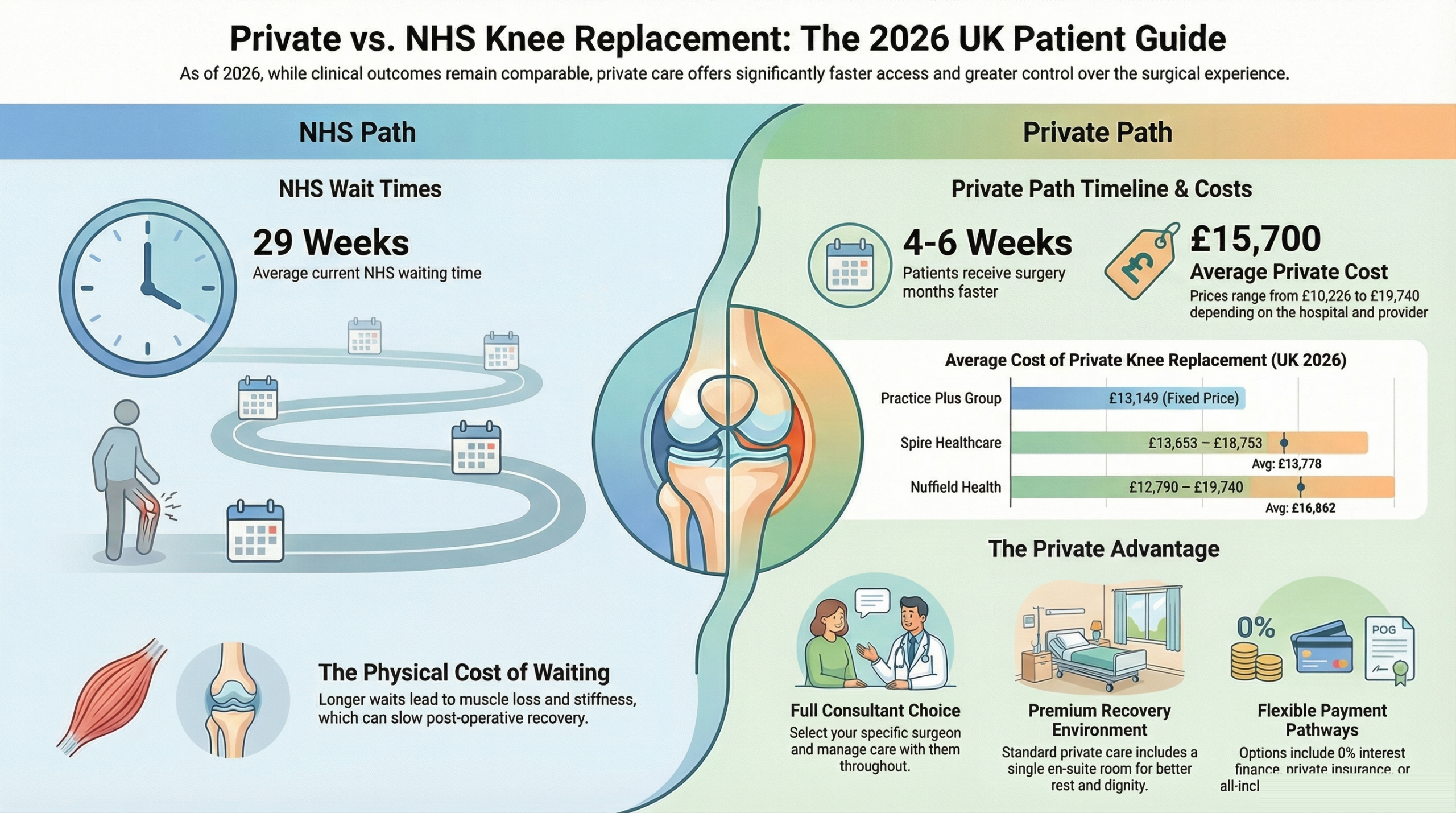
NHS vs private knee replacement compared – costs, waiting times, and what you get for your money in 2026.
The single biggest reason people choose private knee replacement is the wait. As of early 2026, the average NHS waiting time for knee replacement surgery is approximately 28 to 29 weeks. That is more than six months from GP referral to surgery.
The NHS constitutional target is 18 weeks. Yet only around 62 per cent of orthopaedic patients begin treatment within that window.
Trauma and orthopaedics carries the largest waiting list of any NHS specialty. Approximately 860,000 people are waiting for treatment across all orthopaedic procedures.
For someone in daily pain, six months can feel like a lifetime. Pain disrupts sleep, limits mobility, and often leads to weight gain and muscle loss. Low mood frequently follows, making recovery harder when surgery finally arrives.
The hidden cost of waiting
Long waits do not just affect your comfort. They can affect your surgical outcome. Research shows that patients in poorer physical condition before surgery tend to recover more slowly afterwards. Every month spent in pain is a month of reduced activity, weakened muscles, and increased stiffness.
This is one reason many over-50s choose private knee replacement. Getting the operation sooner means going into theatre in better physical shape – and coming out the other side faster.
What Does Private Knee Replacement Cost in the UK?
Private knee replacement prices vary by hospital and provider. Based on current 2026 pricing across 162 UK hospitals with confirmed prices, here is what you can expect to pay.
Private Knee Replacement Costs by Provider (2026)
| Provider | Average Price | Typical Range |
|---|---|---|
| Practice Plus Group | £13,149 | £13,149 (fixed price) |
| Independent Hospitals | £14,649 | £10,226 – £17,500 |
| HCA Healthcare | £14,850 | £14,850 (fixed price) |
| Circle Health Group | £15,427 | £13,149 – £17,800 |
| Spire Healthcare | £15,778 | £13,653 – £18,753 |
| Ramsay Healthcare | £16,258 | £11,814 – £17,950 |
| Nuffield Health | £16,862 | £12,790 – £19,740 |
The overall average across all 162 hospitals is approximately £15,700. The most affordable options start from around £10,226 and London hospitals sit at the higher end.
Most private hospitals offer fixed-price packages. The price you are quoted is the price you pay, with no surprises.
A typical package includes the surgeon’s fee, anaesthetist’s fee, the implant itself, and theatre costs. It also covers your hospital stay in a private room, nursing care, medication, and at least one follow-up consultation.
What is not always included
Some items may sit outside the fixed price. Pre-operative assessments, additional physiotherapy sessions beyond the first follow-up, and any imaging such as MRI or X-rays before surgery may carry separate charges. Always ask for a written breakdown before you commit.
If you have an existing health condition such as diabetes or heart disease, the hospital may require additional pre-operative tests. These are usually straightforward but can add £200 to £500 to the overall cost.
Watch: The Time vs Money Dilemma – NHS vs Private Knee Replacement
This short video breaks down the real trade-offs between NHS and private knee replacement in 2026. You will see how waiting times, costs, and outcomes compare side by side, helping you decide which route makes the most sense for your situation as an over-50s patient in the UK.
Why Choose Private Knee Replacement Over the NHS?
The NHS provides excellent knee replacement surgery. Outcomes are broadly comparable with the private sector. The National Joint Registry reports that the vast majority of knee replacement patients experience improved function, regardless of where the procedure takes place.
So why do people choose to pay privately? The advantages go beyond speed.
You choose your surgeon
On the NHS, your surgeon is allocated by the hospital trust. You may not know who will operate until the day itself.
Privately, you select a named consultant orthopaedic surgeon. You can research their experience, specialisms, and patient outcomes through the National Joint Registry and the GMC register. Your chosen surgeon manages your care from first consultation through to recovery.
You choose your implant
Private patients can discuss implant options directly with their surgeon. These include different bearing surfaces and fixation methods. Together, you select the best fit for your age, activity level, and bone quality.
On the NHS, the implant choice is typically made by the surgical team based on standard protocols. You may have little say in which implant is used.
Surgery within weeks, not months
Private knee replacement typically takes place within four to six weeks of your initial consultation. Compare that with the NHS average of 28 to 29 weeks. If pain is affecting your daily life, work, or mental health, reducing that wait by five months can be transformative.
A private room and personal care
Private hospitals provide a single room as standard. You get your own bathroom and a quieter, more comfortable environment for recovery. NHS patients are usually placed in shared wards.
For a two-to-four-night stay following knee replacement, a private room can make a real difference. Better rest often means a smoother early recovery.
Continuity of care
Privately, the same consultant sees you at every stage. On the NHS, you may see different members of a wider surgical team at different appointments. For many patients, knowing exactly who will perform their surgery provides valuable peace of mind.
When Does Staying With the NHS Make More Sense?
Private knee replacement is not the right choice for everyone. The NHS should be your first consideration if any of the following apply.
- Your waiting time is manageable. If your local NHS trust has shorter-than-average waits and your pain is controlled with medication and physiotherapy, the NHS pathway may work well for you.
- You have complex health needs. NHS hospitals have immediate access to intensive care, specialist medical teams, and emergency backup. If you have significant comorbidities, your GP and consultant may recommend the NHS pathway for safety.
- Cost is a barrier. Knee replacement is a significant expense. If paying privately would cause financial hardship, the NHS provides the same clinical procedure at no direct cost. There is no evidence that private surgery produces better long-term outcomes.
- You have private medical insurance. If your policy covers knee replacement, you may access private care without paying the full self-pay price. Most standard policies do cover it. Check your policy for any excess, pre-authorisation requirements, and whether your preferred hospital is on the approved list.
Can you use both NHS and private pathways?
Yes. You can remain on the NHS waiting list while exploring private options. If your NHS appointment comes through sooner than expected, you can take it. You are not required to choose one pathway exclusively.

How to Pay for Private Knee Replacement
If you have decided to go private, there are several ways to manage the cost.
- Self-pay with a fixed-price package. Most hospitals quote an all-inclusive price. You pay upfront or in instalments. Always confirm exactly what is and is not included before you commit.
- Private medical insurance. Standard PMI policies typically cover knee replacement if it is deemed medically necessary. You will usually need GP referral and pre-authorisation from your insurer. Expect to pay your policy excess.
- Interest-free finance. Many providers offer 0 per cent finance over 10 to 12 months through partners such as Chrysalis Finance. Longer terms of up to 60 months are available at around 14.9 per cent APR. Monthly payments can make private surgery accessible without a large upfront sum.
- NHS to private transfer. If you have been on the NHS waiting list and want to switch, you can self-refer to a private provider at any point. Your GP referral letter and any existing scans or assessments can often be transferred.
Understanding fixed-price versus fee-per-item
Most private hospitals now offer fixed-price packages for knee replacement. This means one price covers everything from your initial consultation to your post-operative follow-up. It removes the worry of unexpected bills.
A smaller number of providers still charge on a fee-per-item basis. Under this model, you receive separate invoices for the surgeon, anaesthetist, hospital stay, and implant. The total can sometimes exceed a fixed-price quote, so always compare like with like.
How to Research Private Knee Replacement Hospitals
If you decide to go ahead with private knee replacement, choosing the right hospital matters. Here are the key things to check.
CQC ratings
Every private hospital in England is inspected by the Care Quality Commission. Look for a hospital rated Good or Outstanding. You can search ratings for free at cqc.org.uk.
PHIN data
The Private Healthcare Information Network publishes data on private hospital performance. You can compare hospitals by procedure volume, patient feedback scores, and complication rates at phin.org.uk.
Getting multiple quotes
It is worth requesting quotes from at least two or three private knee replacement providers. Prices can vary by several thousand pounds for the same procedure. When comparing quotes for private knee replacement, make sure you are comparing like with like. One hospital may include six weeks of physiotherapy; another may include just one follow-up session.
What Questions Should You Ask Before Choosing Private Knee Replacement?
Before committing to a private knee replacement provider, ask these questions to ensure you are making an informed decision.
- What exactly is included in the quoted price? Confirm that the implant, surgeon and anaesthetist fees, theatre time, hospital stay, physiotherapy, and follow-up appointments are all covered.
- What happens if there are complications? Ask about the hospital’s policy on extended stays, readmission, and any additional charges.
- How many knee replacements does the surgeon perform each year? Look for a surgeon who carries out at least 50 to 100 knee replacements annually.
- Is physiotherapy included, and for how long? Some packages include initial physiotherapy only. You may need additional private sessions at £35 to £100 each during recovery.
What Happens After Private Knee Replacement Surgery?
Recovery from knee replacement follows a similar timeline whether you go private or NHS. Most patients spend two to four nights in hospital. You will begin physiotherapy within hours of surgery, learning to bend the knee and walk with support.
In the first six weeks, you will use walking aids – typically a frame initially, progressing to crutches and then a stick. Most people return to driving at around six to eight weeks and resume normal activities within three months.
The key difference with private care is the speed of access to follow-up physiotherapy and the consistency of consultant oversight during recovery.
Understanding knee replacement implant types helps you have an informed conversation with your surgeon about which design suits your lifestyle.
Our guide explains how to choose a knee replacement surgeon, including what credentials to check and which questions to ask at your consultation.
Our guide to physiotherapy after knee replacement covers the full recovery timeline, exercises at each stage, and NHS vs private physio options.
Frequently Asked Questions
What is included in a private knee replacement package?
Most private hospitals offer fixed-price or all-inclusive packages that cover the surgeon fee, anaesthetist fee, hospital stay (typically two to three nights), the implant, pre-operative assessments, and a set number of follow-up physiotherapy sessions. Always ask for a written quote and check whether any extras such as crutches, medications, or extended stays are included.
Can I finance a private knee replacement?
Yes, most private hospital groups offer interest-free or low-interest finance plans that spread the cost over 12 to 60 months. Some providers partner with medical finance companies. You will usually need to pass a credit check. Monthly payments for a total knee replacement typically range from around 200 to 400 pounds depending on the term.
Is private knee replacement surgery quicker than the NHS?
Private knee replacement can usually be booked within two to six weeks of your initial consultation, compared with average NHS waits of 40 to 50 weeks. If speed is a priority – for example, you are in significant pain or losing mobility rapidly – private treatment removes the waiting list delay.
Do private knee replacement costs vary by region?
Yes, there are significant regional differences. London is typically the most expensive, with total knee replacement packages ranging from around 14,000 to 20,000 pounds. Outside London, prices generally range from 10,000 to 15,000 pounds. Northern England, Scotland, and Wales tend to offer the most competitive pricing.
What is the difference between total and partial knee replacement?
A total knee replacement resurfaces all three compartments of the knee joint and is the most common procedure. A partial (unicompartmental) knee replacement only resurfaces the damaged compartment and is suitable if the damage is limited to one area. Partial replacements have a faster recovery but are not suitable for everyone – your surgeon will advise which is appropriate.
Key Takeaways
- Private knee replacement costs between £10,226 and £19,740, with an average of around £15,700 across 162 UK hospitals.
- NHS waiting times average 28 to 29 weeks in 2026; private patients are typically seen within four to six weeks.
- Clinical outcomes are comparable between NHS and private knee replacement.
- The main advantages of choosing private are speed, surgeon choice, implant choice, a private room, and continuity of care.
- Finance options including 0 per cent interest and medical insurance can make private knee replacement more accessible.
- If your NHS wait is manageable or you have complex health needs, the NHS remains an excellent option.
Ready to compare hospitals near you? Use our complete knee replacement hospital directory to compare prices, providers, and CQC ratings across 162 private hospitals.
This article is for information only. Always consult your GP or a qualified healthcare professional before making health decisions.