
Good physiotherapy can make the difference between a smooth recovery and a slow one. But when you start looking to find a physiotherapist for knee replacement rehabilitation, the choice can feel overwhelming. There are hundreds of private practices, NHS options vary by area, and it is not always clear what qualifications to look for.
This guide helps you find a physiotherapist for knee replacement recovery in the UK. We explain what credentials matter, where to search, how much to budget, and what to expect from your first appointment.
Why Does It Matter Which Physiotherapist You Choose?
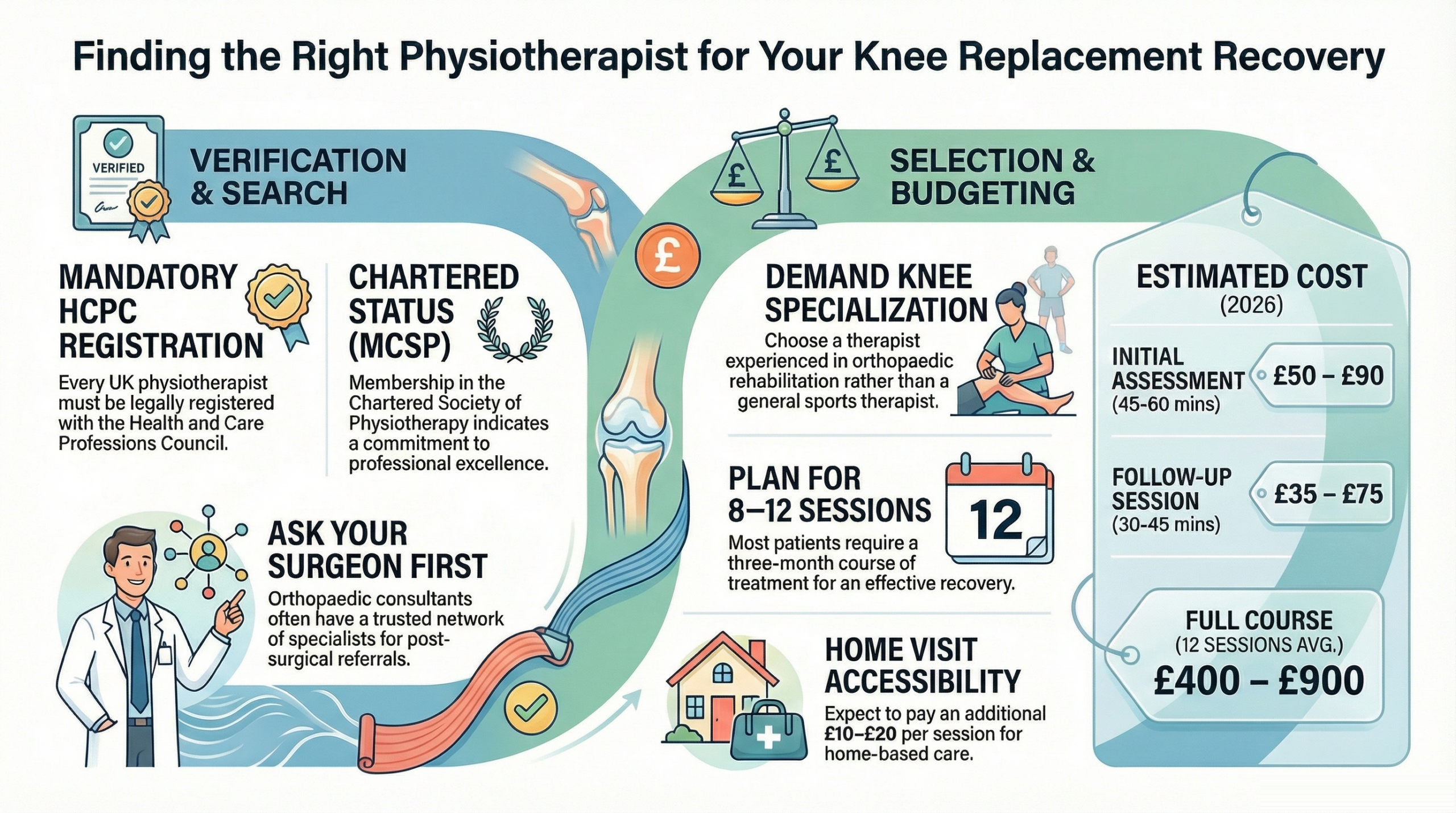
Your guide to finding the right physiotherapist for knee replacement recovery in the UK – qualifications to check, costs to expect, and questions to ask.
Not all physiotherapists specialise in the same areas. A physiotherapist who mainly treats sports injuries in young athletes has a different skill set from one who works with post-surgical knee replacement patients every week.
For knee replacement recovery, you want someone with experience in musculoskeletal or orthopaedic rehabilitation. They should understand the specific challenges after knee surgery – especially the importance of regaining full range of movement. They should know how to progress exercises at each stage and adapt your programme if you have other health conditions.
Choosing the right physiotherapist for knee replacement rehab means faster progress, fewer setbacks, and greater confidence that your recovery is on track.
What Qualifications Should a Physiotherapist Have?
Before you book with anyone, check two essential credentials.
HCPC registration
Every physiotherapist practising in the UK must be registered with the Health and Care Professions Council (HCPC). This is a legal requirement, not optional. You can verify registration at hcpc-uk.org by searching their name.
HCPC registration confirms that the physiotherapist holds a recognised degree, meets professional standards, and renews their registration every two years. If someone is not on the HCPC register, do not use them.
Chartered status (CSP membership)
A chartered physiotherapist is a member of the Chartered Society of Physiotherapy (CSP). You will see the letters MCSP after their name. Chartered status shows that the physiotherapist follows the CSP’s code of conduct and engages in continuing professional development.
HCPC registration is mandatory. CSP membership is voluntary. However, most reputable physiotherapists hold both. If you are claiming physiotherapy through private medical insurance, many insurers require your physiotherapist to be both HCPC registered and a CSP member.
Watch: How to Find a Physiotherapist After Knee Replacement
This short video walks you through the key steps to finding the right physiotherapist for your knee replacement recovery. You will learn what qualifications to look for, where to search, how much private physiotherapy costs, and how to choose a practitioner who understands your needs as an over-50s patient in the UK.
Where to Search for a Physiotherapist for Knee Replacement
There are several reliable ways to find a physiotherapist for knee replacement recovery in your area.
The CSP directory
The Chartered Society of Physiotherapy runs a free online directory at csp.org.uk/public-patient/find-physiotherapist. You can search by location and filter by specialism. Look for physiotherapists who list musculoskeletal, orthopaedic, or post-surgical rehabilitation.
Your surgeon’s recommendation
If you are having private knee replacement, ask your surgeon which physiotherapists they work with. Most orthopaedic consultants have a network of trusted physiotherapists they refer to regularly. This is often the most reliable route.
If you had NHS surgery, your hospital physiotherapist may also recommend a private practitioner in your area.
Your GP
Your GP can refer you to NHS physiotherapy if it is available in your area. They can also suggest local private physiotherapists. Some GP surgeries have physiotherapists attached to the practice through the First Contact Practitioner scheme.
Online directories and reviews
Directories such as Doctify, Top Doctors, and Treatwell list physiotherapists with patient reviews. Google Maps reviews can also help you find local practices with a good reputation.
Take individual reviews with caution. But consistent themes – clear communication, effective treatment, a welcoming clinic – are worth noting.
Your private medical insurer
If you have private medical insurance, your insurer has a list of approved physiotherapists. Using someone on the approved list means your treatment is covered, subject to policy terms and excess. Going outside the list may mean you pay the full cost yourself.
Check with your insurer before booking your first appointment.
How to Choose the Right Physiotherapist for Your Knee Replacement
Once you have a shortlist, here is what to look for.
Experience with knee replacement patients
Ask directly: how many knee replacement patients do you treat each week or month? A physiotherapist who regularly works with post-surgical knee patients will understand the recovery stages. They will know what to watch for and how to progress exercises at the right pace.
Knee replacement rehabilitation is different from hip replacement. Regaining full bend and extension requires specific techniques. Choose someone who knows this.
Location and accessibility
In the first few weeks after surgery, you will not be able to drive. Choose a physiotherapist whose clinic is easy to reach by car (with someone else driving) or who offers home visits.
Home visits typically cost £10 to £20 more per session. However, they remove travel stress during early recovery. They also let the physiotherapist see how you move at home.
Clinic facilities
If attending a clinic, check it has the right equipment for knee rehabilitation. This includes treatment beds at the correct height, resistance bands, balance aids, a stationary bike, and space for walking practice.
Communication style
You will work with this person closely for several weeks. They should explain things clearly, listen to your concerns, and adapt to your needs. If you feel rushed or unheard during the first session, try someone else.
Availability and waiting times
Private physiotherapists can usually see you within a few days. NHS physiotherapy may involve a wait of several weeks. If you need to start promptly, private treatment ensures no delay.

How Much Does a Private Physiotherapist Cost for Knee Replacement?
Private physiotherapy costs vary by location and provider. Here is a general guide for 2026.
| Session Type | Typical Cost |
|---|---|
| Initial assessment (45-60 mins) | £50 – £90 |
| Follow-up session (30-45 mins) | £35 – £75 |
| Home visit | £55 – £100 |
| Online / video session | £30 – £50 |
Most patients need eight to twelve sessions over the first three months. At an average of £50 to £75 per session, a full course costs approximately £400 to £900.
Some physiotherapists offer a package of sessions at a reduced rate. Ask about this at your first appointment.
Can you get physiotherapy free on the NHS?
Yes, but availability varies. Some NHS trusts offer outpatient physiotherapy after knee replacement. Others do not routinely refer patients unless complications arise.
If your GP refers you for NHS physiotherapy, you pay nothing. However, you may wait several weeks for your first appointment. In early recovery, this delay can slow progress.
A practical approach used by many patients is to pay for private physiotherapy in the first six weeks. This is when structured rehab matters most. You can then switch to NHS services or self-directed exercise for the later stages.
What to Expect at Your First Physiotherapy Session
Knowing what happens removes any anxiety about the process.
Your physiotherapist will begin with a full assessment. They will ask about your surgery, any complications, your pain levels, your home situation, and what activities you want to get back to. They will test your knee’s range of movement, muscle strength, and walking pattern.
Based on this, they will create a personalised exercise programme. This will be tailored to your current ability and will progress over time. You should receive a written or printed copy to follow at home.
At the end, you will agree a treatment plan. This usually includes how often to attend (weekly is typical in the first month) and what goals to work towards. Key milestones include achieving 90 degrees of knee bend, walking without a stick, and returning to driving.
Questions to Ask Before Booking a Physiotherapist
Use this checklist when you contact a practice to find a physiotherapist for knee replacement recovery.
- Are you HCPC registered and a CSP member? Both should be yes.
- Do you have experience treating patients after knee replacement? Look for regular, ongoing experience.
- What does a typical course of treatment involve? They should describe a structured plan, not just individual sessions.
- Do you offer home visits? Useful in the first two to four weeks.
- What are your fees, and do you offer a package rate? Get clarity on costs before committing.
- Are you recognised by my insurance provider? Essential if you want to claim on PMI.
- Can you provide a written exercise programme for home? This is standard good practice.
Our guide explains how to choose a knee replacement surgeon, including what credentials to check and which questions to ask at your consultation.
Our guide to physiotherapy after knee replacement covers the full recovery timeline, exercises at each stage, and NHS vs private physio options.
Find out which mobility aids after knee replacement you will need, what the NHS provides free, and what you may need to buy yourself.
Frequently Asked Questions
Do I need a GP referral for private physiotherapy after knee replacement?
No, you do not need a GP referral to see a private physiotherapist. You can book directly with any chartered physiotherapist. However, if you want NHS physiotherapy, you will usually need a referral from your hospital consultant or GP. Some NHS trusts now offer self-referral for musculoskeletal physiotherapy – check your local trust’s website.
How much does private physiotherapy cost after knee replacement?
Private physiotherapy sessions typically cost 35 to 90 pounds each depending on your location, the physiotherapist’s experience, and whether sessions are in a clinic or at your home. Home visits are usually more expensive. A typical course of eight to twelve sessions costs 400 to 900 pounds in total. Some private hospitals include a set number of physio sessions in their surgical package.
Can I choose my own physiotherapist on the NHS?
On the NHS, you are generally referred to the physiotherapy department at your local hospital or community clinic. You may not be able to choose a specific physiotherapist, and you may see different physiotherapists at different appointments. If continuity is important to you, private physiotherapy gives you the option to see the same person throughout your recovery.
What qualifications should I look for in a physiotherapist?
Look for a physiotherapist who is registered with the Health and Care Professions Council (HCPC) and is a member of the Chartered Society of Physiotherapy (CSP). For knee replacement recovery, it is helpful to find someone with musculoskeletal or orthopaedic experience. Ask whether they regularly treat patients recovering from joint replacement surgery.
How often should I have physiotherapy after knee replacement?
In the first two to three weeks after surgery, two to three sessions per week is ideal to establish your exercise programme and build confidence. From weeks three to six, once or twice a week is typical. After six weeks, many people reduce to weekly or fortnightly sessions as they become more independent with their exercises. Your physiotherapist will adjust the frequency based on your progress.
Key Takeaways
- To find a physiotherapist for knee replacement recovery, start with the CSP directory at csp.org.uk or ask your surgeon for a recommendation.
- Always check that your physiotherapist is HCPC registered. Chartered status (MCSP) is also a strong indicator of professionalism.
- Choose someone with regular experience treating knee replacement patients, not a generalist.
- Private physiotherapy costs £35 to £90 per session depending on location and session type. A typical course of eight to twelve sessions costs £400 to £900.
- NHS physiotherapy is free but not always available or timely. Many patients combine private physio in the early weeks with self-directed exercise later.
- Location, accessibility, and communication style all matter. If you are not comfortable with your physiotherapist, it is fine to try someone else.
Preparing for knee replacement? Use our knee replacement hospital directory to compare 162 private providers, prices, and CQC ratings across the UK.
This article is for information only. Always consult your GP or a qualified healthcare professional before making health decisions.