

Hernia Repair Surgery Cost UK: NHS vs Private 2026
If you are over 50 and living with a hernia, you will want to know one thing: how much will it cost, and how long will you wait?

A hernia occurs when internal organs or tissues push through a weakness in your abdominal wall, creating a visible bulge. The good news is that hernia repair surgery is one of the most common and well-established operations in the UK. The challenging part is choosing between the NHS, where you might wait months, or private clinics, where you can often be treated within weeks.
In this guide, we compare the actual cost of hernia repair on the NHS versus private healthcare. We include real prices from named UK providers, typical waiting times, and what affects your bill. By the end, you will understand exactly what hernia repair surgery costs in your area and what that means for your decision.
How Much Does Hernia Repair Surgery Cost?
Hernia repair surgery is free on the NHS if your hernia meets the clinical priority criteria. If you choose private healthcare, costs range from £2,400 to £4,400 depending on the type of hernia, the surgical technique, and your location in the UK.
The NHS covers the full cost of surgery if:
- Your hernia is painful or growing larger
- It affects your ability to work or daily activities
- Your hernia is incarcerated (trapped) or at risk of strangulation
- You have a strangulated hernia (a medical emergency requiring urgent surgery)
For elective private hernia repair, costs include the surgeon’s fee, anaesthetist, theatre use, and overnight stay if required. Initial consultations and diagnostic tests (ultrasound or CT scan) are usually separate and cost £150-£300.
Watch: UK Hernia Repair 2026 – The NHS vs Private Decision Matrix
This cinematic overview compares NHS and private hernia repair surgery in the UK for 2026, covering costs, waiting times, surgical techniques, and what to consider for inguinal, umbilical, and hiatal hernias.
NHS vs Private: Complete Cost Comparison Table
The table below shows typical costs and waiting times for different types of hernia repair across the NHS and private providers in 2026.
| Hernia Type | NHS Wait | NHS Cost | Private Cost | Surgery Type | Recovery |
|---|---|---|---|---|---|
| Inguinal Hernia (groin) | 12-18 weeks | Free | £2,400-£3,200 | Open or laparoscopic | 1-4 weeks |
| Umbilical Hernia (navel) | 8-14 weeks | Free | £2,500-£3,400 | Open surgery | 2-3 weeks |
| Incisional Hernia (post-surgical scar) | 14-24 weeks | Free | £3,200-£4,400 | Open or laparoscopic | 4-6 weeks |
| Hiatal Hernia (stomach/diaphragm) | 16-28 weeks | Free | £3,500-£4,400 | Laparoscopic | 3-6 weeks |
| Femoral Hernia (upper thigh) | 10-16 weeks | Free | £2,600-£3,600 | Open surgery | 2-4 weeks |
Key insight: Inguinal hernias (groin hernias) account for 75% of all hernia repairs. They are also the fastest and least costly to treat privately, making private surgery an attractive option for those who cannot afford a long NHS wait.
If you are weighing up more than one planned procedure, our breakdown of gallbladder removal costs in the UK for 2026 applies the same NHS-vs-private framework to another common operation many adults over 50 face.
Private Hernia Surgery Costs by UK Region
Private hernia repair costs vary significantly by region and provider. The table below shows typical private costs from major UK healthcare providers in 2026.
| Region | Provider | Cost (Inguinal) | Cost (Incisional) | Waiting Time |
|---|---|---|---|---|
| London | Cromwell Hospital | £3,200 | £3,870 | 2-3 weeks |
| London | The London Clinic | £3,225 | £3,800 | 1-2 weeks |
| Manchester | Spire Manchester Hospital | £2,825 | £3,200 | 2-4 weeks |
| Leeds | Nuffield Health Leeds Hospital | £3,155 | £3,650 | 2-3 weeks |
| Birmingham | Spire Parkway Hospital | £2,980 | £4,406 | 3-4 weeks |
| Bristol | Nuffield Bristol Hospital | £3,305 | £3,800 | 2-3 weeks |
| Edinburgh | Spire Edinburgh Hospitals (Murrayfield) | £2,998 | £3,590 | 2-3 weeks |
| Cardiff | Nuffield Health Cardiff | £3,078 | £3,500 | 2-3 weeks |
Regional variations: London and Birmingham offer the widest range of costs, with private inguinal hernia repair ranging from £2,617 to £4,406. Smaller regional hospitals (Leeds, Manchester, Edinburgh) often offer better value, typically £2,800-£3,200 for straightforward inguinal hernias.
Private Hernia Repair Providers: UK Directory 2026
Compare the UK’s leading private hernia repair providers at a glance. See current self-pay prices, locations, and key features to help you choose the right provider.
Directory note: All prices are self-pay guide prices as of early 2026 and may vary by consultant, location, and individual circumstances. Always contact providers directly for an official written quote. Sources: Individual provider websites, PHIN, NHS.uk.
What Causes a Hernia?
A hernia develops when part of your internal tissue or organ pushes through a weakness or hole in the abdominal wall muscle. For adults over 50, the risk increases due to declining muscle strength and elasticity.
Common causes include:
- Heavy lifting without proper abdominal support – straining the weakened muscle
- Chronic constipation – repeated straining creates excess pressure
- Persistent coughing – from smoking, asthma, or respiratory conditions
- Obesity – extra weight increases intra-abdominal pressure
- Post-surgical scarring – incisional hernias occur at the site of previous surgery
- Poor nutrition and smoking – weaken connective tissue
- Straining during urination – common in men with prostate enlargement
Everyday lifestyle factors matter too, particularly for hiatal hernias. Our roundup of common heartburn triggers to watch out for highlights the foods and habits that can worsen symptoms and put extra pressure on the abdominal wall.
Types of Hernia and Their Characteristics
Not all hernias are the same. The location and severity determine whether you need urgent surgery or can wait for a scheduled appointment.
Inguinal Hernia (Groin Hernia)
Inguinal hernias account for 75% of all hernia repairs. They occur when tissue bulges through the groin, sometimes extending into the scrotum in men. They are more common in men due to the natural weakness in the male groin anatomy. Symptoms include a bulge in the groin, discomfort when lifting, and aching in the area. Inguinal hernias are usually not urgent unless they become strangulated.
Umbilical Hernia (Belly Button Hernia)
These occur near the navel and are more common in women and those who are overweight. The bulge may be more noticeable when you strain or cough. Most umbilical hernias in adults eventually require surgery because they rarely shrink on their own.
Incisional Hernia (Post-Surgical Hernia)
These develop along the scar line of previous abdominal surgery. They are more common in elderly patients, those who are overweight, or people who become inactive after surgery. These hernias tend to be larger and more complex, which is why private repair costs more (£3,200-£4,400).
Hiatal Hernia (Stomach Hernia)
A hiatal hernia occurs when part of your stomach pushes through the diaphragm into your chest. Symptoms include heartburn, acid reflux, and difficulty swallowing. If reflux is your main concern day to day, our practical guide to easing acid reflux and heartburn sets out dietary changes, over-the-counter remedies, and the signs that warrant a GP conversation. These are common in people over 50 and often managed with medication first; surgery is reserved for severe cases.
Femoral Hernia (Upper Thigh Hernia)
These occur below the groin crease. They are more common in women and older adults. Femoral hernias carry a higher risk of strangulation, so they usually require surgery sooner than inguinal hernias.
Do You Need Emergency Hernia Surgery?
Some hernias require urgent or emergency surgery. You should seek immediate medical attention if:
- Strangulation: The hernia bulge becomes dark red, purple, or black, and you cannot push it back inside
- Incarceration: The hernia becomes trapped and cannot be reduced (pushed back)
- Sudden severe pain in the hernia area, especially with nausea or vomiting
- Fever and severe pain – signs of infection or tissue death
- Bowel obstruction: You experience inability to pass stool, severe constipation, or vomiting
In these cases, go to your nearest A&E or call 999. Emergency hernia repair on the NHS is prioritised and performed within 24 hours.
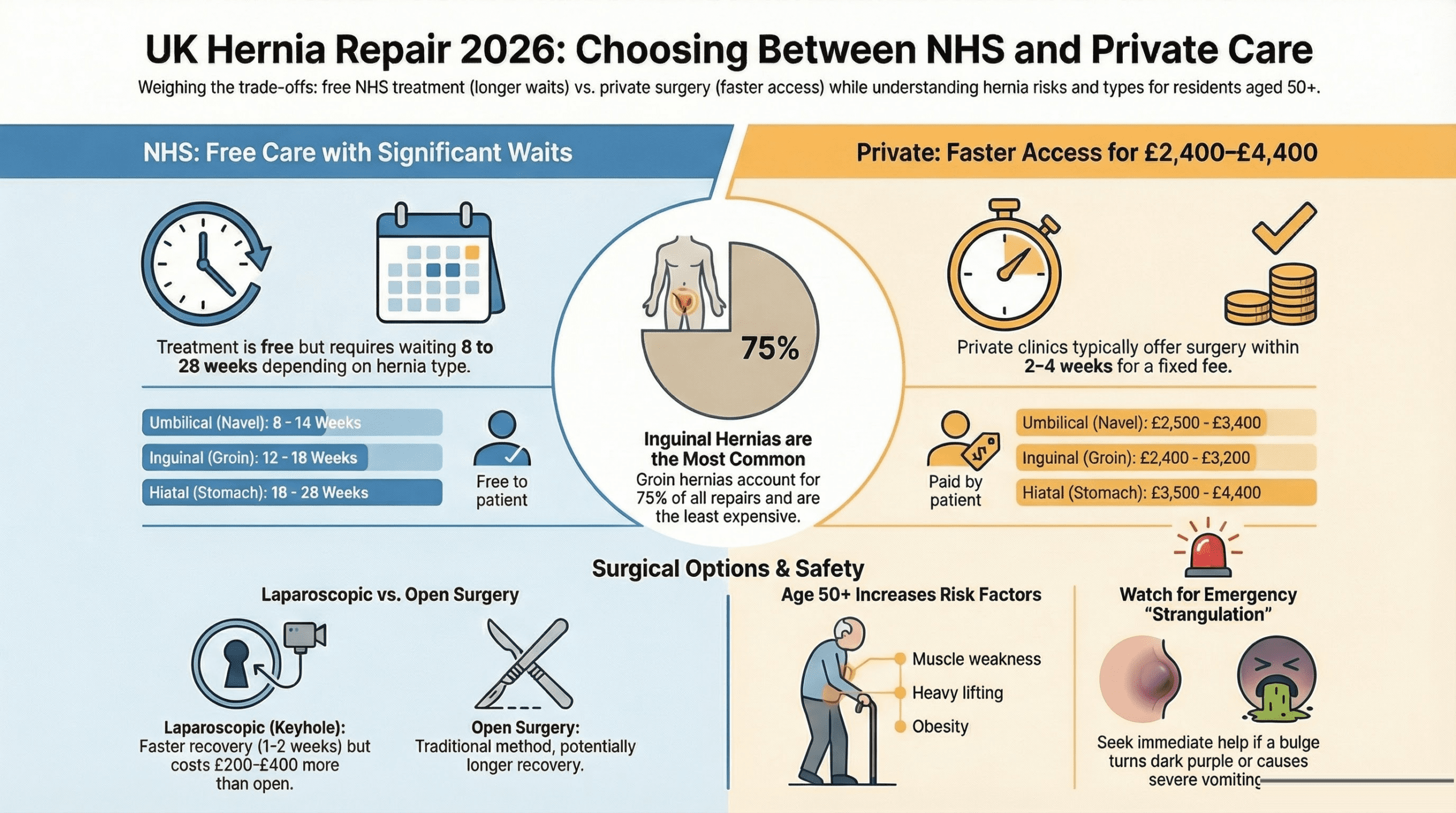
Hernia repair surgery costs in the UK for 2026: NHS vs private prices, waiting times, and what to expect from leading providers.
Open vs Laparoscopic vs Robotic Hernia Repair
Your surgeon will recommend one of three techniques based on your hernia type, size, and general health.
Open Hernia Repair Surgery
Your surgeon makes a single incision (3-6 cm) near the hernia. The displaced tissue is repositioned, and a synthetic or biological mesh is placed over the weakness to reinforce the abdominal wall. The incision is then closed with stitches.
Advantages: Ideal for large or multiple hernias; lower recurrence rates with mesh; direct visualisation of the repair site.
Recovery: Typically 4-6 weeks to full activity. You can usually return home the same day or after one overnight stay.
Private cost: £2,400-£3,200 for inguinal hernias.
Laparoscopic (Keyhole) Hernia Repair
Your surgeon makes 3-4 small incisions (5-10 mm each) and inserts a thin camera and surgical instruments. The hernia is reduced, and mesh is placed from inside the abdomen. This technique is less invasive and causes less tissue damage.
Advantages: Faster recovery (1-2 weeks), less postoperative pain, smaller scars, lower infection risk, same-day discharge is common.
Limitations: Not suitable for very large hernias or patients with extensive scar tissue from previous surgery.
Recovery: Return to light activity in 1-2 weeks; full recovery in 3-4 weeks.
Private cost: Usually £200-£400 more than open repair due to specialised equipment.
Robotic Hernia Repair (Da Vinci System)
This is the most advanced technique. The surgeon controls a robotic system with enhanced precision, magnification, and 3D vision. It combines the benefits of laparoscopic and open surgery.
Advantages: Exceptional precision for complex hernias; faster recovery than open surgery; excellent for recurrent hernias.
Limitations: Most expensive option; available at only a small number of private hospitals in the UK.
Recovery: 2-3 weeks to light activity.
Private cost: On application
Hernia Surgery Recovery: What to Expect Over 50
Recovery after hernia repair depends on your age, general fitness, and the surgical technique used. As an adult over 50, you will typically recover well if you follow your surgeon’s advice.
Week 1-2: Initial Recovery
After open surgery, expect pain for the first few days. Laparoscopic patients often have minimal pain. You may feel tired and need to rest. Light walking is encouraged to prevent blood clots and aid healing.
Week 2-4: Gradual Activity
Pain continues to decrease. You can gradually increase activity as directed. Avoid heavy lifting (more than 5 kg), strenuous exercise, and abdominal strain. Return to desk work is typically safe within 1-2 weeks.
Week 4-6: Return to Normal Activity
Most patients can resume normal activities by week 6. Heavy lifting, gardening, and exercise should resume gradually. Your surgeon will advise when it is safe to return to your specific activities. When you are ready to rebuild strength at home, our picks of affordable home exercise tools and gadgets cover resistance bands, light weights, and balance aids well suited to gentle post-surgery recovery.
Risk of Recurrence in Over-50s
Hernia recurrence is uncommon with modern mesh repair (1-5% for primary inguinal hernias), but is slightly higher in older patients, those who are overweight, or those who smoke. Your surgeon may recommend weight loss and smoking cessation to reduce recurrence risk.
When Should You Choose Private Hernia Surgery Over the NHS?
Private hernia repair costs significantly more but offers advantages in speed and choice of surgeon. Consider private surgery if:
- You cannot wait: NHS waiting times are 12-28 weeks, depending on urgency. If your hernia is affecting your work or quality of life, private surgery (2-4 weeks) is faster.
- You prefer a specific surgeon: Private healthcare allows you to choose your surgeon, whereas NHS assigns you based on availability.
- You want a specific surgical technique: Robotic repair is rarely available on the NHS but is offered privately.
- You have private health insurance: Some policies cover hernia repair with no out-of-pocket cost.
- You are concerned about NHS waiting list pressure: Choosing private keeps NHS capacity free for urgent cases.
However, NHS surgery is equally safe and effective. Your surgeon will have the same training and use the same mesh technology. The main difference is time and choice.
What Are the Risks and Complications of Hernia Surgery?
Hernia repair is one of the safest operations, but like all surgery, it carries some risk.
Common Minor Complications
- Bruising and swelling around the incision
- Temporary numbness or discomfort at the incision site
- Seroma (fluid collection under the skin) – usually resolves on its own
Rare Serious Complications
- Infection: Occurs in 1-2% of cases. Treated with antibiotics or additional surgery.
- Bleeding: Usually minimal; significant bleeding is rare (less than 1%).
- Deep vein thrombosis (blood clots): More common in patients over 60 or with immobility. Prevented by early mobilisation and compression stockings if needed.
- Nerve or tissue damage: Can cause chronic pain in 1-3% of cases. Most resolve within months.
- Hernia recurrence: 1-5% risk with primary inguinal hernias; higher for incisional hernias (10-15%).
- Bowel injury: Rare (less than 1 in 1,000) but serious if unrecognised.
Emergency hernia surgery carries higher complication rates than planned surgery. This is why surgeons recommend repair before your hernia becomes strangulated.
Questions to Ask Your Surgeon Before Hernia Repair
Before you commit to private surgery or accept an NHS appointment, ask your surgeon these questions:
- “Which surgical technique do you recommend for my hernia, and why?”
- “What is your personal recurrence rate for this type of repair?”
- “Will you use biological mesh or synthetic mesh? What are the differences?”
- “How many of these operations do you perform each year?”
- “What complications have you experienced, and how did you manage them?”
- “How long will I be off work, and when can I return to exercise?”
- “What happens if my hernia recurs? Is revision surgery covered?”
- “Do you offer laparoscopic repair for my type of hernia?”
- “Are there any additional costs I should know about (anaesthetist, consultant, hospital fees)?”
- “What aftercare and follow-up will I receive?”
Key Takeaways
Hernia Repair Surgery Cost UK – What You Need to Know:
- NHS hernia repair is free but comes with a 12-28 week wait. Private repair costs £2,400-£4,400 and can be arranged within 2-4 weeks.
- Your hernia type matters: Inguinal hernias are the cheapest and fastest to repair (£2,400-£3,200); incisional hernias are more complex (£3,200-£4,400).
- Laparoscopic repair offers faster recovery (1-2 weeks) than open surgery (4-6 weeks) and costs only slightly more.
- Recurrence risk is low (1-5% for inguinal hernias) but increases with obesity and smoking. Quit smoking and maintain a healthy weight to protect your repair.
- Emergency hernia surgery is free and fast on the NHS if your hernia becomes strangulated or incarcerated. Do not delay if you develop sudden pain, fever, or inability to push the bulge back.
- Choose your surgeon carefully: Ask about their experience and complication rates, whether on the NHS or privately.
- Regional variation is significant. London and Birmingham range from £2,617 to £4,406 for inguinal hernia repair; Leeds and Manchester offer better value (£2,390-£3,300).
Useful Resources and Sources
For further information, consult these authoritative sources. You may also find our guide to gallbladder removal costs helpful if you are considering other abdominal procedures.
- NHS Conditions: Hernia – comprehensive NHS guide to types, symptoms, and treatment
- NICE (National Institute for Health and Care Excellence) – guidelines for hernia assessment and surgical techniques
- Royal College of Surgeons of England – surgical standards and surgeon find service
- British Hernia Centre – specialist hernia advice and surgeon directory
- PHIN (Private Healthcare Information Network) – verified private clinic costs and waiting times
- Nuffield Health – private hospital costs and availability
- Spire Healthcare – private hospital costs and availability
- BMI Healthcare – private hospital costs and availability
Frequently Asked Questions About Hernia Repair Surgery
Can a hernia go away on its own?
No. In adults, a hernia never heals itself. It will typically grow larger over time. The only treatment is surgery. Conservative management (weight loss, activity modification, avoiding heavy lifting) may slow progression but will not cure the hernia.
What is the difference between a reducible and incarcerated hernia?
A reducible hernia can be pushed back inside your body by hand. An incarcerated hernia is trapped and cannot be reduced. This means the blood supply may be at risk. Incarcerated hernias require surgery sooner and are considered more urgent.
How long does hernia repair surgery take?
Most hernia repairs take 30-60 minutes, depending on the type and complexity. Laparoscopic repairs are often faster (30-45 minutes) than open repairs (45-60 minutes).
Can hernia surgery be done under local anaesthetic?
Some minor hernias can be repaired under local anaesthetic, but most require general anaesthetic or regional nerve block. Your surgeon will discuss this based on your health and hernia size.
How high is the risk of hernia recurrence?
For inguinal hernias with modern mesh repair, recurrence is 1-5%. For incisional hernias, the risk is higher (10-15%). Smoking, obesity, and straining increase recurrence risk. Ask your surgeon about their personal recurrence rates.
Is mesh safe? What are the alternatives?
Mesh is safe and has been used for over 30 years. Most surgeons recommend synthetic mesh (polypropylene) for straightforward hernias. Biological mesh is available for special cases (e.g., contaminated hernias) but is more expensive. Suture-only repair has higher recurrence rates and is rarely used today.
Will I need time off work after hernia surgery?
After laparoscopic repair: Most people return to desk work within 1 week and to full activity within 3-4 weeks.
After open repair: Return to desk work typically takes 2-3 weeks; full activity takes 4-6 weeks.
Manual workers may need longer. Discuss this with your surgeon before your operation date.
What Next? Making Your Decision
Hernia repair is safe and effective, but the path you choose – NHS or private – depends on your circumstances, budget, and urgency.
If your hernia is causing you pain or limiting your activities, speak to your GP now. If you decide to go private, request quotes from 2-3 hospitals in your region and ask about their surgeon credentials and complication rates.
Whichever route you take, the evidence is encouraging – our feature on how healthy lifestyle choices are helping people live longer, fuller lives explains why staying active through your 50s, 60s, and 70s pays real dividends in quality of life after surgery.
For more information on NHS waiting times and private costs in your area, read our guide on NHS waiting times and private costs for common operations. You may also find it helpful to explore NHS e-Referral Service guide if cost is your main concern.
This article is for information only. It is not a substitute for professional medical advice. Always consult your GP or a qualified healthcare professional before making decisions about hernia surgery or treatment. If you develop sudden severe pain, fever, or inability to push a hernia back inside, seek emergency medical attention by calling 999 or visiting your nearest A&E.