

Loss of Libido After Menopause: Understanding Causes and Finding Solutions
A decline in sexual desire during and after menopause is one of the most common – yet least discussed – changes many women face. If you’ve noticed a shift in your libido, you’re certainly not alone. Loss of libido after menopause affects a significant proportion of women navigating this life stage, yet many believe it’s simply an inevitable part of ageing. The truth is more encouraging: understanding why this happens and exploring the range of effective treatments available can help you reclaim your sexual confidence and enjoyment.
If you or your partner takes sildenafil (Viagra) to address erectile dysfunction, our guide to whether Viagra is safe for your heart covers the cardiac risks men over 50 should consider.
This guide explores the physical, hormonal, and psychological factors behind loss of libido after menopause, compares NHS and private treatment options, and equips you with practical steps to take if you want to restore intimacy in your life.
How Common Is Loss of Libido After Menopause?
Menopause-related changes to sexual function affect many women in the UK and beyond. Research shows that libido changes are among the most frequent concerns reported during the menopause transition. However, this does not mean your sex life must diminish.
Importantly, research from the University of Manchester challenges the stereotype that older people are not sexually active. The study found that 54% of men and 31% of women over age 70 remained sexually active, with roughly one-third of these individuals having sex regularly. Dr David Lee, who led the research, emphasised that these findings help counter outdated assumptions and allow people to set realistic expectations for their own lives.
The key message: sexual desire and activity are normal and achievable at any age. Loss of libido after menopause is treatable, and many women report improved sexual satisfaction once they understand their options.
Why Does Menopause Cause Loss of Libido?
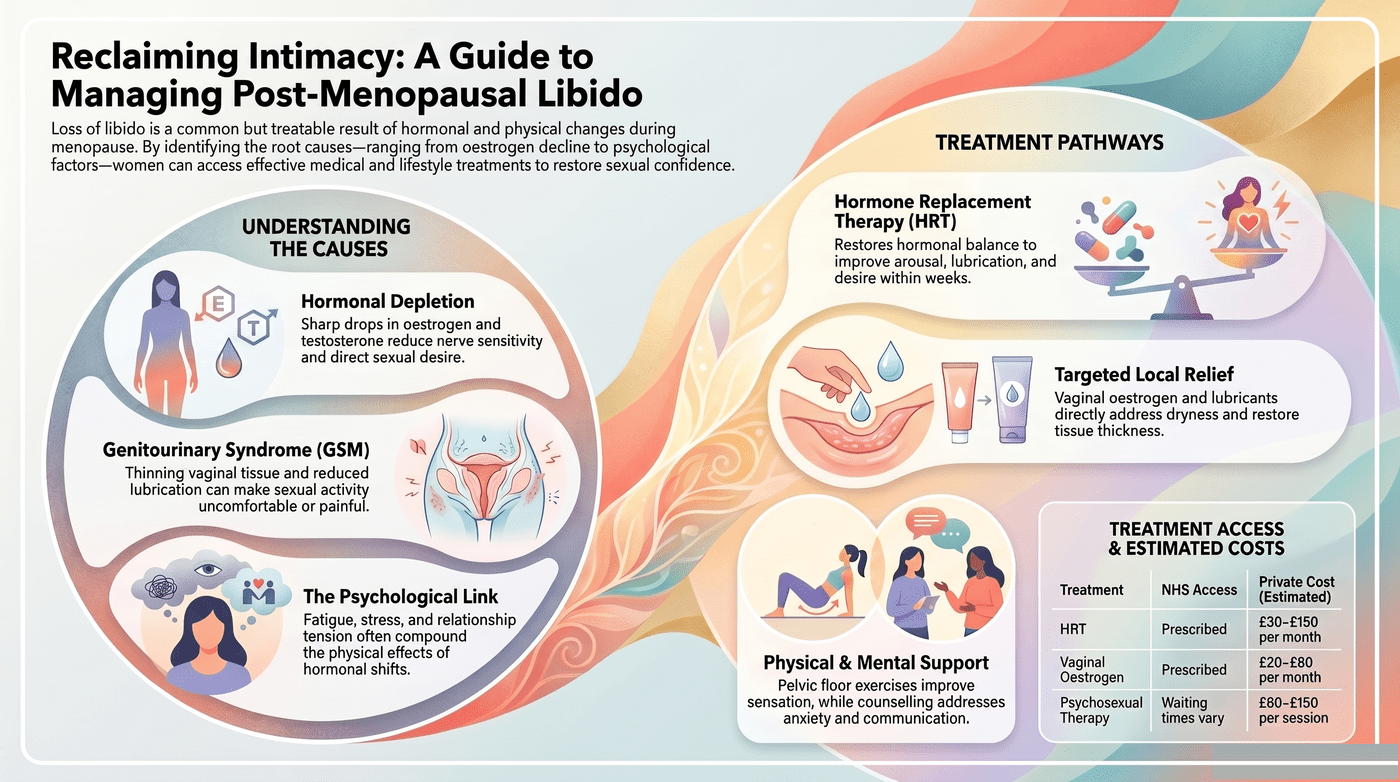
Loss of libido after menopause has multiple, interconnected causes. Recognising them helps you and your GP identify the best treatment approach.
Hormonal Changes: Oestrogen and Testosterone Decline
The primary driver is a sharp drop in oestrogen and testosterone production. Oestrogen supports blood flow to the genitals, natural lubrication, and the sensitivity of nerve endings involved in sexual pleasure. Testosterone, present in smaller amounts in all women, fuels sexual desire directly.
When these hormones decline, sexual arousal may take longer to develop, orgasm may feel less intense, and spontaneous desire may vanish altogether. This is not a sign of lost capacity for pleasure – it’s a measurable biological change that responds well to treatment.
Vaginal Dryness and Genitourinary Syndrome of Menopause (GSM)
Declining oestrogen leads to thinning of the vaginal tissue and reduced natural lubrication. This condition is now formally called Genitourinary Syndrome of Menopause (GSM), recognised by the International Society for the Study of Women’s Sexual Health. GSM can cause discomfort or pain during intercourse (dyspareunia), which naturally discourages sexual activity.
For many women, addressing vaginal dryness alone – through lubricants, vaginal oestrogen, or systemic HRT – restores comfortable, pleasurable intercourse and a renewed interest in sex.
Physical Symptoms and Body Confidence
Hot flushes, night sweats, and fatigue are common during menopause. Waking drenched in sweat or experiencing sudden heat and visible flushing during intimate moments can undermine confidence and desire. Over time, avoidance of sexual situations can weaken the emotional and physical connection with a partner.
Weight changes, skin texture shifts, and other visible changes can also affect how you feel about your body during this life stage – an emotional factor just as real as any physical one.
Relationship and Psychological Factors
Loss of libido after menopause is not purely physical. Stress, anxiety, depression, relationship tension, and life circumstances all play a role. Some women report that unresolved concerns with their partner, or a lack of emotional intimacy, directly impact sexual desire. Others struggle with anxiety about physical changes or fear of discomfort during sex.
A holistic approach – addressing both body and mind – often yields the best results.
Treatment Options for Loss of Libido After Menopause
The following table outlines the main treatment pathways available on the NHS and privately. Each addresses different aspects of loss of libido after menopause, and your GP can help you choose the right one or combination for your situation.
| Treatment | How It Helps | NHS Availability | Private Cost (approx.) |
|---|---|---|---|
| Hormone Replacement Therapy (HRT) | Restores oestrogen and/or testosterone; improves arousal, lubrication, and desire. | Yes, on prescription. Available as tablets, patches, gels, sprays. | £30-£150/month (private consultation + medication) |
| Vaginal Oestrogen | Targets GSM directly; restores vaginal tissue health and natural lubrication. | Yes, on prescription. Available as creams, pessaries, or vaginal ring. | £20-£60/month (private consultation + medication) |
| Vaginal Lubricants | Reduces friction and discomfort; safe to use alongside other treatments. | Available over-the-counter; no prescription needed. | £5-£20 per product |
| Testosterone Therapy (off-label) | May boost sexual desire and arousal; available for women with documented low testosterone. | Limited; prescribing is specialist-led and not routine. | £50-£200/month (specialist consultation required) |
| Psychosexual Counselling | Addresses anxiety, communication issues, and relationship factors affecting desire. | Available via NHS talking therapies services; waiting list varies. | £60-£150 per session (private therapists) |
| Pelvic Floor Exercises (Kegel exercises) | Strengthens muscles around the vagina; improves sensation, arousal, and orgasm. | Free; can be learned via NHS guidance or women’s health physiotherapy. | £40-£80 per session (women’s health physiotherapy, typically 6-8 sessions) |
Hormone Replacement Therapy and Loss of Libido
HRT is one of the most effective treatments for menopause-related loss of libido. By restoring oestrogen (and sometimes testosterone), HRT addresses the hormonal root cause. Many women report that their sexual desire, arousal, and ability to reach orgasm improve significantly within weeks of starting HRT.
HRT is available on the NHS as a standard treatment for menopausal symptoms. Your GP can discuss whether it’s right for you, considering your personal health history and preferences. Options include tablets, patches, gels, and sprays, allowing you to find a form that suits your lifestyle.
If you choose to explore HRT privately, a specialist menopause consultant can provide faster access and tailored dosing. Private consultations typically cost £150-£300, with ongoing medication costs depending on the type and strength of therapy.
NICE guideline NG23 recommends discussing HRT with any woman experiencing bothersome menopausal symptoms, including sexual dysfunction. Your GP or menopause specialist can help weigh benefits and risks specific to you.
Managing Vaginal Dryness and Discomfort
If intercourse is uncomfortable due to vaginal dryness, several options can help without waiting for systemic changes from HRT.
Vaginal Oestrogen
Vaginal oestrogen creams, pessaries, and rings deliver oestrogen directly to vaginal tissue. They work locally to restore tissue thickness, improve natural lubrication, and ease discomfort. Many women use vaginal oestrogen alongside systemic HRT for maximum benefit, and it’s also effective as a standalone treatment.
On the NHS, vaginal oestrogen is readily prescribed. Private costs are comparable to NHS prescriptions, around £20-£60 per month depending on formulation.
Vaginal Lubricants
Over-the-counter lubricants (silicone-based, water-based, or hyaluronic acid formulations) provide immediate relief during intercourse. While they don’t address the underlying hormone deficiency, they’re safe, affordable, and useful alongside medical treatment.
Testosterone Therapy for Women
Testosterone is essential to sexual desire in both men and women. Although present in smaller amounts in women, testosterone decline during menopause contributes to loss of libido. Some evidence suggests that testosterone therapy – delivered as a patch, gel, or cream – may restore sexual desire in women with documented low testosterone.
However, testosterone therapy for menopausal women remains somewhat controversial and is not routinely prescribed in UK primary care. It is typically prescribed by menopause specialists or sexual medicine experts, often on an off-label basis. If you’re interested, discuss it with your GP or ask for a referral to a menopause specialist.
Psychosexual Counselling and Communication
Loss of libido after menopause often has a psychological dimension. Anxiety about discomfort, fear of rejection, stress, or unresolved relationship issues can suppress desire just as effectively as hormone changes.
Psychosexual counselling, delivered by a trained therapist, helps you explore these factors and develop strategies to reconnect with your sexuality. Sessions may focus on relaxation techniques, communication with your partner, and rebuilding confidence.
The NHS offers talking therapy services for sexual concerns through integrated sexual health services in many areas. Waiting lists vary, but referral is free. Private psychosexual therapists typically charge £60-£150 per session.
Importance of Communication with Your Partner
Open conversation with your partner is one of the most powerful tools available. Discussing what’s happening, exploring what feels good without pressure, and asking for patience and support can transform the experience.
Many couples find that taking penetration off the table temporarily – focusing instead on non-sexual intimacy, massage, or other forms of pleasure – reduces anxiety and reignites desire naturally.
Pelvic Floor Exercises: A Practical First Step
Pelvic floor muscles weaken with age and hormonal changes. Strengthening them through Kegel exercises can improve sensation, increase sexual arousal, and enhance orgasm intensity.
To perform pelvic floor exercises: identify the muscles (the ones you use to stop the flow of urine mid-stream), contract them for 3 seconds, then relax for 3 seconds. Repeat 10 times, three times daily. Gradually increase the hold and relaxation time as you get stronger.
Many women see noticeable improvement in sexual sensation within 4-6 weeks of consistent practice. A women’s health physiotherapist can provide guidance, though pelvic floor exercises are free once you know the technique.
When Should You See Your GP?
Consider seeing your GP if:
- Loss of libido after menopause is causing you distress or relationship strain
- Sex is painful or uncomfortable
- You’ve noticed a sudden, significant shift in sexual desire
- You want to explore HRT or other medical treatments
- You’d benefit from a referral to a sexual health specialist or psychosexual therapist
Your GP can rule out other causes (such as medication side effects or thyroid disease), discuss your options, and refer you to appropriate services on the NHS or recommend private specialists if you prefer faster access.
Callout: There is no “right” amount of sex you should be having. What matters is what feels right for you and your partner. Loss of libido after menopause is common, treatable, and not something you need to accept as inevitable.
Frequently Asked Questions About Loss of Libido After Menopause
Is it normal to lose your sex drive after menopause?
Very. Studies suggest up to 40% of post-menopausal women experience a significant reduction in libido, making it one of the most common menopause symptoms. The important thing to know is that it is not inevitable, and effective treatments exist.
Why does menopause cause loss of libido?
The main driver is the sharp decline in oestrogen and testosterone that occurs at menopause. Oestrogen maintains vaginal lubrication and tissue sensitivity; testosterone is the primary hormone responsible for sexual desire in both men and women. When both fall, libido typically follows. Fatigue, mood changes, and sleep disruption – also common at menopause – compound the effect.
Will my libido return after menopause on its own?
For some women it does, particularly once other menopause symptoms like hot flushes settle and sleep improves. For others, low libido persists without treatment. There is no fixed timeline – it varies significantly between individuals. If low libido is affecting your relationship or wellbeing, speak to your GP rather than waiting it out.
Does HRT help with low libido?
It can, particularly if low desire is linked to vaginal dryness, discomfort, or low mood. However, HRT does not directly boost testosterone, so some women find their libido improves only partially. In those cases, testosterone therapy (prescribed separately) is often the next step. According to NHS guidance on HRT, testosterone for women is available but currently unlicensed in the UK – meaning it is prescribed off-label.
Can testosterone therapy improve libido after menopause?
Evidence is strong that low-dose testosterone significantly improves sexual desire in post-menopausal women. It is more commonly available via private menopause clinics than through NHS GPs. Costs typically run to £50 to £80 per month privately. The British Menopause Society supports its use for women with low libido when other causes have been excluded.
How do I talk to my GP about low libido?
Be direct – GPs are familiar with this as a menopause symptom. Describe how long it has been an issue, whether it is affecting your relationship, and whether other symptoms are present. Ask specifically about HRT, vaginal oestrogen, and testosterone therapy. If your GP is not menopause-specialist trained, you are entitled to request a referral to a menopause clinic.
Key Takeaways
- Loss of libido after menopause is common and caused by declining oestrogen and testosterone, vaginal dryness, physical symptoms, and psychological factors.
- Being sexually active in your 50s, 60s, 70s, and beyond is normal and achievable – research shows many older adults continue to enjoy regular sex.
- HRT is one of the most effective treatments for loss of libido after menopause and is available on the NHS.
- Vaginal oestrogen, lubricants, pelvic floor exercises, and psychosexual counselling all address specific aspects of sexual dysfunction.
- Open communication with your partner and practical strategies like reducing pressure and exploring non-sexual intimacy can reignite desire.
- Your GP can help identify the cause and recommend the best treatment approach for your individual circumstances.
What to Ask Your GP or Healthcare Provider
If you book an appointment to discuss loss of libido after menopause, consider asking:
- Could my sexual symptoms be related to menopause or another treatable condition?
- Am I a suitable candidate for HRT, and what form would work best for me?
- Which treatment option would address my specific concern – hormone levels, vaginal dryness, or psychological factors?
- Are there any side effects or contraindications I should know about?
- Could I be referred to a menopause specialist, sexual health service, or psychosexual therapist?
- What can I do at home while waiting for an appointment or treatment to take effect?
Taking the Next Step
Loss of libido after menopause does not have to be permanent. Whether you choose HRT, vaginal treatments, pelvic floor exercises, counselling, or a combination, effective options exist. The first step is acknowledging the change and recognising that it’s worth addressing – for your wellbeing, confidence, and relationship.
If you’re navigating menopause and want practical, trustworthy guidance, managing other menopause symptoms for more articles on managing this life stage. You may also find helpful information on the NHS guidance on HRT and menopause treatment and the British Menopause Society patient resources.
Remember: sexual desire and satisfaction are achievable at any age. With the right support and treatment, many women find that their sexual confidence and pleasure increase after menopause. You deserve to feel comfortable and confident in your body and your relationships.
Call to Action
Have you navigated loss of libido after menopause? We’d love to hear your story and share experiences in our community. join our Facebook community or sign up to our free newsletter, The Best of Friends, to stay updated on articles and resources for women over 50.
Disclaimer
This article is for information only and should not be taken as medical advice. Always consult your GP or a qualified healthcare professional before making health decisions, starting a new treatment, or making significant changes to your healthcare routine. If you experience severe pain, bleeding, or other concerning symptoms, seek urgent medical attention.