

Is Viagra Safe for Your Heart?
If you’re over 50 and considering Viagra (sildenafil) for erectile dysfunction, you’ve probably asked yourself: is Viagra safe for your heart? It’s a sensible question. Many men at this age have heart conditions or take heart medications, and the last thing you want is to harm your health while trying to improve your sex life.

The good news is that for most men without certain heart conditions, Viagra has a solid safety record. However, there are specific situations where it can be risky-and knowing the difference could protect you.
This guide explains how Viagra works, what the evidence says about heart safety, who should avoid it, and what to discuss with your GP before taking it. We also cover the new over-the-counter Viagra Connect option now available in UK pharmacies, and safe alternatives if Viagra isn’t right for you.
How Viagra Works in Your Body
To understand Viagra’s heart safety, it helps to know what the drug actually does. Viagra contains the active ingredient sildenafil, which works by relaxing blood vessels and improving blood flow.
Specifically, sildenafil inhibits an enzyme called phosphodiesterase-5 (PDE-5). This allows blood vessels to dilate, increasing blood flow to the penis and enabling an erection. However, PDE-5 is found throughout your body-not just in the penis-which is why sildenafil can affect other tissues and organs, including your heart and blood vessels.
This wider action on blood vessels is why your GP needs to know your full heart and medication history before you take Viagra. The relaxation of blood vessels is generally beneficial for blood pressure, but in certain circumstances-especially when combined with specific heart medications-it can cause problems.
What the Evidence Says About Viagra and Heart Safety
Since Viagra was approved in 1998, there has been extensive research into its heart safety. The evidence is reassuring for most men without significant heart disease.
The 2002 Safety Study and Beyond
A landmark 2002 study published in the American Journal of Cardiology found that sildenafil was safe in men with heart disease who were not taking nitrate medications. Researchers studied over 3,000 men with cardiovascular disease and found no increased risk of heart attacks or strokes in those using sildenafil.
Since then, decades of real-world use have supported this finding. Millions of men worldwide have taken Viagra safely, and serious heart complications directly caused by the drug remain rare when used correctly.
Blood Clotting Concerns and Contradictory Evidence
In 2005, researchers from the University of Chicago raised a concern about sildenafil potentially increasing blood clotting risk in certain conditions. However, this finding has not been consistently replicated in larger population studies, and most cardiologists do not regard it as a major contraindication for most users.
Current NHS guidance and European cardiovascular organisations emphasise that Viagra is generally safe in heart disease, provided you avoid specific drug interactions and your heart condition is stable.
Recent 2024-2026 Evidence
Recent observational studies continue to support a favourable safety profile. A 2025 systematic review in the British Medical Journal found no significant increase in serious cardiovascular events among sildenafil users compared to placebo-even in men with existing heart disease. However, the same evidence emphasises the critical importance of avoiding nitrate interactions.
The Critical Drug Interaction: Viagra and Nitrates
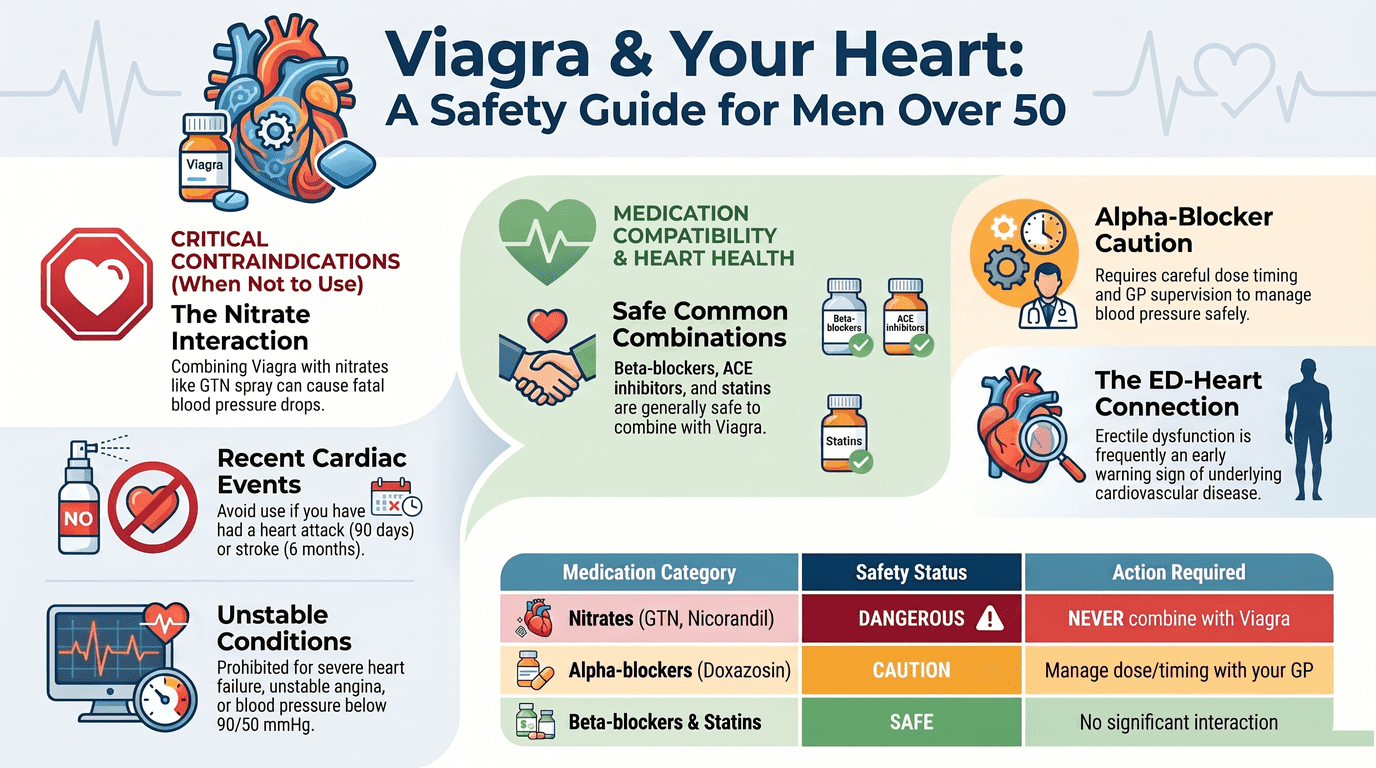
The most important safety issue with Viagra is its interaction with nitrate medications. If you take any form of nitrate for your heart, you must not take Viagra under any circumstances.
Why Nitrates and Viagra Don’t Mix
Nitrates are medications that dilate blood vessels to improve blood flow and reduce chest pain (angina). They include drugs such as:
- Isosorbide dinitrate (Isordil, Imdur)
- Isosorbide mononitrate (Elantan, Ismo)
- GTN spray (glyceryl trinitrate, used for acute chest pain)
- Long-acting nitrate patches
When Viagra and nitrates are combined, both drugs lower blood pressure by relaxing blood vessels. The effect is additive and dangerous: blood pressure can drop to critically low levels (a condition called severe hypotension), potentially causing:
- Fainting or loss of consciousness
- Stroke
- Heart attack
- Death
This is not a theoretical risk-it has happened, and it is why the combination is strictly contraindicated. If you take any nitrate, you cannot safely use Viagra, Cialis, or any other PDE-5 inhibitor.
Other Heart Medications That Interact with Viagra
Beyond nitrates, other medications require caution. These interactions may not be absolute contraindications, but they do require medical supervision.
| Medication Type | Common Examples | Interaction Risk | Safe? |
|---|---|---|---|
| Nitrates | GTN spray, isosorbide mononitrate, patches | Severe drop in blood pressure; risk of collapse or heart attack | No-strictly contraindicated |
| Alpha-blockers (for prostate) | Tamsulosin (Flomax), doxazosin (Cardura), terazosin | Additional blood pressure drop; dizziness, fainting | Use with caution; GP approval required |
| Blood pressure medications (ACE inhibitors, ARBs) | Lisinopril, ramipril, losartan, valsartan | Additive blood pressure lowering; may be beneficial in some cases | Usually safe; GP monitoring advised |
| Beta-blockers | Bisoprolol, atenolol, carvedilol | Additive blood pressure lowering; generally mild | Usually safe; GP monitoring advised |
| Ritonavir and certain antiretrovirals | HIV protease inhibitors | Increased sildenafil levels; risk of side effects | Requires dose adjustment; specialist advice essential |
The key point: never start Viagra without telling your GP about every medication you take. Your GP or pharmacist will check for interactions.
Who Should NOT Take Viagra
Viagra is not suitable for everyone. Beyond those taking nitrates, the following groups should avoid Viagra or require specialist assessment:
Absolute Contraindications (Do Not Take)
- Taking any nitrate medication – for angina, chest pain, or any cardiovascular reason
- Recent heart attack or stroke (within 6 months) – unless approved by your cardiologist
- Uncontrolled severe high blood pressure (systolic pressure persistently above 180 mmHg)
- Severe liver disease – the liver metabolises sildenafil; impaired function raises drug levels dangerously
- Severe kidney disease (eGFR below 30) – requires specialist advice and possible dose adjustment
- Hypersensitivity or allergy to sildenafil or any ingredient
Situations Requiring GP Approval Before Use
- Heart failure (especially if not well-controlled)
- Aortic stenosis (narrowing of the main heart valve)
- Recent unstable angina
- Uncontrolled arrhythmias (irregular heartbeat)
- Taking alpha-blockers for prostate problems
- Low baseline blood pressure (systolic below 90 mmHg)
- Retinal problems (such as retinitis pigmentosa) – rare but serious
- Bleeding disorders or on anticoagulants (e.g., warfarin, apixaban)
If you have any of these conditions, discuss Viagra with your GP or cardiologist before considering it. They may say it’s safe for you, or they may recommend an alternative treatment.
Side Effects of Viagra: What to Expect
Viagra is generally well-tolerated, but side effects do occur. Most are mild and temporary, but some warrant immediate medical attention.
Common Side Effects (Usually Mild)
- Headache (15-20% of users)
- Flushing or facial redness
- Indigestion or upset stomach
- Nasal congestion or runny nose
- Blurred vision or colour changes in vision
- Dizziness or lightheadedness
- Back pain
- Muscle aches
Most common side effects disappear within a few hours and tend to diminish with repeated use as your body adjusts.
Serious Side Effects (Seek Immediate Medical Help)
- Severe chest pain or pressure – seek emergency help (call 999)
- Sudden vision loss or blindness – rare but serious; stop the drug and see an eye specialist urgently
- Sudden hearing loss – very rare; seek urgent medical attention
- Severe dizziness or fainting – lie down and call your GP or NHS 111
- Priapism (erection lasting more than 4 hours) – this requires emergency treatment to prevent permanent damage; go to A&E
- Severe allergic reaction (rash, swelling, difficulty breathing) – call 999
If you experience any of these serious effects, stop taking Viagra immediately and seek help.
Viagra Connect: The Over-the-Counter Option Now Available in the UK
As of 2024-2026, sildenafil is available over the counter in UK pharmacies as Viagra Connect (50 mg tablets). This is a significant change from the past, when all sildenafil required a prescription.
What Is Viagra Connect?
Viagra Connect is a branded formulation of sildenafil (50 mg) available without a doctor’s prescription. You can buy it directly from a pharmacy-no GP appointment needed. However, pharmacists are required to ask health questions to screen for contraindications.
Who Can Buy Viagra Connect?
You must be aged 18 or over. However, the pharmacy will ask about:
- Whether you take nitrate medications (critical safety question)
- Recent heart attacks or strokes
- High or low blood pressure
- Other medications you’re taking
- Serious liver or kidney disease
If you answer ‘yes’ to any red-flag questions, the pharmacist may refuse to sell it or recommend you speak to your GP first. This is a safety measure-the pharmacist is protecting you.
Advantages of Viagra Connect
- No GP appointment needed-saves time and NHS resources
- Private conversation with a pharmacist in a confidential setting
- Faster access for men with mild erectile dysfunction
- No prescription cost (though it is more expensive than generic prescription sildenafil)
Disadvantages Compared to Prescription Sildenafil
- Fixed 50 mg dose-not customisable (prescriptions offer 25 mg, 50 mg, or 100 mg)
- Significantly more expensive (around £15-£20 for a few tablets vs. £5-£10 for a prescription)
- Limited availability of lower or higher doses
- If you have specific heart or kidney conditions, you still need a GP prescription and specialist input
Should You Buy Viagra Connect or Ask Your GP?
Viagra Connect is suitable for younger men (under 60) with no significant medical history and a straightforward need for erectile dysfunction. However, if you’re over 60, have heart disease, high blood pressure, or take multiple medications, it’s safer to see your GP first. Your GP can:
- Review your full health history and medication list
- Customise the dose (25 mg, 50 mg, or 100 mg)
- Check for interactions you might not know about
- Suggest alternatives if Viagra isn’t suitable
- Provide ongoing monitoring
For most men reading this article (aged 50+), a GP consultation is the safest route.
Generic Sildenafil and Cost in the UK
Since Viagra’s patent expired, generic sildenafil is widely available on the NHS and privately. Generic sildenafil is chemically identical to Viagra and just as effective. A 28-day supply on prescription typically costs £5-£10 through the NHS, making it far more affordable than branded Viagra or Viagra Connect.
If you can get a prescription, generic sildenafil is usually the most cost-effective option.
Viagra and Pre-Existing Heart Disease: Is It Safe?
Many men over 50 have some degree of heart disease-high blood pressure, atherosclerosis, or previous heart attack. Can they safely take Viagra?
The answer, supported by evidence, is: yes, in most cases-but only with GP approval and if specific conditions are met.
What the NHS Says
The NHS recognises that erectile dysfunction is common in men with heart disease and that Viagra is often an appropriate treatment. However, the NHS guidance emphasises:
- Your heart condition must be stable and well-controlled on medication
- You must not take nitrates under any circumstances
- Your GP must be aware of your full medication list
- Your blood pressure must be monitored
- You should discuss with your cardiologist if your heart disease is complex
Special Considerations for Heart Patients
If you have heart disease and are considering Viagra, your GP or cardiologist will assess whether you are a good candidate based on:
- Stability of your condition: Has your heart disease been stable for several months? Or are you having frequent symptoms or recent changes?
- Type of heart disease: Some conditions (e.g., aortic stenosis) carry higher risk; others (e.g., well-controlled hypertension) are lower risk.
- Your blood pressure: Viagra lowers blood pressure slightly. If you are already on blood pressure medications, this needs monitoring.
- Sexual activity and heart load: Sexual activity itself increases heart workload. If your heart is too weak to tolerate the physical exertion, Viagra may not be appropriate.
A helpful rule of thumb: if you can climb a flight of stairs or walk briskly without severe chest pain or breathlessness, your heart may be stable enough for sexual activity (and thus Viagra). Discuss this with your GP.
What to Discuss with Your GP Before Taking Viagra
If you’re considering Viagra, here are the essential questions to raise with your GP:
Health History Questions
- “I’m experiencing erectile dysfunction. Do you think Viagra might be suitable for me?”
- “Do you have any concerns about my heart or blood pressure?”
- “Have I had any recent changes in my heart health-chest pain, shortness of breath, or palpitations?”
- “Is my heart condition currently well-controlled on my current medications?”
Medication Questions
- “I take [list your medications]. Are any of these incompatible with Viagra?”
- “Do any of my medications interact with sildenafil?”
- “Would my blood pressure medications and Viagra work safely together?”
Dosing and Safety Questions
- “What dose would you recommend-25 mg, 50 mg, or 100 mg?”
- “When and how should I take it?”
- “What side effects should I watch for?”
- “Are there any warning signs I should seek immediate help for?”
- “How long should I wait before trying it, or can I start it today?”
Alternative Options
- “If Viagra isn’t suitable, what are my other options?”
- “Would a different PDE-5 inhibitor (Cialis, Levitra) be safer for me?”
- “Are there non-medication treatments I should consider?”
Alternatives to Viagra for Erectile Dysfunction
If Viagra isn’t suitable or doesn’t work for you, several alternatives exist.
Other PDE-5 Inhibitors
- Cialis (tadalafil): Longer-acting (up to 36 hours); may suit men wanting a “weekend dose” approach. Same contraindications as Viagra regarding nitrates.
- Levitra (vardenafil): Similar to Viagra but may work for men who don’t respond to sildenafil. Also contraindicated with nitrates.
- Stendra (avanafil): Newer, fast-acting option; less commonly used in the UK but available on prescription.
Non-Medication Treatments
- Penile vacuum devices (penis pumps): Effective, non-invasive, and safe even for men with heart disease. Available on the NHS in some regions.
- Psychosexual counselling: Erectile dysfunction often has psychological components; talking therapy can help.
- Lifestyle changes: Weight loss, exercise, reduced alcohol, smoking cessation, and stress reduction can improve erectile function-especially beneficial for heart health too.
- Testosterone replacement: If low testosterone is the cause, hormone therapy may help (requires testing and specialist input).
- Penile injections or implants: For severe cases not responding to tablets; requires specialist urology input.
Addressing the Underlying Cause
Erectile dysfunction is often an early warning sign of cardiovascular disease. If you’ve recently developed erectile dysfunction and you’re not sure why, your GP should investigate. Improving heart health through exercise, diet, blood pressure control, and smoking cessation often improves erectile function as a bonus.
Managing blood pressure is one of the most effective ways to protect both heart health and sexual function. Our guide on how to lower your blood pressure covers lifestyle changes, diet, exercise, and when medication may be necessary.
Key Takeaways: Is Viagra Safe for Your Heart?
Key Takeaways
- For most men without nitrate medications or severe heart disease: Viagra has a good safety record supported by decades of evidence and millions of users.
- Critical contraindication: If you take any nitrate medication (for angina or chest pain), you must never take Viagra-the combination can cause life-threatening blood pressure drop.
- Other interactions: Alpha-blockers, some blood pressure medications, and certain antiretrovirals require GP supervision. Always declare all your medications.
- Heart disease doesn’t automatically rule out Viagra: If your heart condition is stable and well-controlled, Viagra may be safe. Your cardiologist can advise.
- Viagra Connect is now available over the counter in UK pharmacies: Convenient but more expensive than prescription generic sildenafil. Best for younger, healthier men; older men with multiple conditions should see a GP first.
- Side effects are usually mild: Headache, flushing, and indigestion are common. Seek emergency help if you experience chest pain, vision loss, or an erection lasting over 4 hours.
- Always see your GP first: Especially if you’re over 50, have heart disease, high blood pressure, or take multiple medications. A 10-minute consultation can prevent serious complications.
What to Do Next
If you’re experiencing erectile dysfunction and considering Viagra:
Step 1: Book a GP appointment. Even if you think you can buy Viagra Connect over the counter, a 5-minute phone consultation with your GP is worth the effort. Your GP knows your health history and can spot contraindications you might miss.
Step 2: Be honest about your medications and health. Write down all the medications you take, including over-the-counter drugs and supplements. Mention any history of heart disease, high blood pressure, strokes, or vision problems.
Step 3: Ask about the right dose for you. If your GP approves Viagra, ask what dose is best. Many older men do well on 25-50 mg rather than the standard 100 mg, especially if they’re on blood pressure medications.
Step 4: Start low and go slow. Take your first dose at home in a relaxed setting, not before a big event. Allow time to see how your body responds.
Step 5: Report any side effects. If you experience unusual symptoms-dizziness, chest discomfort, or vision changes-contact your GP and stop taking it.
If you are managing a heart condition and wondering about sexual activity, our guide to reducing cardiovascular risk through lifestyle offers practical steps your GP is likely to recommend before prescribing Viagra.
For a broader overview of treatment options beyond Viagra, our guide to erectile dysfunction causes and treatments covers NHS and private options including injections, vacuum devices, and psychological support.
External Resources and Further Reading
- NHS: Erectile Dysfunction – Official NHS guidance on diagnosis, treatment, and when to see your GP.
- British Heart Foundation – Resources on heart disease, medications, and sexual health for cardiac patients.
- NICE Guidance – Evidence-based recommendations on erectile dysfunction treatments for the UK.