
Hair Transplant Surgery Abroad: The Benefits and the Risks Involved
Hair loss affects over 8 million men and 2 million women in the UK. For adults aged 50 and over, male pattern baldness and thinning hair can feel deeply personal. Modern hair transplant surgery offers a permanent solution-but the cost can be eye-watering in the UK private sector.
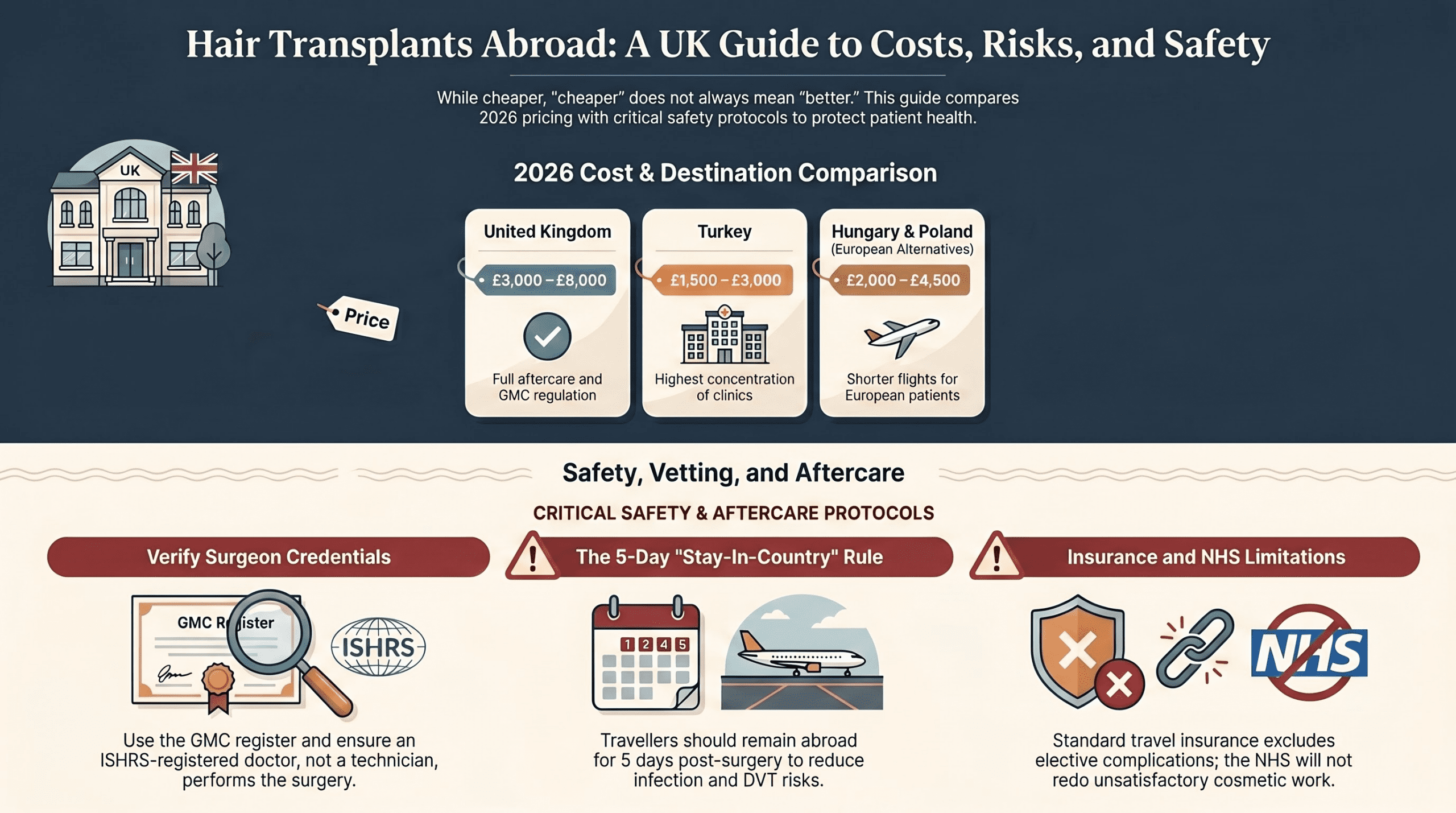
Many British patients are tempted by hair transplant surgery abroad, particularly in Turkey, Hungary, and Poland, where prices can be 50-70% lower than UK clinics. However, the savings come with significant risks: unregulated clinics, poor aftercare, infection, scarring, and limited legal recourse if things go wrong.
This guide compares hair transplant surgery abroad versus UK options. We’ll break down real costs, explain the regulatory differences, and help you weigh the genuine benefits against the genuine dangers. By the end, you’ll know whether going abroad for hair transplant surgery makes financial and medical sense for you.
Why Hair Transplant Surgery Abroad Is So Popular
Hair transplant surgery is not a small investment. Before booking any treatment overseas, see our travel health checklist for over-50s for the wider preparation every UK traveller should do. A typical FUE (follicular unit extraction) procedure requires 1,500-4,000 grafts and takes 6-8 hours. In the UK, this can cost £8,000-£15,000.
Turkey has become the world’s hair transplant capital. Over 600,000 procedures are performed there each year, compared to roughly 20,000 in the UK. This volume has created a medical tourism industry with slick marketing, all-inclusive packages, and a reputation (not always deserved) for high volume and efficiency.
The appeal is simple: a full FUE transplant in Istanbul costs £1,500-£3,500. Add flights and a hotel for two nights, and the total is still less than one UK private clinic.
Hungary and Poland offer similar pricing-typically £2,000-£4,500 for a full procedure. Bulgaria and India have even lower costs, but regulation is weaker and distance makes aftercare follow-up harder.
But low cost is not the only reason. Some patients also cite:
- Shorter waiting times (often available within weeks, not months)
- Perception of experienced surgeons (Turkey’s high volume creates a reputation for expertise)
- All-inclusive packages (flights, hotel, airport transfer, translator)
- The possibility to combine treatment with a holiday
Real Cost Comparison: UK vs Abroad
To make an informed decision, you need to compare not just the surgeon’s fee, but the total cost of ownership-including flights, accommodation, time off work, and any revision or complication costs.
The table below shows 2026 pricing from named UK clinics and typical costs in Turkey, Hungary, and Poland for a standard 2,500-graft FUE procedure:
| Location / Clinic | Procedure Type | Cost (£) | Waiting Time | Follow-up Aftercare |
|---|---|---|---|---|
| UK Private Clinics | FUE (2,500 grafts) | £10,000-£15,000 | 4-12 weeks | Local, included |
| Harley Street, London (example) | FUE (2,500 grafts) | £12,000 | 6-8 weeks | Local follow-up appointments |
| Turkey | FUE (2,500 grafts) | £2,500-£4,000 | 2-4 weeks | Limited; video consultations only |
| Istanbul clinic (typical) | FUE (2,500 grafts) | £2,800 + flights (£150-£300) | 2-3 weeks | Email/WhatsApp support |
| Hungary | FUE (2,500 grafts) | £3,000-£4,500 | 3-6 weeks | Limited; online consultations |
| Budapest clinic (typical) | FUE (2,500 grafts) | £3,500 + flights (£80-£150) | 3-4 weeks | Email/phone support |
| Poland | FUE (2,500 grafts) | £2,500-£4,000 | 2-4 weeks | Limited; occasional in-person visits |
| Warsaw/Krakow clinic (typical) | FUE (2,500 grafts) | £3,000 + flights (£60-£120) | 3-5 weeks | Email/video support |
Total Cost Breakdown (Turkey Example):
- Procedure: £2,800
- Flights (London-Istanbul, return): £200
- Hotel (2 nights): £120
- Transfers/transport: £50
- Meals: £100
- Total: £3,270
Total Cost Breakdown (UK Private Clinic Example):
- Procedure: £12,000
- Travel (local): £50
- Time off work: unpaid (1 week) = £200-£300 in lost income for some
- Total: £12,050-£12,300
The saving is real: £8,780-£9,030. For a pensioner or early retiree on a limited income, this is life-changing money.
The Real Benefits of Going Abroad
1. Dramatic Cost Savings
The most obvious benefit is price. A full FUE transplant abroad can cost 70% less than in the UK. For someone with male pattern baldness at 55, this might be the difference between getting the procedure done now or waiting another decade.
The savings extend beyond the surgery itself. Many overseas clinics include accommodation, airport transfers, and a companion translator-costs that UK clinics expect you to cover separately.
2. Faster Access and Less Waiting
NHS waiting times for hair transplant are extremely long-often 18-24 months if you qualify at all (the NHS rarely funds hair transplants unless you have severe alopecia or psychological impact). Private UK clinics often have waiting lists of 6-12 weeks.
Overseas clinics can often book you within 2-4 weeks. For someone psychologically distressed by hair loss, shorter waiting time is a genuine quality-of-life benefit.
3. High Volume = Experience
Turkey’s 600,000+ annual procedures mean some surgeons perform 100+ transplants per month. UK surgeons might perform 20-40 per month. High volume can correlate with faster technique and lower complication rates-if the surgeon is reputable.
The caveat is essential: volume alone does not guarantee quality. Many high-volume clinics in Turkey are franchises with varying standards and surgeon expertise.
4. All-Inclusive Packages Reduce Stress
Reputable overseas clinics manage the entire process: booking, flights (sometimes), transfers, accommodation, pre- and post-operative appointments, and translator support. For a patient unfamiliar with international travel or medical tourism, this can reduce anxiety.
The Serious Risks of Hair Transplant Surgery Abroad
The cost savings are real. Many of these risks also apply to cosmetic surgery abroad, so the same caution and clinic-vetting steps apply. But so are the risks. Many hair transplant complications arise weeks or months after surgery, when you’re back in the UK with limited access to your overseas surgeon.
1. Infection and Poor Wound Healing
Hair transplant surgery creates hundreds of tiny incisions. Each one is a potential entry point for bacteria. In the UK, sterile surgical protocols, antibiotic prophylaxis, and aftercare wound checks are standard and regulated.
In many overseas clinics, especially budget ones, post-operative wound care is minimal. You’re given basic instructions and sent home. If infection develops days or weeks later-a red, warm, oozing scalp with pain-you’ll need to see a UK GP or dermatologist who may have no access to your original surgical notes.
[VERIFY: infection rates in overseas vs UK clinics-estimate 5-10% of overseas patients experience post-operative infection]
2. Poor Graft Survival and Failed Results
Hair transplant success depends on surgeon skill, timing, temperature control during graft handling, and post-operative aftercare. A failed transplant means grafts don’t grow, leaving you with patchy regrowth, visible scarring, and a waste of £2,500-£4,000.
UK private clinics guarantee graft survival rates of 90-95%. Many overseas clinics do not publish these figures, and if a graft fails, your recourse is limited.
3. Scarring and Poor Aesthetic Outcome
Poor surgical technique can leave visible scarring on the donor site (the back of your head). FUE should leave minimal scarring, but if the surgeon uses poor extraction angles or removes grafts too aggressively, you can end up with a patchy, scarred appearance.
Fixing bad scarring often requires a second procedure in the UK, adding another £5,000-£10,000 to your total cost and offsetting any saving from going abroad.
4. Unregulated Clinics and Variable Standards
Turkey and Hungary have cosmetic surgery sectors that are lightly regulated compared to the UK. Any doctor can advertise “hair transplant” services without independent verification of qualifications or outcomes.
A clinic that looks professional and polished online may have a surgeon with minimal training or a track record of complaints. You have no way to verify credentials before arriving.
The UK’s Care Quality Commission (CQC) inspects all private healthcare settings and publishes ratings. Turkey has no equivalent for cosmetic clinics.
5. Aftercare Complications You’ll Manage Alone
Hair transplant aftercare is critical. For the first two weeks, you must:
- Keep the scalp dry (no washing for 48 hours, then gentle washing only)
- Avoid strenuous exercise and sweating
- Avoid sleeping on the transplanted area
- Monitor for signs of infection (redness, warmth, pus, increasing pain)
- Attend follow-up appointments to check graft take
If you’re back in the UK after surgery, your GP can advise on basic infection signs, but they won’t know the details of your specific surgical technique. If something goes wrong-itching, swelling, or a graft that looks inflamed-you’re dependent on email or WhatsApp communication with your overseas surgeon, who may be slow to respond.
More importantly, if you need emergency in-person care (e.g., abscess drainage or infection treatment), the NHS will treat you, but they’ll have no record of your surgery and may charge you. Private cosmetic surgeons in the UK can also refuse to manage complications from overseas surgery.
6. No Legal Recourse If Things Go Wrong
If a UK private clinic causes harm, you can complain to the CQC, pursue a medical negligence claim, or seek compensation via private medical indemnity insurance (most reputable UK clinics hold this).
If a Turkish, Hungarian, or Polish clinic causes harm, your legal options are almost non-existent. Medical negligence law varies by country, and enforcing a judgment in a foreign court is expensive and time-consuming. Most overseas clinics have no insurance and limited assets in the UK.
In reality, you have almost no protection if a transplant goes wrong.
7. Post-Operative Hair Loss and Shock Loss
“Shock loss” is normal temporary hair loss around the transplant site, usually reversible. However, some patients experience permanent hair loss in the donor or recipient area if the surgery is aggressive or if underlying alopecia is progressive. A reputable surgeon will counsel you on this risk and monitor your hair loss pattern post-operatively. Many overseas clinics do not.
How UK Regulation Differs from Overseas
The difference in regulation is stark.
UK Private Hair Transplant Clinics
- CQC inspection: Independent inspection of facilities, staffing, safety, and outcomes
- Surgeon credentials: Must be registered with the General Medical Council (GMC). Cosmetic surgeons typically hold membership of the British Association of Aesthetic Plastic Surgeons (BAAPS) or the British Association of Cosmetic Surgeons (BACS)
- Indemnity insurance: Professional liability insurance required to cover malpractice claims
- Standards of care: Informed consent, detailed pre- and post-operative protocols, and documented outcome tracking
- Patient complaints: CQC handles complaints and can take enforcement action (warnings, fines, closure)
Turkey, Hungary, Poland
- Minimal regulation: Cosmetic clinics operate with much lighter oversight. Turkey has some regulation, but enforcement is weak
- Surgeon credentials: No international equivalent to the GMC. A doctor with a medical degree can perform hair transplants with no specialist training
- Insurance: Most overseas clinics do not hold malpractice insurance
- Standards: Variable. Reputable clinics follow good practice; budget clinics may not
- Complaints: No independent body to investigate. You’re at the mercy of the clinic’s goodwill
The regulatory gap is enormous. It’s one reason why going abroad for surgery is considered higher risk by medical bodies like the and the British Medical Association.
How to Choose a Reputable Overseas Clinic
If you do decide to go abroad, choosing a reputable clinic dramatically reduces risk. Red flags and green flags matter.
Green Flags
- Real before-and-after photos: Not photoshopped, with identifiable patients (consented) and visible date stamps. The more photos, the better. [VERIFY: seek at least 100+ before-and-after results online]
- Surgeon named and qualified: The clinic clearly names the surgeon, lists qualifications, and shows years of experience. Avoid clinics that advertise “team” surgeons without naming individuals
- Realistic expectations: Good clinics counsel you on outcomes, graft survival rates (90-95%), shock loss, and the unpredictability of hair growth pattern. Clinics promising miraculous results are red flags
- Clear consent process: They provide detailed written information in English, a phone or video consultation before booking, and send consent forms in advance
- Published pricing: No hidden costs. Flights, transfers, hotel, and medications are itemised
- Aftercare plan: Clear post-operative instructions, regular follow-up video calls, and a WhatsApp or email contact for urgent issues
- Testimonials from UK patients: Independent reviews on TrustPilot, Google Reviews, or hair transplant forums (e.g., HairrestoreForum.com) from UK and Irish patients
- Established history: The clinic has been operating for 5+ years and has a consistent online presence
Red Flags
- Pressure to book quickly: “Only two spaces left this month” or “discount ending today” are sales tactics, not medical necessities
- Guaranteed results: No surgeon can guarantee hair growth. Avoid clinics claiming 100% success
- Cheap pricing with no detail: £1,200 for 4,000 grafts is unrealistically low and suggests cutting corners
- No named surgeon: You don’t know who will operate on you until you arrive
- Vague aftercare: “Don’t wash for one week” and that’s it. No structured follow-up
- No English communication: Reliance on a translator raises risk during the consent process
- Negative independent reviews: Especially on TrustPilot or medical tourism forums citing infection, poor results, or communication breakdowns
- No photos of clinic facilities: Vague website with stock images and no real photos of the operating theatre
Questions to Ask Your Overseas Clinic Before Booking
Before you commit, ask these questions. A reputable clinic will answer them clearly and in writing.
- Who is the surgeon? Name, qualifications, years of hair transplant experience, and how many procedures they perform per year
- What is the expected graft survival rate? (Should be 90-95% for a reputable clinic)
- What is the extraction technique? FUE, DHI (Direct Hair Implantation), or FUT? Each has different outcomes
- How many grafts will I need? (Based on your hair loss pattern and donor availability)
- What are the realistic outcomes? How much regrowth can I expect, and over what timeline? (Hair grows 6-12 months post-op; final results at 12-18 months)
- What are the risks specific to me? Age, hair loss pattern, ethnicity, and skin type all affect outcomes and complication risk
- What is included in the price? Itemise flights, transfer, hotel, meals, medications, translator, and aftercare
- What aftercare is included? Video follow-ups, wound checks, suture removal support, and contact details for emergencies
- What happens if there’s an infection or complication? Can I contact the surgeon 24/7? Will they cover costs for additional treatment?
- Do you have liability insurance? (Most overseas clinics will say no; if they do, ask for proof)
- Can you provide UK patient references? And permission to contact them independently?
- What is your cancellation and refund policy? What if I cancel after booking? What if the surgery is postponed?

Complications to Watch For After Your Transplant
Even with a reputable clinic, hair transplant carries risks. Pack a properly stocked travel first aid kit with antiseptic wipes, dressings and antihistamines for the journey home. Know the signs so you can act fast if something goes wrong.
Infection (Early Complication)
Signs: Increasing redness, warmth, pus, crusting that doesn’t improve after day 5, fever, or spreading redness beyond the transplant area
Action: Contact your overseas surgeon immediately, but also see your UK GP or attend an urgent care centre. Infections require oral or intravenous antibiotics and should be treated within 48 hours to prevent scarring and graft loss
Bleeding or Haematoma (Early)
Signs: Continued bleeding after day 3, swelling that increases instead of decreases, or a fluid-filled lump on the scalp
Action: Gentle pressure with a clean cloth. Contact your surgeon. If severe swelling or persistent bleeding, see your GP
Shock Loss (Normal but Distressing)
Signs: Temporary shedding of hair in and around the transplant area, usually between 2-8 weeks post-op. Hair typically regrows by month 4-6
Action: This is normal. Reassurance from your surgeon is important. A UK dermatologist can confirm it’s shock loss and not permanent damage
Numbness of the Scalp (Normal)
Signs: Loss of feeling on the scalp, usually at the donor site. Typically improves over 3-6 months
Action: Normal after hair transplant. Sensation usually returns; if it persists beyond 6 months, seek advice from a UK dermatologist
Poor Hair Growth (Late Complication)
Signs: By month 6-12, transplanted hair is not growing as expected, or growth is patchy and uneven
Action: This may be due to poor graft handling, low survival rate, or progression of underlying hair loss. A UK dermatologist or hair transplant surgeon can assess and discuss options (e.g., a revision procedure)
Visible Scarring (Late Complication)
Signs: The donor site (back of scalp) shows linear or spotty scarring that doesn’t fade with time, or the transplant site shows visible grafts (pluggy appearance)
Action: Minor scarring is expected; significant scarring suggests poor surgical technique. A UK dermatologist or cosmetic surgeon can discuss options such as scar camouflage or revision surgery (costly)
UK Hair Transplant: Is the Premium Worth It?
By now, you understand the trade-off: overseas surgery saves money but increases risk. Is paying 3-4 times more for a UK transplant worth it?
What You Get for the Premium in the UK
- Local aftercare: Regular in-person follow-up appointments to check graft take and manage any complications
- Surgeon accountability: CQC registration, GMC credentials, and medical indemnity insurance
- Continuity of care: If complications arise, your surgeon is available and liable
- Revision guarantees: Many UK clinics offer free or discounted revision procedures if results are poor
- Access to NHS GP: If you have complications, your NHS GP has access to your UK surgeon’s notes and can coordinate care
- Peace of mind: Regulatory oversight and legal recourse if things go wrong
Top UK Hair Transplant Clinics (for reference)
[VERIFY: seek current pricing from named UK clinics; examples below are illustrative]
- Harley Street Hair Clinic: FUE from £10,000-£15,000 depending on graft count. CQC-rated. Surgeons are GMC-registered and BAAPS members
- Crown Clinic: FUE from £8,000-£12,000. Manchester-based. Published graft survival rates (95%+)
- Farjo Hair Institute: London and Manchester. FUE from £8,500-£14,000. Known for detailed consent and aftercare
All of these clinics offer payment plans (e.g., 12-month interest-free) to spread the cost.
Non-Surgical Alternatives
Before committing to surgery-overseas or UK-discuss non-surgical options with your GP or dermatologist:
- Minoxidil (Rogaine): Over-the-counter topical solution that can slow hair loss and promote regrowth. Costs £20-£30 per month. Works for some men but requires lifelong use
- Finasteride (Propecia): Prescription tablet that blocks the hormone driving male pattern baldness. On the NHS for some patients; private cost £50-£100 per month. Again, lifelong use needed
- Hair density treatments: Specialist shampoos and scalp treatments (e.g., low-level laser therapy) claim to improve hair density. Evidence is mixed, and they won’t reverse significant baldness
- Accepting hair loss: For some men, a well-groomed short haircut or shaved head is the most confidence-restoring option-no cost, no risk
These options won’t work for everyone, but they’re worth exploring before spending thousands on surgery.
Insurance and Legal Recourse: What You Need to Know
Will the NHS Cover Hair Transplant Complications?
The NHS will treat an infection or emergency related to your overseas transplant, but you may face charges. For wider context, see our complete UK guide to travel insurance with medical conditions covering specialist providers and disclosure rules. If your overseas surgery was unregulated and caused harm, the NHS may argue it was elective and beyond their scope to cover fully.
Check with your GP before travelling to understand what’s covered if you develop complications.
Travel Insurance
Standard travel insurance does not cover cosmetic surgery complications. Some cosmetic surgery clinics include travel insurance in their package, but verify the terms. It often covers flights home if you’re too unwell to travel, not the cost of treating the complication itself.
Legal Claims
If a UK clinic causes harm, you can sue for medical negligence. If an overseas clinic causes harm, your options are almost zero. The time, cost, and difficulty of pursuing a claim in another country are prohibitive. Most overseas clinics have no insurance and limited UK assets.
In short: if something goes wrong abroad, the financial and legal burden falls entirely on you.
Red Flags: Clinics to Avoid
Some overseas clinics operate with minimal safeguards. Avoid these red flags:
- Clinics that pressure you to pay in full upfront before consultation
- Pricing that seems too cheap (e.g., £800 for 3,000 grafts) suggesting rushed procedures
- No named surgeon or unclear qualifications
- Refusal to provide before-and-after photos or references
- No detailed consent form or medical history review
- Promises of guaranteed results or unrealistic outcomes
- Poor online reviews on independent platforms, especially citing infection or poor results
- No clear aftercare plan or contact details for emergencies
- Booking agent (not the clinic) handles all communication
- Pressure to book before you’ve had time to research
If a clinic ticks even two of these boxes, look elsewhere.
When Paying for a UK Clinic Is Worth the Cost
The saving abroad is real, but so is the risk. A UK transplant makes more financial sense if:
- You want to minimise revision costs: If your first transplant fails or looks poor, a revision is often free or discounted in the UK. Revisions cost an additional £5,000-£10,000, which eats into any initial saving
- You have complex hair loss: Advanced alopecia, previous surgeries, or unusual patterns need careful assessment. UK surgeons typically invest more time in detailed consultations
- You cannot take time off work for complications: If you develop an infection or bleeding, being able to see your surgeon same-day (UK) rather than via WhatsApp is invaluable
- You’re concerned about mental health impact of a failed transplant: The peace of mind and local support may be worth the premium to you
- You’re 65+: Older patients have higher complication rates and slower healing. Local aftercare becomes more important
Payment plans spread the cost: a £12,000 UK transplant costs £250-£500 per month over two years, making it more affordable than it first appears.
Key Takeaways
- Hair transplant surgery abroad costs 50-70% less than in the UK (typically £2,500-£4,000 versus £10,000-£15,000), but the saving comes with significant risks
- Turkey, Hungary, and Poland are popular because of low cost, short waiting times, and perceived high-volume surgeon experience-but regulation is much weaker than in the UK
- Real risks include infection, poor graft survival, visible scarring, limited aftercare access, and almost no legal recourse if complications arise
- UK clinics offer local aftercare, surgeon accountability, medical indemnity insurance, and the option to pursue negligence claims-you pay for these protections
- If you choose to go abroad, verify the surgeon’s name and qualifications, review independent patient testimonials, and ask detailed questions about aftercare
- For over-50 patients with complex hair loss or who cannot easily access overseas aftercare, a UK transplant may offer better value despite the upfront cost
- Before surgery, explore non-surgical options (minoxidil, finasteride) and consider whether the psychological benefit justifies the cost and risk
- If complications develop after an overseas transplant, seek urgent NHS care and inform your GP of the overseas surgery details so they can document the complication
Next Steps
If you’re considering hair transplant surgery, here’s what to do next:
- Consult your GP: Discuss male or female pattern baldness, rule out underlying conditions, and ask for referral to a dermatologist if needed. Your GP can also advise on waiting times for NHS funding (if you qualify) and regulation of private options
- Get a UK private consultation: Even if you’re leaning towards abroad, a UK specialist’s assessment will clarify how many grafts you need, what results are realistic, and whether surgery is right for you. Many offer free initial consultations
- Research overseas clinics thoroughly: Use HairrestoreForum.com, TrustPilot, and independent review sites. Ask for UK patient references and contact them
- Request detailed written information: Before booking, get itemised pricing, a medical history form, and detailed consent information in English
- Have a video consultation: Meet (virtually) the surgeon who will operate on you. Avoid clinics that won’t provide this
- Plan your aftercare: Whatever you choose, know who to contact if complications develop and ensure your NHS GP is informed of your surgery
Hair loss is distressing, and the cost of correction is genuine. But making the right decision-UK or abroad-is more important than making it quickly.
[Expert quote placeholder for final draft]
[Hair transplant surgeon or dermatologist, e.g., “A consultant at a leading UK hair transplant clinic” – quote about the importance of surgeon expertise, local aftercare, or regulatory oversight in minimising complications]
Join the community
For more advice on healthcare decisions abroad, join our Facebook community where we share weekly tips, NHS updates, and reader stories.
Frequently Asked Questions
Is hair transplant surgery cheaper abroad than in the UK?
Yes – significantly. A typical FUE hair transplant in the UK costs £3,000 to £8,000. The same procedure in Turkey can be £1,500 to £3,000, in Hungary around £2,000 to £4,000, and in Poland £2,500 to £4,500. Always check what is included – travel, accommodation, aftercare medication, and follow-up appointments.
Which countries are most popular for hair transplants?
Turkey is the largest market by some distance, treating an estimated 1 million international patients a year (figures from the Turkish Ministry of Health). Hungary, Poland, the Czech Republic, and India are also well-established. Choose by clinic credentials and surgeon experience, not by country alone.
How can I check if a hair transplant clinic abroad is reputable?
Verify the surgeon is registered with the country’s medical regulator, check membership of the International Society of Hair Restoration Surgery (ISHRS), read independent reviews on Trustpilot or Google, and ask for genuine before-and-after photos with timestamps. Avoid clinics where technicians (not surgeons) perform the procedure – this is illegal in the UK and risky abroad.
What are the main risks of having a hair transplant abroad?
The most reported issues are infection at the donor site, poor density or unnatural hairline, scarring, and shock loss of existing hair. Less common but serious risks include nerve damage and reactions to local anaesthetic. Travelling soon after surgery also raises infection risk – the British Association of Hair Restoration Surgery recommends staying in-country for at least 5 days after the procedure.
Will the NHS treat me if I have complications after a hair transplant abroad?
Yes – the NHS will treat any genuine medical emergency such as a serious infection, but it will not redo botched cosmetic work. NHS dermatology referrals for follow-up are limited and slow. Many UK clinics will not take over aftercare for procedures done abroad. Build the cost of UK aftercare into your decision.
Can I claim on travel insurance if my hair transplant goes wrong?
No. Standard travel insurance excludes elective cosmetic procedures and any complications arising from them. You would need specialist medical-tourism cover (offered by a small number of UK insurers) to be protected. Always get this in writing before you travel.
Medical Disclaimer: This article is for information only and does not constitute medical advice. Hair transplant surgery carries real risks including infection, scarring, and unsatisfactory aesthetic outcomes. Always consult your GP or a registered dermatologist before making decisions about cosmetic surgery. If you have complications after an overseas procedure, seek urgent medical advice from your NHS GP or a private UK dermatologist. The Best of Health does not endorse any specific overseas clinic and takes no responsibility for outcomes from surgery undertaken abroad.